
Ghostly white halos kept appearing around sunken barrels on the deep ocean floor and scientists had no idea what was creating them
 Credits: Schmidt Ocean Institute
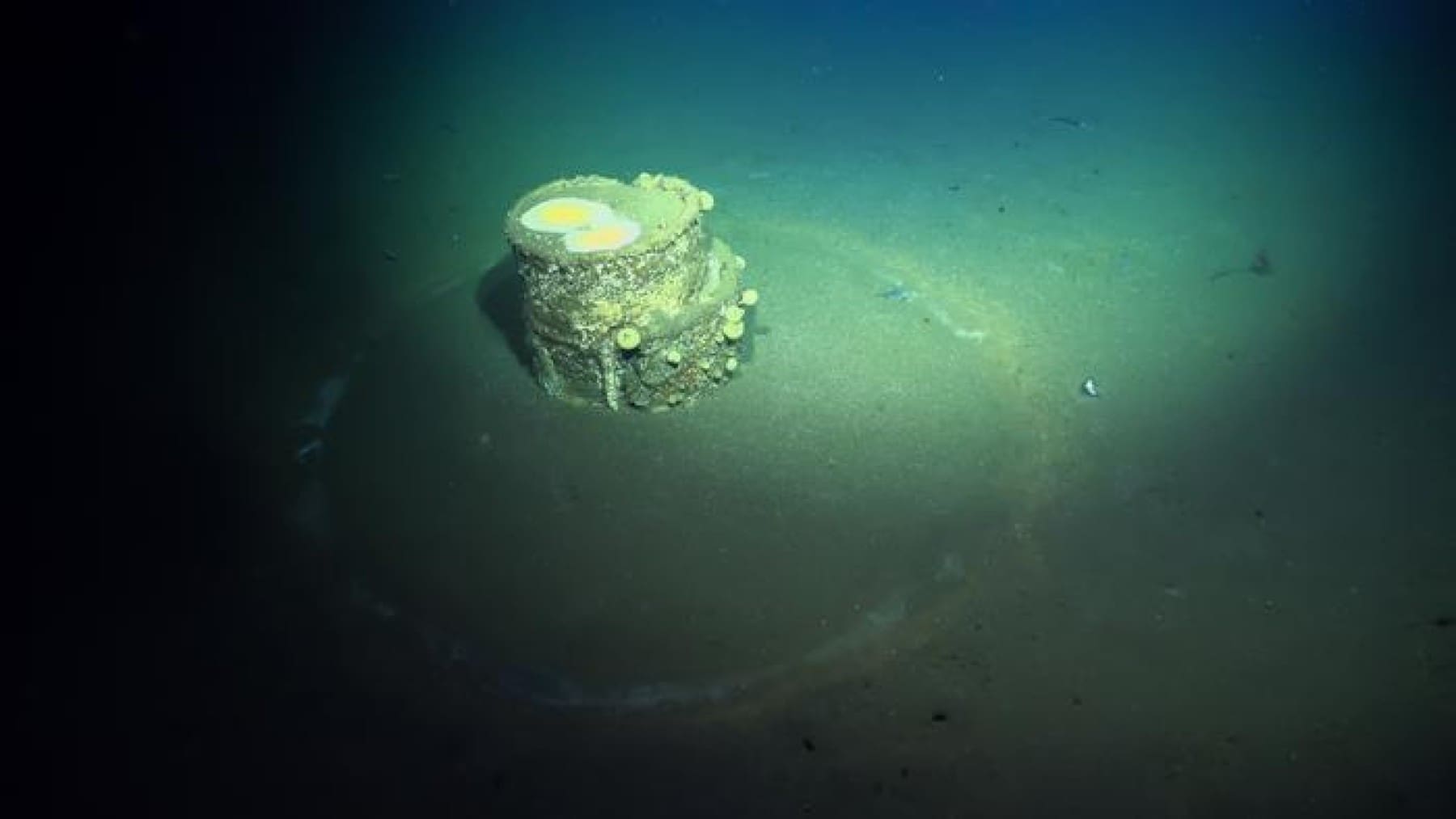
When haunting images of corroded metal barrels on the deep seafloor off Los Angeles surfaced in 2020, they captured the public’s attention — and raised an immediate question. The barrels were assumed to be part of the region’s well-documented DDT dumping legacy. But several of them were ringed by pale, ghostly halos in the sediment that nobody could explain.
Researchers from UC San Diego’s Scripps Institution of Oceanography have now traced what was causing them — and it wasn’t what anyone was looking for. Whatever has been leaking from those barrels has been quietly reshaping life on the ocean floor for more than 50 years.
A mystery hiding in plain sight
When the 2020 images went viral, public attention locked onto one word: DDT. The region’s history justified that focus. From the 1930s until the early 1970s, 14 deep-water dump sites off Southern California received a wide range of industrial refuse — refinery wastes, chemical byproducts, military explosives, and radioactive materials, according to the EPA. DDT waste, largely pumped directly into the ocean, left sediments heavily contaminated with the banned pesticide.
White halos can now serve as visual indicators to map the extent of alkaline waste contamination across the dump site — no sampling required for an initial survey.
The white halos surrounding some barrels didn’t fit that story. They were distinct, consistent, and unexplained. The total number of barrels on the seafloor remains unknown, and their full contents are still a matter of incomplete records and educated guessing.
What the sediment samples revealed
The researchers didn’t originally set out to solve the halo mystery. In 2021, aboard the Schmidt Ocean Institute’s Research Vessel Falkor, Scripps postdoctoral scholar Johanna Gutleben and her colleagues collected sediment samples near five barrels off Catalina Island — three of which had white halos — using the remotely operated vehicle SuBastian. Inside the halos, the seafloor had hardened into something resembling concrete, blocking standard coring devices. The team used SuBastian’s robotic arm to collect a piece of the crust instead.
When the samples were analyzed for DDT, no increase in concentration appeared near the halo barrels. That deepened the puzzle rather than resolving it. The breakthrough came almost by accident — Gutleben was struggling to extract microbial DNA from the halo samples when she decided to test their pH. The readings came back at around 12, extremely alkaline. Every sample taken near a halo barrel showed similarly elevated readings.
Alkaline waste and the chemistry of the halos
That pH result unlocked the explanation. The leaking alkaline waste reacted with magnesium in seawater to form brucite, a mineral that cemented the surrounding sediment into a hard crust. Brucite dissolves slowly, keeping the pH in the surrounding sediment persistently elevated — more than 50 years after the barrels were dumped. Where that high-pH zone meets normal seawater, calcium carbonate precipitates as a fine white dust. That is the halo.
The source of the alkaline waste hasn’t been definitively identified. DDT manufacturing did produce alkaline byproducts, but so did other major regional industries, including oil refining. “One of the main waste streams from DDT production was acid and they didn’t put that into barrels,” said Gutleben. “It makes you wonder: What was worse than DDT acid waste to deserve being put into barrels?”
Toxic vents on the seafloor: a new extreme environment
The alkaline conditions have transformed portions of the seafloor into something resembling a natural hydrothermal vent. Microbial diversity near halo barrels was dramatically reduced compared to surrounding sediments, and the bacteria that do survive belong to families adapted to extreme alkaline environments — the kind found near deep-sea vents and alkaline hot springs.
The effect extends beyond microbes. Prior research led by co-author Lisa Levin showed that small animal biodiversity around halo barrels was also lower. Senior author Paul Jensen noted that roughly a third of visually observed barrels appeared to have halos, though whether that ratio holds across the entire dump site remains unknown. Jensen said he would have expected the alkaline waste to dissipate quickly in seawater. Instead, it has persisted for over half a century, suggesting it “can now join the ranks of DDT as a persistent pollutant with long-term environmental impacts.”
What comes next — and why it matters
The identification of brucite and the halo-forming chemistry gives researchers a practical tool going forward. White halos can now serve as visual indicators to map the extent of alkaline waste contamination across the dump site — no sampling required for an initial survey.
Gutleben and Jensen are also experimenting with DDT-contaminated sediments from the site, searching for microbes capable of breaking down the pesticide. That microbial pathway may be the only realistic cleanup option. Physically removing contaminated sediment would likely cause more harm than good — the highest DDT concentrations are buried several centimeters below the surface, and any suction attempt would stir them into the water column.
The broader implication may be the most consequential. “DDT was not the only thing that was dumped in this part of the ocean,” said Gutleben. “We only find what we are looking for.” With alkaline waste now confirmed as a persistent seafloor pollutant, researchers may need to scan for entirely different contaminants — ones that nobody has thought to look for yet.

Carlos is an engineer with strong expertise in technical and industrial topics. He previously worked at international companies such as Siemens and is multilingual.
