
Farmers and solar panels are sharing the same fields, and more people are willing to pay for the electricity it produces
 AI-made
Europe has a massive space problem. The continent wants to clean up its power grid. It needs millions of new solar panels to do that.
But the push to build giant solar farms has run straight into local anger. People love clean energy in theory. They hate it when it takes over the countryside.
Green fields are disappearing behind rows of aluminum and glass. This has triggered protests, lawsuits, and deep community resentment.
They also stated whether they would pay extra on their electric bill to support each project as nations focus on scaling up renewable energy generation.
Rural towns feel sacrificed for urban climate goals. It is a classic land-use war. Right now, solar developers are hitting roadblock after roadblock.
How a quiet shift started in the fields
But if you drive through parts of the countryside today, a different picture is emerging.
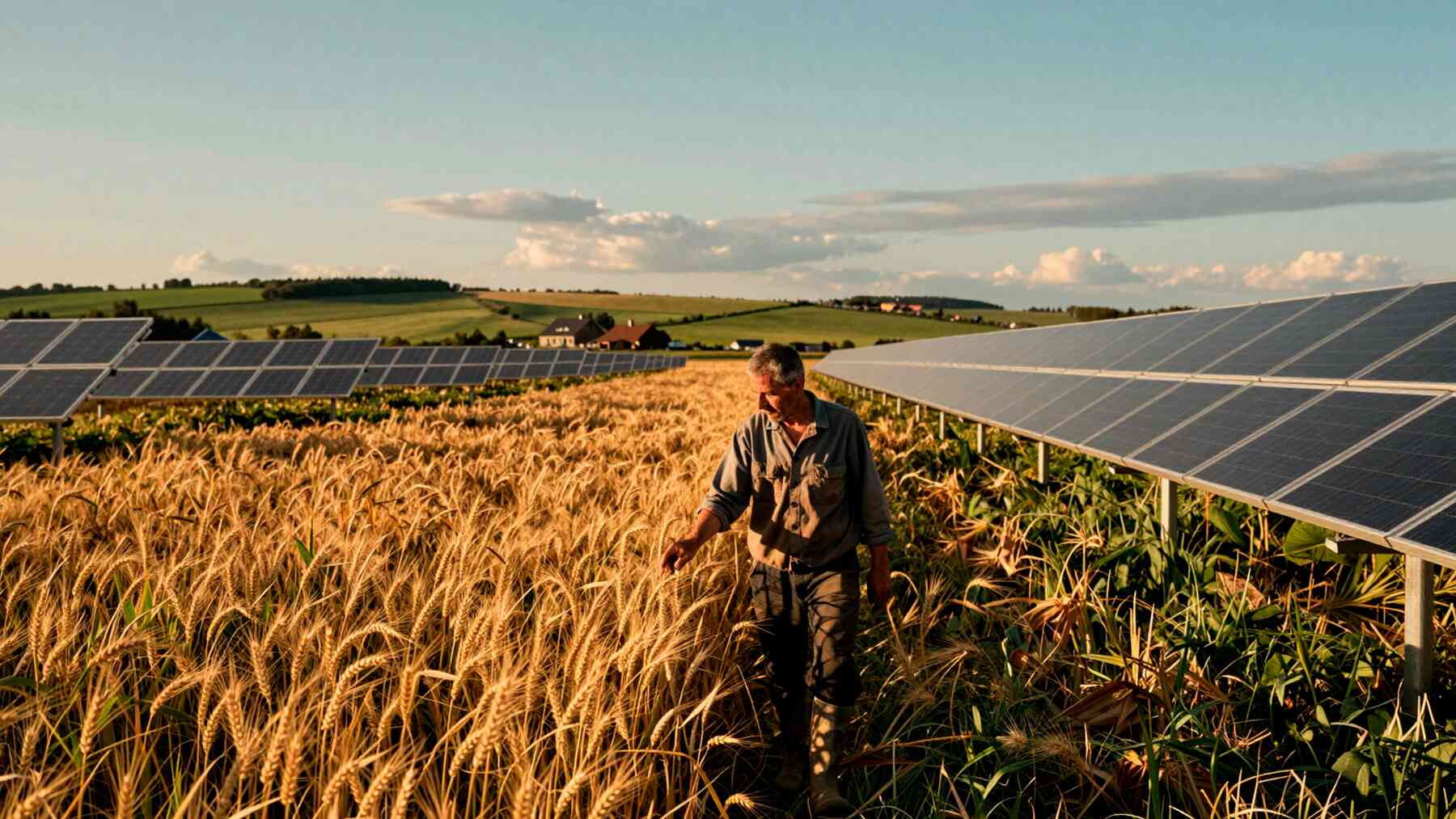
In some fields, wheat grows in the shadows of high-tech solar arrays. In others, beef cattle wander calmly between panel rows.
Grapevines grow under protective photovoltaic canopies. This is agrivoltaics.
The core idea is simple. You harvest both food and fuel from the exact same acre of land.
Skeptics thought this was too complex to work. They assumed it would ruin crop yields.
But a major study from Germany suggests public reaction to these dual-use fields is changing in unexpected ways.
How dual-use farming actually works
The setup is highly flexible. Engineers can mount panels high on stilts so tractors drive underneath.
Alternatively, they can install vertical panels that look like high-tech fences.
There are obvious downsides. Crops get less direct sunlight, lowering yields. Farming equipment must navigate around steel poles.
But the benefits are surprising. The panels act as weather shields.
Hendrik Zeddies from the University of Bonn notes that these structures protect fruit trees from devastating hail storms.
In dry regions, shade helps soil retain moisture. On windy plains, panels act as windbreaks. Even cows use the panels for shade on hot days.
Testing public opinion in the lab
Do people actually prefer looking at a shared farm?
To find out, researchers at the University of Bonn surveyed nearly 2,000 citizens across Germany. The group matched national demographics perfectly.
Participants received a balanced breakdown of the pros and cons of both systems. Then came the visual test.
Participants looked at pastures, wheat fields, or vineyards. Each person saw paired photographs.
One showed a standard solar park. The other showed the exact same landscape with an agrivoltaic system integrated into the farm.
Participants rated the visual appeal. They also stated whether they would pay extra on their electric bill to support each project as nations focus on scaling up renewable energy generation.
Measuring the community approval gap
The survey data revealed an overwhelming public preference.
Nearly 44% of respondents stated they would pay a premium on their electricity bill for power from an agrivoltaic system. For conventional solar parks, that number cratered to 29%.
Active opposition was also much lower. Only 2.9% of people said they would spend money to block an agrivoltaic project.
For standard solar parks, that number doubled to 4.8%.
Researchers believe this comes down to psychology. A standard solar park feels like a total loss of community land, prompting governments to seek innovative solutions for clean power. An agrivoltaic farm feels like a compromise.
The real economic roadblocks
We must be realistic here. The study looked at hypothetical choices.
The real challenges are not social. They are financial.
Agrivoltaic systems are expensive to engineer. You need more steel to raise panels high into the air. You need specialized wiring to keep ground space clear.
This means developers take much longer to earn back their investment, creating hurdles for the expansion of solar infrastructure.
Zeddies is frank about this reality. Without direct government subsidies, commercial developers simply will not build these systems at scale. The math does not work yet.
The hidden twist in the data
But the German study uncovered a massive surprise that completely flips the economic argument.
Energy investors build standard solar farms because the panels are cheap and dense. They assume agrivoltaics is an expensive luxury.
But they forget the cost of delay.
When a community fights a standard solar park, the project gets trapped in court. Developers spend thousands on lawyers and public relations.
Permits sit on desks for years. Sometimes, the project gets canceled entirely.
The University of Bonn study proves that agrivoltaics buys local peace. By cutting community resistance in half, these dual-use farms bypass expensive legal warfare.
The higher cost of building stilts is instantly neutralized by the money saved on lawyers and lost time. A project facing no resistance gets built years faster.
In the energy market, time is money. The future of solar is not about finding the cheapest panel. It is about finding the best path toward sustainable development.
Kelly is an experienced writer with 15 years of experience exploring the big stories that shape our world, from tech breakthroughs and space exploration to climate, energy, and the fascinating quirks of science. She has a talent for turning complex ideas into sharp, memorable insights that stay with readers long after they’ve finished reading.
