
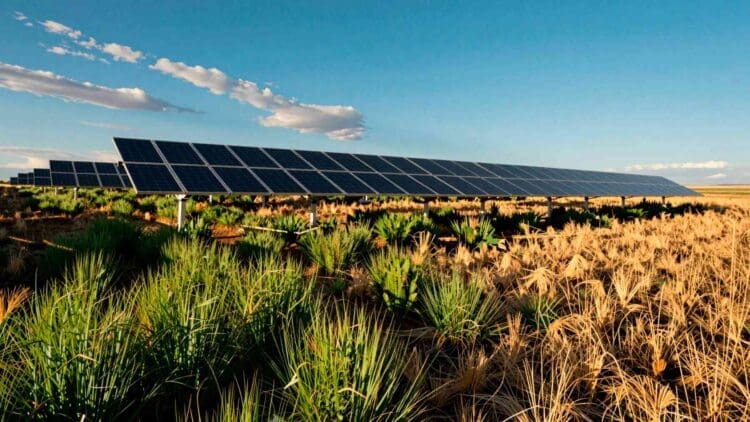

Every summer, Colorado’s semi-arid grasslands wage a quiet battle against heat and thirst — a landscape where rainfall routinely falls short of what the grasses need to survive. Across parts of that terrain, rows of solar panels now rise above the struggling vegetation, casting shadows over plants that seem like they should be worse off for it.
But four years of field data from a solar facility in Longmont, Colorado are telling a different story.
A field experiment four years in the making
The research comes from a collaboration between Colorado State University and Cornell University, anchored at an agrivoltaics facility in Longmont, Colorado. Over four years, the team collected field data on how co-locating solar arrays and grasslands changes the ecosystem beneath the panels — the first study of its kind to test those dynamics in a real-world setting.

The paper, published in Environmental Research Letters in June 2025, was led by Cornell postdoctoral researcher Matthew Sturchio and CSU University Distinguished Professor Alan Knapp. Knapp has spent decades studying how grasslands cope with chronic water stress and drought, which put him in a good position to notice when something unexpected started happening under the panels.
What the panels are actually doing to the grass beneath them
The mechanism is straightforward. Solar panels cast partial shade, reducing heat stress on plants during the harshest summer months. They also collect water on their surfaces, which drips to the ground and quietly supplements soil moisture below.
The effects were most striking during dry years. Grass growing on the east side of the panels was up to 90% more productive than grass in open control sites under those conditions. During wet or normal years the benefit shrank, but it didn’t disappear — east-side grass still outperformed the open field. Overall, plant growth increased by roughly 20% or more compared to open fields, particularly when drought conditions took hold.
Why aridity is the key variable
Colorado’s semi-arid grasslands routinely face a deficit — precipitation falls short of what plants need each season. That chronic thirst is exactly what makes the solar panel effect so meaningful here.
According to Sturchio, previous studies had noted improved plant and water relations near solar arrays, but this is the first analysis to show that the benefit becomes more pronounced as conditions get drier. The drier the year, the more the panels matter. What makes the finding especially notable is that the array studied wasn’t designed with the grassland in mind at all — it was built to maximize energy output.
“Even though this solar array was designed to maximize energy generation — not to promote beneficial environmental conditions for the grasses grown beneath — it still provided a more favorable environment during a dry year,” Sturchio said. The researchers suggest that panels intentionally configured to optimize shade and water redistribution could unlock even greater ecological gains.
The broader promise of agrivoltaics
Agrivoltaics is the practice of designing solar infrastructure to serve double duty — generating power while supporting livestock grazing or pollinator habitats on the same land. Both of those agricultural uses share one important characteristic: they rely on rain, not irrigation or machinery, to sustain plant growth. That rain-dependence makes the local microclimate created by solar panels directly relevant. If panels can buffer drought stress, they may also stabilize the ecosystems that grazing animals and pollinators depend on.
Sturchio goes further, suggesting that solar arrays could become tools for grassland restoration. By creating environmental heterogeneity — patches of shade, moisture variation, differing light levels, and shifting microclimates — panels may support more diverse plant communities than open fields can sustain on their own. In arid and semi-arid regions, that kind of structural complexity could give struggling ecosystems a foothold.
What comes next: hotter, drier grasslands under the microscope
The Longmont study focused on C3 “cool season” grasses — perennial plants that prefer wetter conditions. The next phase will shift attention to C4 grasses, the warm-season species that dominate Colorado’s plains and flourish in high sunlight.
Those grasslands are even more water-limited than the ones studied in Longmont. “We expect the capability of solar arrays to mitigate water stress may be even greater,” Knapp said. If that hypothesis holds, the ecological case for thoughtful solar siting in arid regions could grow considerably stronger.
The research team is already preparing to test that idea at the newly constructed Shortgrass Ecovoltaic Research Facility in Nunn, Colorado. Small adjustments to panel angle, spacing, and orientation could also be tuned to balance energy production with ecological benefit — a calibration that nobody had much reason to attempt before studies like this one started making the tradeoff visible.

Carlos is an engineer with strong expertise in technical and industrial topics. He previously worked at international companies such as Siemens and speaks Spanish, German, English, and Italian.