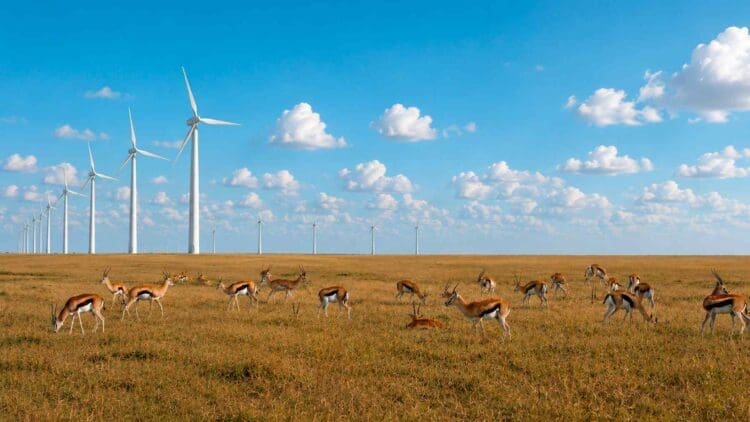

Giant wind turbine farms have become a cornerstone of modern life, but they are disrupting ancient migration journeys of antelopes.
Technology has evolved significantly over the past few years and continues to do so at a rapid pace.
This swift transformation has led to substantial infrastructure scaling and upgrades to ensure everything remains operational.


Since wildlife cannot adapt to these sudden changes as quickly, what will happen to the local biodiversity?
How the “green” horizon is undergoing prompt changes
Two directives are driving the swift transformation of the world’s energy landscape.
Nations around the globe are under immense pressure to decarbonize their grids and sectors.
The ever-growing electricity demand of an AI-integrated world deepens this pressure.
These pressures are why the wind energy sector has been scaling up turbines and accelerating capacity expansion.
The “bigger is better” philosophy is fundamental to making wind energy more affordable and efficient.
At higher altitudes, wind speeds are stronger and more consistent, and a bigger blade is essential to capture more energy.
Now, many existing wind farms are undergoing upgrades, during which smaller turbines are being replaced with modern, giant ones.
Unfortunately, the greater the scale of the wind farm, the greater the economic and ecological costs.
The complex ripple effect of scaling up wind turbines
In theory, larger wind farms do result in more affordable electricity production.
However, in reality, their deployment presents substantial hidden costs.
Transportation of turbine components is more complex, especially since a single modern blade can now exceed 300 feet in length.
At this size, specialized conveyance and custom-built trailers are required. More often than not, rural roads and bridges must also be temporarily widened.
The infrastructure also needs greater foundation reinforcement, and local grids need upgrades to handle high-density outputs.
Furthermore, manufacturing requires higher volumes of critical minerals for magnets and electric components. The increase in critical mineral demand raises supply chain disruptions and geopolitical instabilities.
In addition to these economic costs comes a greater physical footprint on the environment.
Researchers found that a wind farm influenced antelope-like migration routes.
The specific wildlife impacted are pronghorns, and the team explored ways to overcome this disruption.
Breaking the barriers of wind farms on migration routes
A study revealed that wind turbines disrupt natural migration zones that wildlife have used for years.
North American pronghorns are among the animals usually affected.
You can review the study “Wind‐energy development alters pronghorn migration at multiple scales,” published in PubMed Central.
The peer-reviewed study “Wind-energy development alters pronghorn migration at multiple scales” was published in Ecology & Evolution.
They are adapted to open horizons and are creatures of habit. The rise of modern wind infrastructure, however, has become a “persistent threat” to them.
Wind farms form a landscape of fear
Giant, rotating blades cause a strobe-like “shadow flicker.” This, along with low-frequency vibrations, signals “danger.”
This is why pronghorns stay miles away from this “zone of influence.”
The mere presence of turbines becomes an invisible functional barrier that disconnects their habitat and migration paths.
Researchers suggest that a giant “zebra crossing” for wildlife could help overcome this hidden obstacle.
This includes predictive modeling to create migration lanes through the center of wind farms. Fences must also be modified.
The bottom wire must be able to rise at least 18 inches to help with crawling.
Scaling up wind energy is essential for an AI-driven, zero-carbon future.
However, these ambitions should not compromise the existing, ancient systems of nature.
The study underscores the challenge of balancing industrial growth with ecological preservation that must be overcome to achieve sustainability.
Wind farm developers are thus left with the responsibility to integrate careful, structured layouts into infrastructure designs. This way, modern energy efficiency can be achieved while sustaining local biodiversity.
Anke Maree is a writer with a clear and engaging editorial style. Her work focuses on making complex topics accessible, informative, and relevant for readers across different areas of interest.