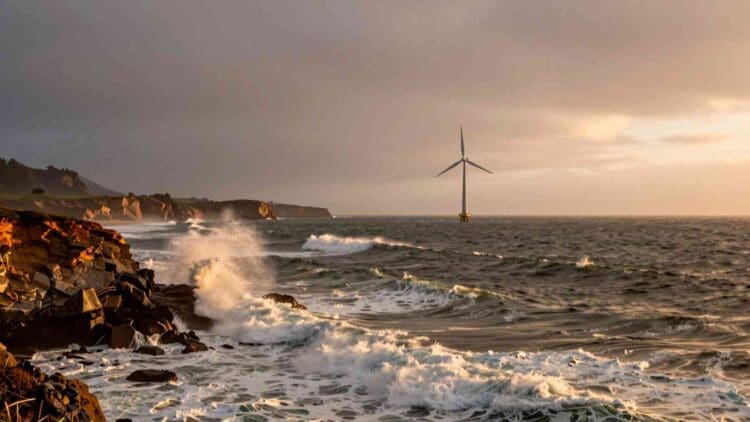

California Attorney General Rob Bonta and California Energy Commission Chair David Hochschild have filed a formal Notice of Intent to Sue against the U.S. Department of Interior and Golden State Wind LLC over a proposed federal agreement to pay the company $120 million in taxpayer funds to walk away from its offshore wind lease off California’s Central Coast.
The filing argues the deal is illegal — and that approving it could set back California’s offshore wind sector by years.
California officials file formal legal notice against federal offshore wind buyout
Attorney General Rob Bonta and CEC Chair David Hochschild sent the Notice of Intent to Sue directly to both the U.S. Department of the Interior and Golden State Wind LLC. The notice targets a specific agreement where the DOI would use $120 million in federal taxpayer funds to pay GSW to surrender its offshore wind lease in federal waters off California’s Central Coast.

The 60-day notice period is a procedural requirement, not an immediate lawsuit. Both the DOI and GSW have that window to reverse the alleged violations before California can move forward with formal legal action. Think of it as a final warning before the courtroom door opens.
Why California objects: Terms of the buyout agreement
The core of California’s objection isn’t just the dollar amount—it’s what the money requires GSW to do. Under the agreement, GSW would need to invest an amount equal to the $120 million buyout into out-of-state fossil-fuel projects, investments that California officials argue do nothing for the state’s economy or its clean energy goals.
The state also contends the deal violates the Outer Continental Shelf Lands Act, known as OCSLA—a law that ensures coastal states have a voice in offshore leasing decisions. California officials say the DOI bypassed the consultation process the OCSLA was designed to protect, cutting the state out of a decision that directly affects its coastline and energy future.
That’s the “backroom deal” language you’ll see Bonta use. Pointed, yes — but it reflects a legal argument that the process itself was compromised.
Potential consequences for California’s offshore wind sector
State officials aren’t treating this as a minor procedural dispute. They warn the buyout could delay California’s offshore wind development by multiple years, a significant setback for a sector the state is counting on heavily.
The financial exposure is real too. According to the filing, the deal puts more than $100 million in public investments at risk. Beyond the dollars, thousands of jobs tied to the offshore wind industry could be affected if the lease is surrendered and development stalls. For a state that has made offshore wind central to its long-term energy strategy, losing a key lease to a federally engineered buyout isn’t just frustrating — it’s a direct threat to the plan.
Broader pattern: Trump Administration’s use of offshore wind lease buyouts
The GSW deal isn’t an isolated move. The Trump administration also attempted a $765 million lease buyout with Invenergy, another California offshore wind leaseholder—bringing proposed buyouts targeting California’s offshore wind pipeline to nearly $900 million combined.
The administration had previously flagged offshore wind projects as national security concerns, a designation that contributed to project freezes. Lease buyout arrangements appear to be an extension of that broader posture: a way to wind down offshore wind development without outright canceling permits through regulatory action. California’s legal challenge may be the first formal test of whether that strategy can hold up under existing federal law.
California’s offshore wind targets and the stakes of the dispute
To understand why California is pushing back this hard, it helps to know what’s actually on the line. The state’s energy strategy mandates 25 gigawatts of offshore wind capacity by 2045 — enough to power approximately 25 million homes and supply roughly 13% of California’s total electricity. Those aren’t aspirational numbers. They’re embedded in the state’s clean energy roadmap, making offshore wind a load-bearing piece of the plan rather than a bonus.
California also isn’t among the top wind energy-producing states right now. Texas, Iowa, Oklahoma, and Kansas lead the country in wind generation, and California simply doesn’t have the same land-based wind resources those states do. The Central Coast leases represent one of the clearest paths to closing that gap, which is precisely why surrendering them to a federal buyout carries so much weight.
California is prepared to go to court
Here’s where things stand: California has filed a formal Notice of Intent to Sue against the DOI and Golden State Wind over a $120 million federal buyout that would pay GSW to exit its offshore wind lease and redirect funds into out-of-state fossil-fuel projects. The state argues the deal violates the OCSLA by bypassing required state consultation and could push offshore wind development back by years.
The DOI and GSW have 60 days to reverse the alleged violations before California can file suit. At least two major lease buyout attempts are now targeting California’s offshore wind sector — the GSW deal and a separate $765 million arrangement involving Invenergy. With 25 gigawatts of offshore wind capacity targeted by 2045, California has made clear it intends to fight for its clean energy pipeline in court if necessary.
Kelly is an experienced writer with 15 years of experience exploring the big stories that shape our world, from tech breakthroughs and space exploration to climate, energy, and the fascinating quirks of science. She has a talent for turning complex ideas into sharp, memorable insights that stay with readers long after they’ve finished reading.