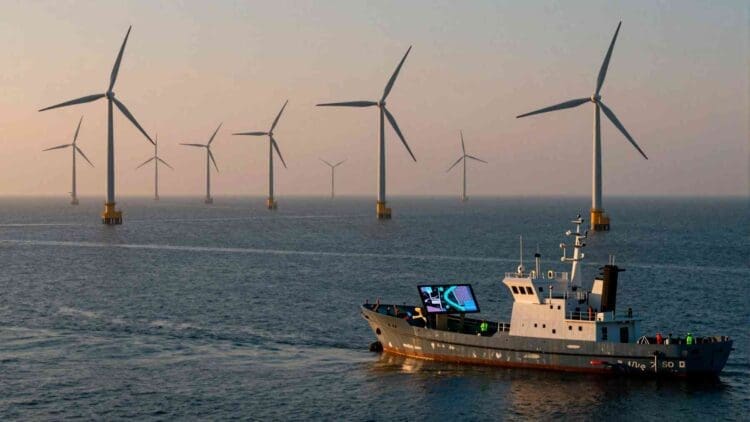

China has spent ten years building a massive offshore wind program.
The nation added over 34 gigawatts of capacity. It keeps pushing turbines into deeper waters.
Early research painted a very bright picture. Analysts often estimated potential above 5.6 petawatt-hours annually.

New data suggests those early numbers were far too high.
A fresh study takes a new approach. Researchers used farm-scale models based on real satellite layouts. They found the actual potential is much lower than expected.
Why earlier estimates were so optimistic
The core issue is how analysts defined scale. Older studies treated the ocean like a blank, infinite grid. They placed turbines one by one across the entire sea.
Real offshore wind development does not function that way.
Farms are planned as discrete, separated units. Planners leave buffer zones between farms to stop interference.
Ignoring these zones drastically inflates the usable area. Spacing assumptions also hurt the accuracy of earlier work. Many studies used a simple, uniform grid pattern.
Satellite analysis shows Chinese wind farms use different spacing. Windward spacing often runs 8 to 12 rotor diameters. Crosswind spacing typically ranges from 3 to 6 diameters.
These real layouts pack less power into the same area. Earlier models also relied on a weak 10% penalty for wake losses. This figure is far too low for actual field conditions.
What the new farm-scale model actually found
Researchers analyzed satellite images of existing wind farms. They created six representative layouts for their simulation. Then they applied three distinct wake-loss models to those layouts.
Results shifted sharply once inter-farm buffers were added.
Without buffers, estimates reached 9 to 10 petawatt-hours. Adding real-world spacing cut that total in half.
Full wake-loss modeling pushed the numbers even lower.
The final range is roughly 2.5 to 4.2 petawatt-hours per year. The median sits at about 3.3 petawatt-hours annually.
Wake losses: The hidden drag on output
The 10% rule of thumb is no longer sufficient.
Wake losses actually range from 12% to 20%. Specific configurations can push these losses even higher.
Layout plays a huge role in energy output. Four-row farms lose more power than three-row farms. More turbines sit downstream, catching the disrupted wind.
The cumulative curl model provided the most detail. It showed losses hitting 24% in some specific setups. Floating farms showed slightly better efficiency in deep water.
The economic divide between nearshore and deep-water farms
Costs are tied tightly to geography for China.
Bottom-fixed nearshore farms are the cheapest option today. Most cost less than $125 per megawatt-hour.
Explore China’s offshore wind market trends to understand global context.
Floating deep-water farms are much more expensive. These projects range from $130 to $160 per megawatt-hour.
Most floating projects require subsidies to stay viable. Floating wind faced significant bottlenecks recently due to high supply chain costs.
Costs drop when developers build larger, sprawling farms. Small farms face much higher costs per unit.
What this means for China’s energy planning
Revised numbers change the math for local planners.
Most provinces cannot meet demand with wind alone. Shanghai can cover less than 20% of its needs.
Even resource-rich areas hit a ceiling soon. Provinces like Guangdong reach only 80% of local demand.
Inflated estimates can lead to wasted investment. Building in the wrong spots creates massive inefficiency. Planners must pivot toward site-specific, realistic evaluations.
Innovation in floating wind technology remains critical. China deploys world’s largest floating wind turbine to test deep-water limits.
Costs must drop for deep-water power to succeed. Expansion is currently anchored to nearshore foundations.
China must prioritize efficiency over raw potential. Setting realistic grid targets will prevent future shortages. China wants its wind turbines to predict weather shifts with greater accuracy.
The energy transition requires precise, data-driven planning.
The industry now faces a reality check. Understanding true wake losses is the first step. China’s wind future depends on better model accuracy.
Will China’s wind sector adapt in time, or will overconfidence ground its grandest energy ambitions?
The full study is available at: Xu, S., Yin, G., Hu, P. et al. Substantially lower estimates in China’s offshore wind potential using farm-scale spatial modeling and wake effects. Nat Commun 17, 2043 (2026). https://doi.org/10.1038/s41467-026-68655-2
Kelly is an experienced writer with 15 years of experience exploring the big stories that shape our world, from tech breakthroughs and space exploration to climate, energy, and the fascinating quirks of science. She has a talent for turning complex ideas into sharp, memorable insights that stay with readers long after they’ve finished reading.