
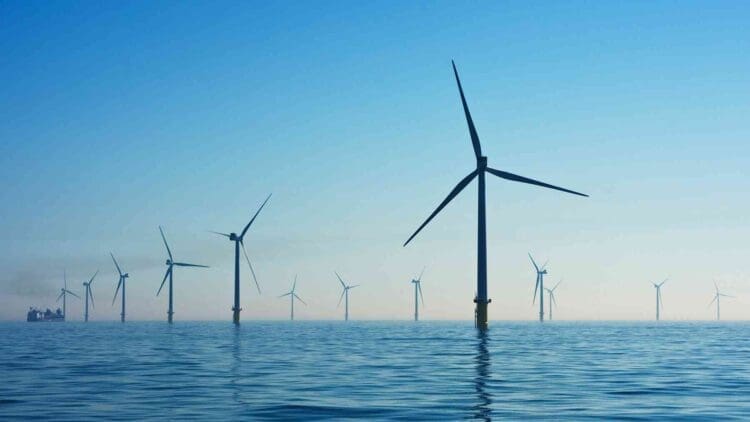

For more than a year, the offshore wind industry absorbed blow after blow from the federal government — frozen leases, repealed tax credits, stop-work orders issued on national security grounds. Five major wind farms under construction along the eastern seaboard, capable of powering millions of homes, sat in legal limbo.
Then something shifted. A series of federal courts pushed back, and the Interior Department made a quiet decision that may have changed the trajectory of the industry — and reopened a political conversation many had written off entirely.
A year of relentless pressure on offshore wind
The Trump administration’s campaign against offshore wind has been methodical and wide-ranging. Beyond freezing new federal leases and repealing clean energy tax credits, the administration went so far as to pay an oil company to abandon a planned wind project. The most dramatic escalation came in December, when Interior Secretary Doug Burgum issued stop-work orders on five wind farms already under construction — citing national security as the justification.

Those five projects weren’t minor ventures. Two were off the Massachusetts coastline, two south of Long Island, and one off Virginia. Together, they would generate enough electricity to power well over two million homes. Halting them mid-construction wasn’t a policy signal — it was a direct strike at the industry’s core.
Courts push back — and the government blinks
Developers didn’t accept the stop-work orders quietly. They sued, federal judges sided with them, and injunctions against the Interior Department’s interventions followed. Burgum publicly vowed to appeal.
Then the department let the final deadline to appeal those decisions quietly lapse. No announcement, no explanation — just silence where a legal filing should have been. Construction on all five projects can now continue, absent a new legal challenge.
Tony Irish, who served as an Interior Department lawyer for decades before departing in 2025, read the silence as significant. “If the actual reason behind the stop-work orders was legitimately founded in national security, I would be very surprised by the lack of appeal,” he said. “So I think the lack of appeal is telling in that regard.” The implication is hard to ignore: the national security rationale may not have had the legal footing to survive scrutiny.
Turbines are already spinning
Several of the five projects have already begun delivering electricity to the grid.
Revolution Wind, a project from Danish company Ørsted, sent its first power to the New England grid in mid-March. Coastal Virginia Offshore Wind, developed by Dominion, is approximately 70 percent complete and also delivered its first electricity last month. Vineyard Wind demonstrated its value during Winter Storm Fern earlier this year — producing significant power at a moment when other resources went offline. That kind of performance during a stress event is exactly what advocates have long argued offshore wind could provide.
A bipartisan permitting deal back on the table
The lapsed appeal deadline didn’t just keep construction moving — it unlocked something in Washington. Bipartisan permitting reform talks in the Senate, led by Senator Sheldon Whitehouse of Rhode Island, had stalled in the wake of Burgum’s stop-work orders. Whitehouse made his position clear: talks would only resume if the Interior Department declined to appeal the court injunctions. That condition has now been met.
The proposed permitting reform bill would speed up environmental review for critical energy projects, ease the construction of interstate transmission lines, and shield clean energy permits from executive interference. It would also extend similar protections to oil and gas projects — giving Republicans a concrete reason to engage. The White House’s energy dominance council has joined the congressional talks, and with midterm season approaching, proponents say the next few months represent a narrow but real window.
Why permitting reform could reshape the entire industry
The stakes extend well beyond the five projects currently under construction. A recent survey of roughly 50 renewable developers found that about 80 percent had chosen project sites specifically to avoid triggering federal environmental review — a figure that reveals how much permitting friction suppresses development before a single turbine is ever proposed.
The bottleneck has real costs. Reviews for historical artifacts and endangered species can add months or years to timelines, and those delays may have held up at least 11 gigawatts of energy capacity — enough to power nearly five million homes.
Liz Burdock, CEO of the Oceantic Network, put the industry’s position plainly: without a predictable permitting path, “manufacturers, shipyards, and skilled workers are forced to sit idle, creating gaps that raise costs and delay benefits for millions of ratepayers.” If permitting reform clears Congress, the five projects now spinning off the eastern seaboard could be the beginning of a much larger buildout — not an exception to the rule, but the start of a new one.

Carlos is an engineer with strong expertise in technical and industrial topics. He previously worked at international companies such as Siemens and speaks Spanish, German, English, and Italian.