
In California, a small group of monarch butterflies brought construction of a wind farm to a halt over the risk of collisions with the turbines
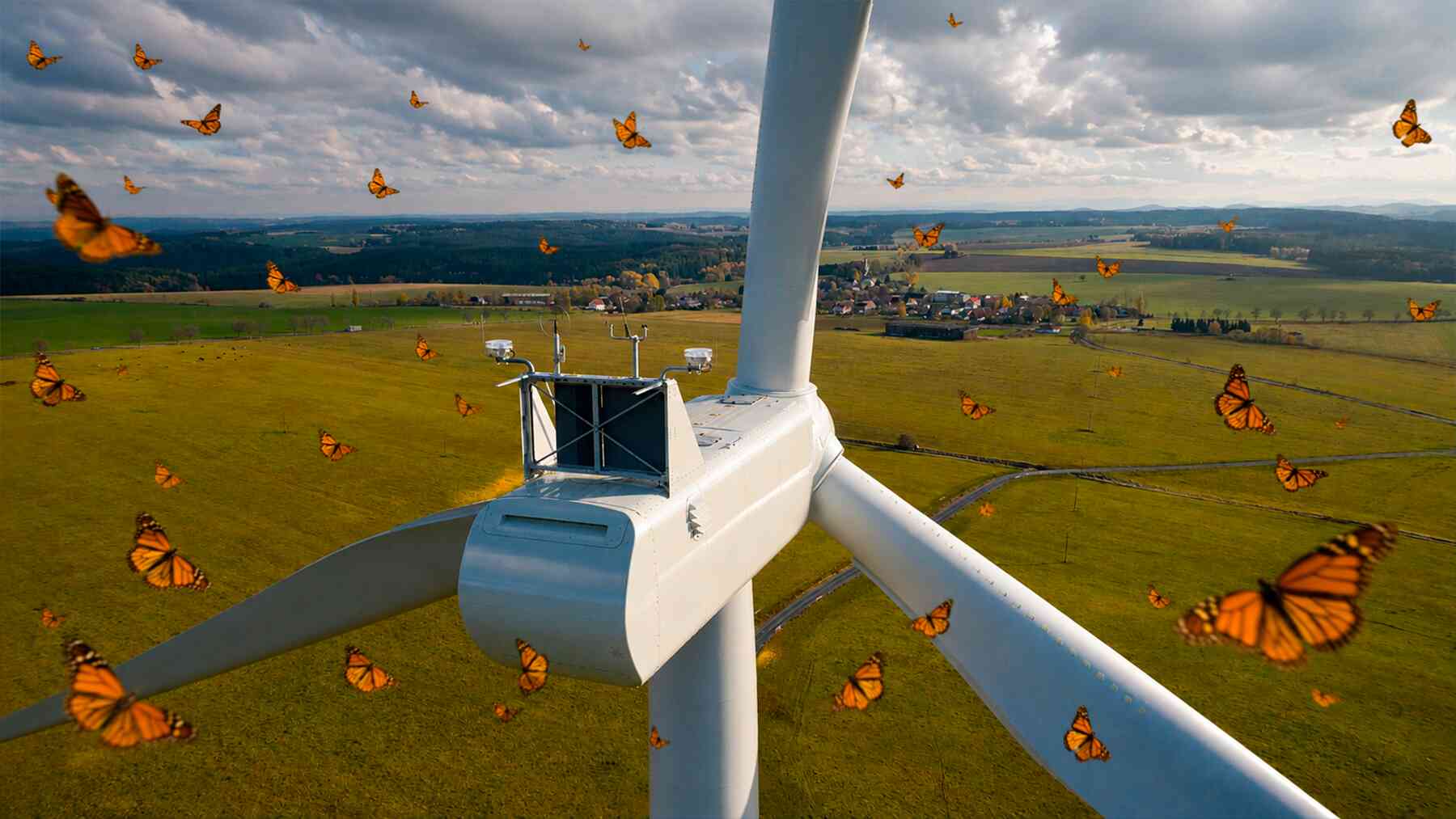 Credits: Edited, representative image
Tension is rising at a California wind farm after a wildlife biologist pointed out the consequences regarding monarch butterflies.
The effects of climate change continue to worsen and impact nations worldwide.
Governments are now left with a great responsibility to boost green infrastructure.
Under no circumstances does it seek to promote an opinion or create a trend, nor can it be taken as investment advice or a recommendation of any kind.
Large-scale wind is essential to this task, but concerns about fragile biodiversity are slowing progress.
What can be done to ensure that renewable energy capacity grows without conflicting with locals and wildlife?
How the pressure to go green is building worldwide
Public and political awareness of climate change finally increased by the 1980s.
It was not until 1992 that several nations came together to address global warming.
Five years later, developed countries were legally required to lower their greenhouse gas emissions.
But it was not until the 2015 Paris Agreement that governments were truly actively working to achieve net-zero.
To ensure that global warming remains within the agreed-upon threshold, the landmark COP28 agreement was adopted.
Under the COP28, approximately 200 countries are committed to tripling renewable energy capacity to 11,000 GW by 2030.
Soon, the world saw a significant rise in solar and wind power installations.
Despite this, recent IEA data highlights that many nations are far from achieving global climate targets.
Current policies will achieve just around 70% of this tripling goal on time.
Now, governments are pressured to overcome bottlenecks to accelerate capacity growth.
Making large-scale wind farms a priority
Globally, a crisis is rising as climate change continues to worsen.
Experts project that 2026 will be among the hottest years recorded since 1850. These significantly high temperatures are triggering an intense surge of extreme weather conditions.
These events are devastating nations worldwide, displacing entire communities and wildlife.
The combination of potential disasters threatens the world’s food security and strains economies.
Governments are turning to utility-scale wind energy as a key solution to this growing crisis.
The high-volume carbon-free power and high scalability make wind power suitable for replacing outdated fossil fuel plants.
So far, it generates over 11% of global electricity demand, as capacity exceeds 1,300 GW.
Despite the benefits of this scalable weapon, experts remain concerned about the ecological footprint.
The Fountain Wind project in California’s Shasta County faced local pushback due to these concerns.
The California State Portal highlights the contests over the project’s environmental assessments.
Float like a monarch butterfly, sting like a bee
Wildlife biologist Jim Wiegand submitted a public comment to the California Energy Commission to contest Stantec’s environmental assessments.
Initially, it was claimed that no evidence supported that monarch butterflies collide with wind turbines.
Wiegand stated otherwise, with formal data indicating that the wind farm is located inside a migratory pathway.
These butterflies rely on particular wind currents moving through a split in the Cascade Mountains.
The placement of utility-scale wind turbines in this corridor increases aerial dangers.
The vortex hazard of spinning blades
Studies show that turbine blades produce a vortex effect.
This phenomenon sucks passing insects and birds backward into the blades’ path.
However, monarch butterflies are not the only ones at risk.
High insect mortality rates attract aerial predators like bats, putting them at risk for blade collisions.
Furthermore, as pollinator populations drop, ecosystems become disrupted as pollination decreases.
In the end, state regulators were forced to issue a final denial for the wind farm project.
California’s Fountain Wind project serves as an example of what can happen when projects bypass crucial steps.
The lack of in-depth environmental impact studies and project transparency can lead to a major distrust in renewable energy developments.
To ensure that nations meet climate targets on time, developers must accept that the correct measures must be taken.
By implementing responsible planning and management, wind farm projects can succeed while protecting biodiversity.
Disclaimer: Our coverage of events affecting companies is purely informative and descriptive. Under no circumstances does it seek to promote an opinion or create a trend, nor can it be taken as investment advice or a recommendation of any kind.
Anke Maree is a writer with a clear and engaging editorial style. Her work focuses on making complex topics accessible, informative, and relevant for readers across different areas of interest.
