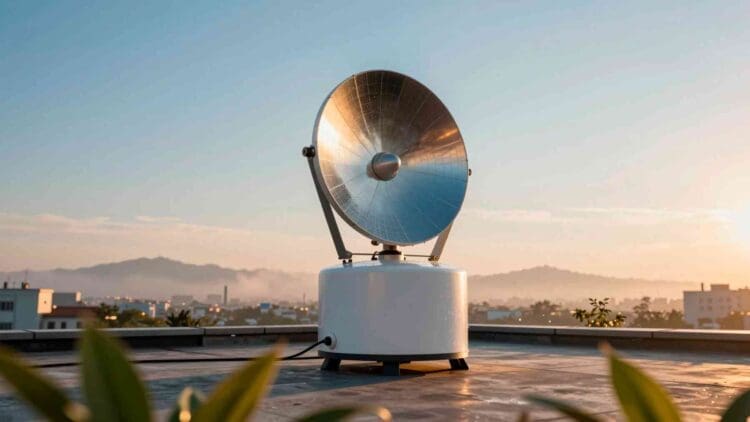

Under the open sky, a small reactor does something quietly unusual: it coaxes carbon dioxide straight from the air into a specialized liquid solution. Then, it uses the full spectrum of the sun to do two things at once. A built-in mirror concentrates infrared radiation to heat the liquid, trapping and releasing the CO2, while a semiconductor powder absorbs ultraviolet light to drive the chemical reaction.
The result? The University of Cambridge researchers have built a solar-powered device that captures atmospheric CO2 and converts it directly into syngas—a versatile fuel precursor—using nothing but sunlight as its energy source.
A reactor that works like a sponge — and a plant
The device operates in two distinct phases, and the division between them is simply day and night. After dark, specialized filters draw CO₂ directly from the surrounding air — much like a sponge soaking up water. No pumps, no electricity, no industrial inputs. The gas accumulates inside the reactor, waiting.



When sunlight arrives, two things happen simultaneously. Infrared radiation heats the captured CO₂, while a semiconductor powder absorbs ultraviolet light and triggers the chemical reaction that converts the gas into syngas. A mirror built into the reactor concentrates the incoming sunlight, improving efficiency without drawing on any external power source.
Syngas itself is a versatile intermediate product — a building block for fuels, chemicals, and pharmaceuticals, though not a finished fuel on its own. The Cambridge team describes their device as drawing inspiration from photosynthesis: like a plant, it takes sunlight and converts it into something chemically useful.
Why this is different from conventional carbon capture
Carbon Capture and Storage, or CCS, has attracted significant political and financial support. The UK government recently committed £22 billion to the approach. The basic idea is to capture CO₂ at the source — typically a power plant — and pump it underground for permanent storage.
The problems with that model are well documented. CCS is energy-intensive, and that energy often comes from fossil fuels. Transporting and compressing CO₂ for underground injection requires substantial infrastructure, and storing pressurized gas deep underground indefinitely raises long-term safety questions that researchers are still working to answer.
Professor Erwin Reisner, who led the Cambridge research, puts it plainly. He describes CCS as a “non-circular” process — one where CO₂ is removed from circulation and locked away, contributing nothing further. “At best, stored underground indefinitely, where it’s of no use to anyone,” he said.
The Cambridge reactor takes a fundamentally different approach. CO₂ is captured and immediately converted into a useful product — no storage phase, no pressurized gas being trucked across the country, no fossil-fuel-powered machinery driving the process. The carbon loop, in principle, closes.
From syngas to liquid fuel: the road ahead
Syngas is a useful product, but it is not yet what you put in a car or an aircraft. The Cambridge team is actively working on that next step — converting solar syngas into liquid fuels that could power vehicles without adding new CO₂ to the atmosphere.
The potential applications reach well beyond transport. Syngas can be converted into a wide range of everyday chemicals and pharmaceutical products, and researchers highlight this sector as a particularly promising near-term opportunity. Reducing reliance on fossil-fuel-derived feedstocks across multiple industries at once is a meaningful prize.
The work is not staying in the lab. A larger-scale version of the reactor is currently being built, with outdoor tests planned for spring. The technology is also being commercialized through Cambridge Enterprise, the university’s dedicated commercialization arm. The path from demonstration device to real-world deployment remains long, but the steps are already underway.
Decentralized energy: fuel from thin air, anywhere
One of the more striking possibilities the researchers raise is decentralization. If the reactor can be scaled and made reliably robust, it could operate far from any grid — in remote communities, in regions where fuel supply chains are fragile or expensive, or in contexts where centralized infrastructure simply does not exist.
That is a significant departure from how energy systems currently work. Fossil fuel extraction is centralized by nature, concentrated at points of geological accident. The Cambridge model points toward something structurally different: small, distributed units drawing carbon from the local atmosphere and converting it into usable fuel on-site.
Dr. Sayan Kar, the study’s first author, frames the opportunity plainly. “CO₂ is seen as a harmful waste product, but it is also an opportunity,” he said. Professor Reisner echoes that view, describing a potential circular, sustainable economy built around atmospheric carbon rather than extracted fossil fuels — then adds one important caveat: “if we have the political will to do it.”
The reactor works. How far and how fast the technology spreads will depend as much on policy decisions as on what happens in any laboratory. That part is still an open question.
Kelly is an experienced writer with 15 years of experience exploring the big stories that shape our world, from tech breakthroughs and space exploration to climate, energy, and the fascinating quirks of science. She has a talent for turning complex ideas into sharp, memorable insights that stay with readers long after they’ve finished reading.