
Solar-powered algae engines were planted inside animal cells and kept generating energy on their own
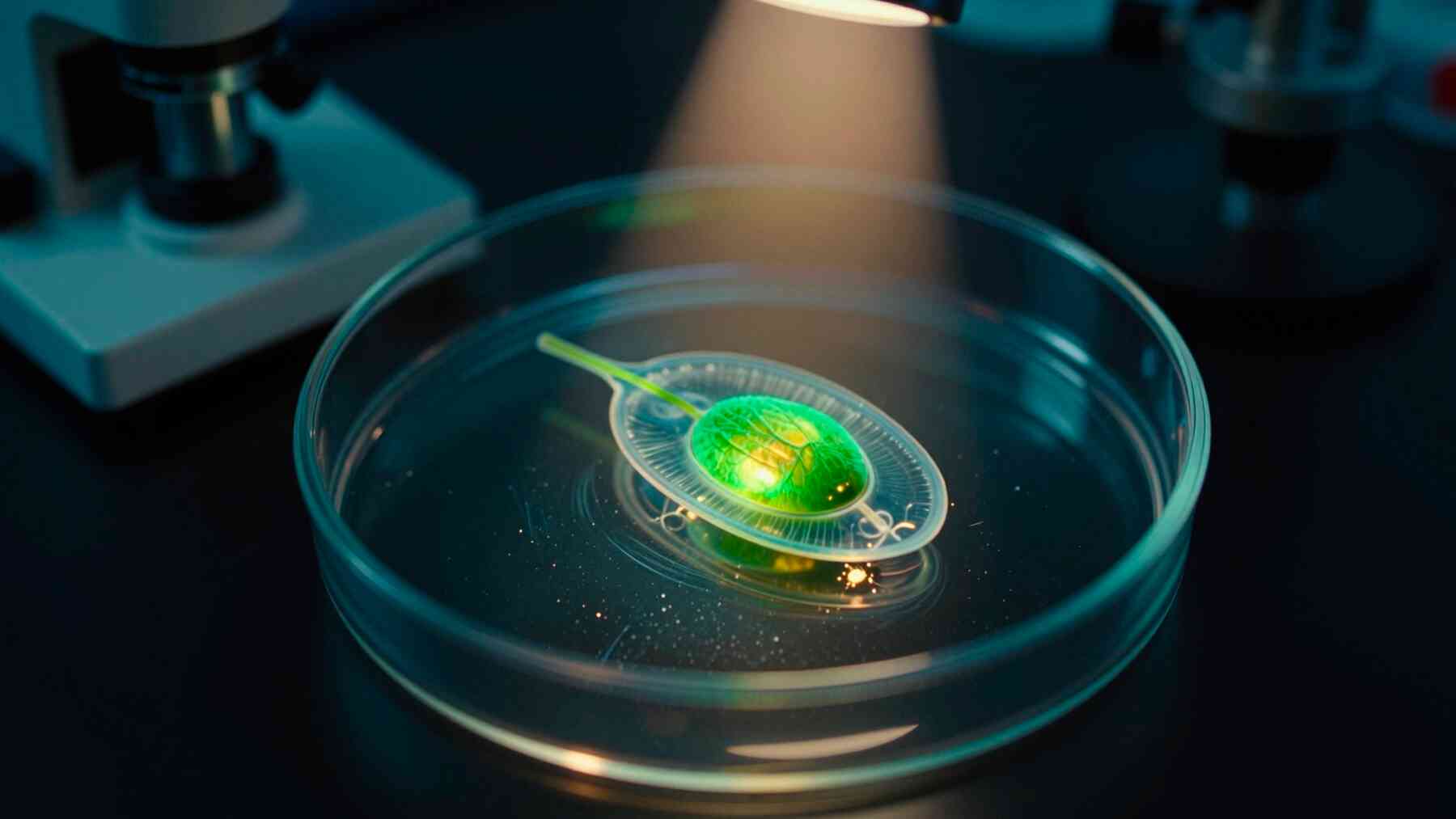
Animal cells run on food and oxygen — never sunlight. That’s always been one of the cleaner dividing lines in biology: plants and algae photosynthesize; animals don’t. The key difference sits inside the cell itself, in a small structure called the chloroplast.
Researchers at the University of Tokyo recently decided to test whether that line could move.
A biological boundary no one expected to cross
Chloroplasts are the structures inside plant and algal cells that capture light and convert it into chemical energy. They’re why plants can grow on sunlight alone. Animal cells have never had them — and for a long time, scientists assumed that even if you forced a chloroplast inside an animal cell, the cell’s internal machinery would simply destroy it. Lysosomes, the cell’s digestive compartments, would likely break it down within hours.
Matsunaga has described planimal cells as potentially contributing to a “green transformation” — a shift toward more carbon-neutral biotechnology.
That assumption wasn’t unreasonable. It was based on how animal cells handle foreign material.
There is a loose precedent in nature. Giant clams live in a symbiotic relationship with algae, benefiting from the energy algae produce through photosynthesis. But that’s a relationship between separate organisms — not a case of one cell type absorbing and running the internal machinery of another. Inserting a working chloroplast into an animal cell and having it actually function was a different proposition entirely, and most researchers would have predicted failure before the experiment even started.
How the experiment actually worked
The team at the University of Tokyo took chloroplasts from red algae and inserted them into cultured cells derived from hamsters. To observe what happened next, they used four imaging approaches: confocal microscopy, superresolution microscopy, electron microscopy, and pulse amplitude modulation fluorometry. The first three let researchers examine the physical structure of the chloroplasts once inside the animal cells.
Seeing the chloroplasts survive structurally was one thing. Confirming they were actually doing something was another.
Pulse amplitude modulation fluorometry delivers controlled pulses of light and measures the cell’s response. It confirmed that photosynthetic electron transport was genuinely occurring inside the animal cells. The activity continued for up to two days — far longer than the team had expected.
What ‘photosynthetic electron transport’ means — and why it matters
Photosynthetic electron transport is the core process by which chloroplasts generate chemical energy from light. Light hits the chloroplast, electrons move through a chain of proteins, and that movement produces usable energy. It’s the engine inside the engine.
Professor Sachihiro Matsunaga has described this as the first reported detection of that activity inside animal cells — not just a structural curiosity, but a functional one. The chloroplast-containing cells also showed an increased growth rate compared to cells without them, which the researchers attribute to the chloroplasts possibly supplying a carbon source, essentially fuel, for the host cells.
Still, it’s worth being clear about what this doesn’t mean. Animal cells containing chloroplasts aren’t suddenly capable of surviving on sunlight alone. The scale of energy production here falls far short of what would be needed to sustain a complex organism. This is early-stage science, not a blueprint for photosynthetic humans.
A potential solution to a stubborn problem in tissue engineering
Growing tissues in a lab is harder than it sounds. One of the most persistent obstacles is hypoxia — low oxygen levels inside thicker tissue structures. When oxygen can’t reach the interior layers of a growing tissue, cells stop dividing, which limits how thick and complex lab-grown tissues can become.
Chloroplast-infused cells could offer a way around that constraint. Expose those cells to light, and they could generate oxygen directly inside the tissue.
Matsunaga points to artificial organs, lab-grown meat, and skin sheets as areas where this could matter. Each requires growing multiple layers of cells, and each runs into the hypoxia problem. Mixing chloroplast-implanted cells into those tissue layers could, in theory, supply oxygen where it’s needed most — enabling larger and healthier structures to develop.
The road ahead for ‘planimal’ cells
The researchers have a name for what they’re building toward: “planimal” cells — hybrid cells that carry functional features of both plants and animals. It’s a useful shorthand for something genuinely novel.
What comes next involves understanding the exchange of substances between the host animal cell and the inserted chloroplasts. What does the chloroplast take from the cell? What does it give back beyond oxygen and energy? Those questions remain open.
The broader vision is ambitious. Matsunaga has described planimal cells as potentially contributing to a “green transformation” — a shift toward more carbon-neutral biotechnology. Whether that scales up depends on questions current research hasn’t answered: long-term stability, behavior in more complex cell types, and whether results from cultured cell lines translate to anything beyond the lab. Those are the things worth watching as this work continues.

Carlos is an engineer with strong expertise in technical and industrial topics. He previously worked at international companies such as Siemens and is multilingual.
