
Bats just trying to get a drink keep finding wind turbines in the way and it could cost them their survival
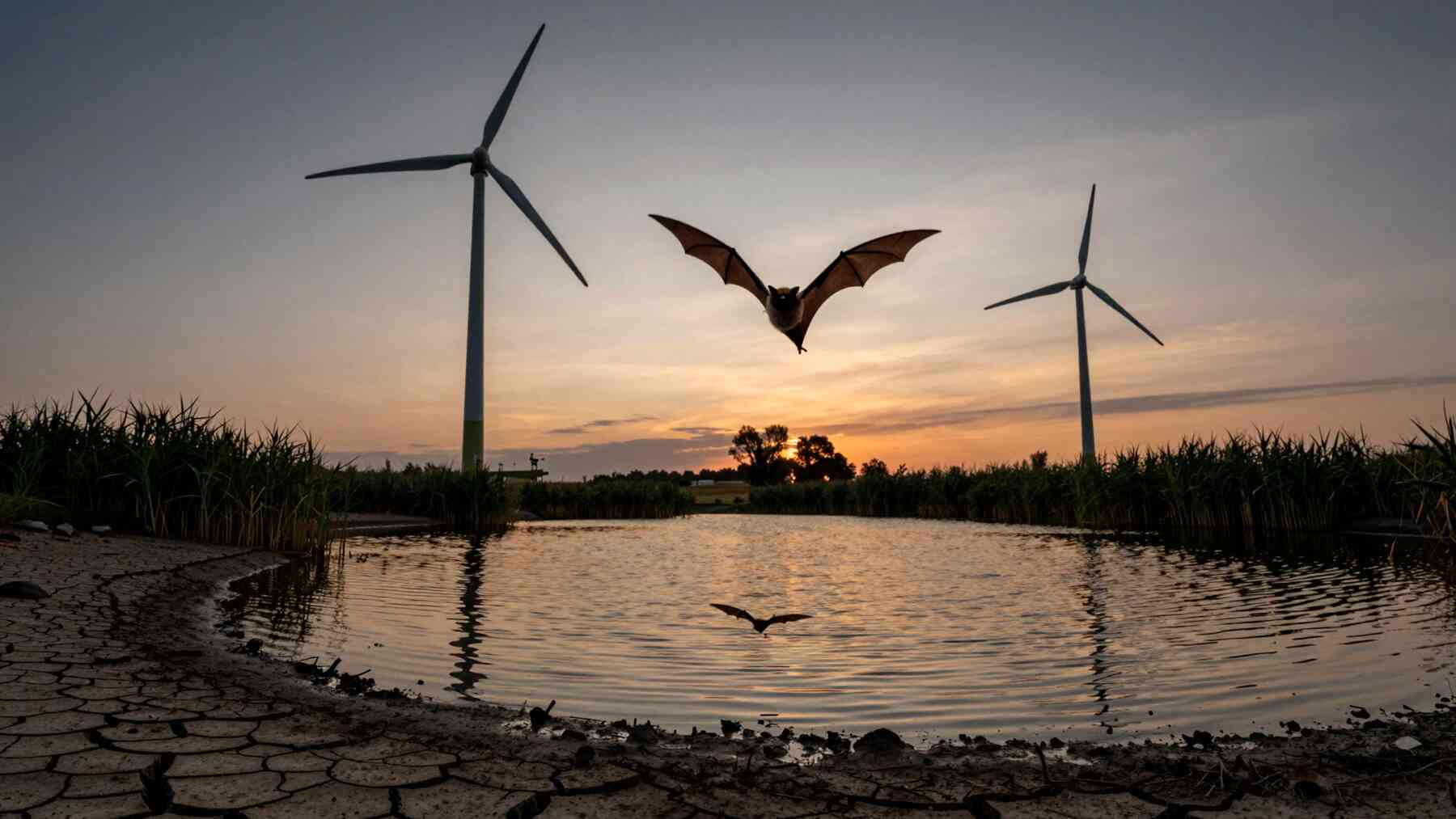
Wind turbines are supposed to help slow climate change — but in the farm country of Brandenburg, Germany, they may be making it harder for bats to survive the consequences of it.
Every summer, as temperatures climb and smaller ponds dry up, bats depend on permanent water bodies to drink and hunt. Researchers studying those ponds began noticing something was off near the turbines. The bats, it seemed, weren’t showing up.
A contradiction at the heart of green energy
Wind energy is expanding fast. Governments worldwide are building turbines to cut CO2 emissions and slow the warming that’s already reshaping ecosystems. In that framing, turbines are unambiguously good — or so the story goes.
Brandenburg has thousands of such ponds — called kettle holes, a legacy of the region’s glacial history — scattered across an intensively farmed landscape.
Researchers at the Leibniz Institute for Zoo and Wildlife Research (IZW) in Berlin have identified a direct conflict between where turbines get placed and where bats need to go. Bats are protected under both German nature conservation law and EU law, and they qualify for additional protection as migratory species — a legal status that puts them squarely in tension with wind energy expansion.
The IZW team has a name for this: the “green-green conflict.” It describes situations where one environmental goal — generating clean electricity — collides with another — protecting wildlife. In Brandenburg, that collision is playing out at the water’s edge.
Why water matters so much — especially now
Bats aren’t casual visitors to ponds. They depend on open water for both drinking and foraging, swooping low across the surface to catch insects and hydrate. Water isn’t optional — it’s a survival necessity.
July makes this dependency even more acute. That’s when female bats are finishing lactation and weaning their pups — an energetically demanding stretch where mothers need to drink more, forage more, and recover faster. Any disruption to water access hits hardest during this window.
Climate change is tightening the squeeze. Hotter, drier summers are causing smaller water bodies to vanish entirely in midsummer, pushing bats toward the ponds that hold water year-round and making those sites more critical than ever. Brandenburg has thousands of such ponds — called kettle holes, a legacy of the region’s glacial history — scattered across an intensively farmed landscape. Some of them sit close to wind turbines.
How the study was designed and what it found
To measure what was actually happening, the research team — Prof. Christian Voigt, Dr. Carolin Scholz, and Hannah Klein from the University of Potsdam — placed acoustic detectors at 59 permanently water-filled ponds in northern Brandenburg. The ponds were chosen at varying distances from wind turbines, ranging from roughly 50 to 5,000 meters away.
Recordings were taken during July, with conditions controlled for rain and wind. Nearly 8,400 bat calls were captured across two functional guilds: open space foragers and narrow space foragers, plus a third edge space group.
The numbers were stark. As proximity to turbines increased, activity among open space foraging bats dropped by 53%; narrow space foragers fell by 63%. When the team looked specifically at foraging behavior, the declines sharpened further — 87% and 76% respectively, as distance to a turbine shrank toward zero.
Not all bats respond the same way
One finding stands out: not every bat group was affected equally.
Edge space foraging bats — species like the common pipistrelle, soprano pipistrelle, and western barbastelle — showed no significant displacement near turbines. They kept showing up at ponds regardless of how close a turbine was. The species hit hardest were open space hunters, including noctule bats and house bats, and narrow space hunters like mouse-eared bats and long-eared bats.
These are some of Europe’s most widespread bat species. Their vulnerability here matters for conservation planning at scale. The researchers suggest the difference likely relates to how each guild navigates space — open and narrow foragers may perceive turbines as obstacles or threats in ways that edge foragers, adapted to cluttered transition zones, simply don’t.
Rethinking where turbines go
Prof. Voigt didn’t soften his assessment. He called it “a certain tragedy” — a tool designed to fight climate change inadvertently making it harder for certain species to cope with climate change’s effects.
The team’s argument is direct: turbine siting decisions need to weigh the ecological value of nearby habitats, not just wind resource availability. Water bodies and other critical bat habitats should be treated as low-priority or excluded sites for wind energy development. This study adds to years of IZW research documenting both direct bat fatalities at turbines and the subtler, wider disruptions caused by wind energy expansion.
The green-green conflict isn’t a hypothetical — it’s already unfolding. The tools we’re building to protect the planet’s future may be quietly undermining parts of the living world those tools were meant to preserve. Getting the placement right isn’t just a technical question. It’s an ethical one.
If you want to learn more about this discovery, you can check the article “Wind turbines impair the access of bats to water bodies in agricultural landscapes” from the Leibniz Institute for Zoo and Wildlife Research.
Disclaimer: Our coverage of events affecting companies is purely informative and descriptive. Under no circumstances does it seek to promote an opinion or create a trend, nor can it be taken as investment advice or a recommendation of any kind.

Carlos is an engineer with strong expertise in technical and industrial topics. He previously worked at international companies such as Siemens and is multilingual.
