
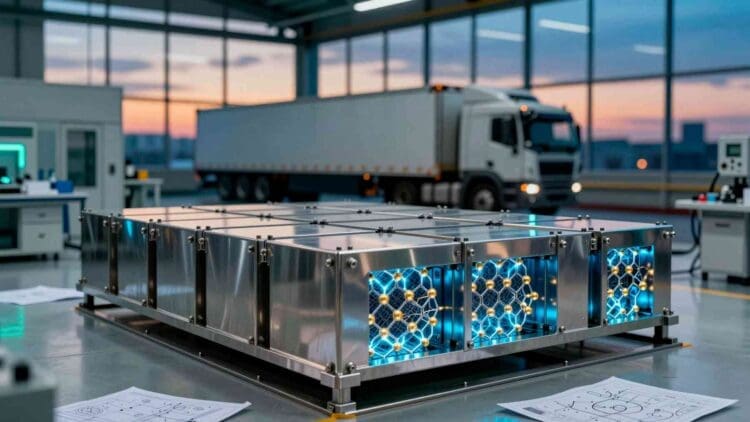

Heavy-duty trucks are a small fraction of what’s on the road — roughly 5% of all vehicles — yet they generate nearly a quarter of automotive greenhouse gas emissions. For a long-haul rig covering hundreds of thousands of miles, clean power isn’t just a policy goal; it’s an engineering problem that has resisted easy answers.
Batteries carry too much weight and take too long to recharge. Hydrogen fuel cells can refuel in minutes and run clean, but they’ve struggled to survive the brutal voltage demands that trucking places on them. Now, a team at UCLA says it has crossed a durability threshold that could fundamentally change what’s possible.
A durability problem that has stalled hydrogen trucking
Hydrogen fuel cells have long looked like a promising path — they refuel as fast as a gasoline tank and emit only water vapor. But the catalyst at the heart of every fuel cell, the component that converts hydrogen into electricity at practical speeds, has a durability problem commercial operators can’t ignore.




Platinum-alloy catalysts have historically been the best performers. Alloying elements leach out over time, and that degradation accelerates under the harsh voltage cycles heavy trucks demand. The U.S. Department of Energy set a 2050 durability target of 30,000 hours for heavy-duty fuel cell systems — a number already considered ambitious before this research began.
The breakthrough: platinum nanoparticles locked inside graphene pockets
The UCLA team’s solution was structural rather than chemical. Instead of searching for a better alloy, they eliminated alloying entirely and redesigned how platinum is protected.
Ultrafine pure platinum nanoparticles were embedded inside pockets made of graphene — a single-atom-thick carbon lattice that’s lightweight, extraordinarily strong, and highly conductive. Pure platinum removes the leaching problem at the source. The graphene layer then shields the metal from chemical degradation it would otherwise face during operation, without adding meaningful weight.
Those graphene-encased nanoparticles were nested inside Ketjenblack, a porous powdery carbon material. The result is a “particles-within-particles” architecture that provides long-term structural stability without sacrificing the catalytic activity needed for efficient energy conversion.
Test results: less than 1.1% power loss after 90,000 voltage cycles
To stress-test the design, the team ran the catalyst through 90,000 square-wave voltage cycles — an accelerated protocol meant to simulate years of real-world driving under conditions far more demanding than standard laboratory tests.
The outcome was notable. Power loss after the full test came in at less than 1.1%. A 10% loss is typically considered an excellent result in the field. This catalyst didn’t come close to that threshold.
The projected fuel cell lifetime based on those results exceeds 200,000 hours — nearly seven times the DOE’s 30,000-hour target for 2050. The design also delivers a projected power output of 1.08 watts per square centimeter, matching conventional battery performance at a fraction of the weight.
Why weight and infrastructure economics matter for trucking
The weight advantage of fuel cells isn’t a minor footnote. Fuel cells are significantly lighter than battery packs, which means less energy spent moving the truck itself — something that matters enormously when hauling heavy cargo across long distances.
A fuel cell system delivering equivalent power to a battery pack would weigh up to eight times less, according to the UCLA team’s projections. That frees payload capacity and reduces rolling energy demand on every trip. On the infrastructure side, building a national hydrogen refueling network is expected to require less capital than a comparable electric-vehicle charging infrastructure, though that comparison depends heavily on assumptions about scale and timeline.
This work also extends a pattern in the research group’s output. Their earlier catalyst for light-duty vehicles demonstrated a lifespan of 15,000 hours, nearly doubling the DOE’s 8,000-hour target for passenger vehicles. The heavy-duty result is a much larger leap.
What comes next for the technology
The findings were published in Nature Nanotechnology, and UCLA’s Technology Development Group has already filed a patent on the catalyst design. The research was led by Professor Yu Huang and co-authored by UCLA Ph.D. graduates Zeyan Liu and Bosi Peng, with collaborators from UC Irvine. Producing graphene-encased platinum nanoparticles at lab scale is one thing; scaling that process to commercial volumes remains an unsolved engineering problem.
If real-world performance tracks the projections, the implications for heavy-duty transport could be significant. Long-haul trucking is one of the hardest sectors to decarbonize — too energy-intensive for battery weight limits, too demanding for earlier fuel cell designs. A catalyst that survives 200,000 hours under truck conditions removes the durability objection that has kept hydrogen on the margins of the commercial conversation. Whether the lab result translates into something fleets can actually buy will depend on the scale-up work ahead.

Carlos is an engineer with strong expertise in technical and industrial topics. He previously worked at international companies such as Siemens and speaks Spanish, German, English, and Italian.