
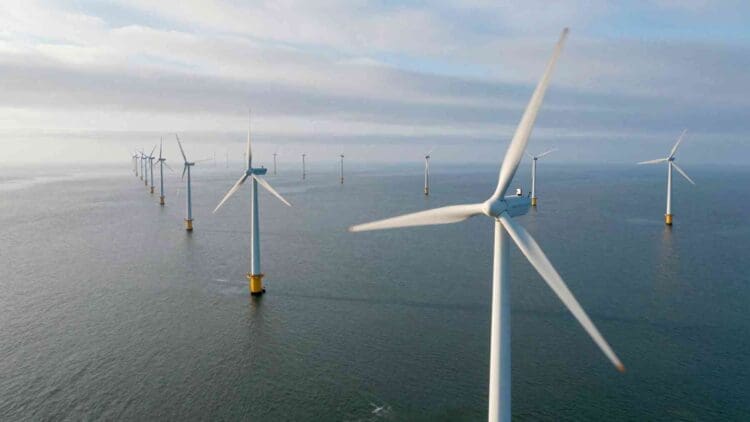

Hundreds of turbines are going up off the US East Coast, part of a build-out that could eventually deliver gigawatts of offshore wind power to the grid. But how much energy those turbines actually produce depends heavily on how much they slow each other down — and on whether the computer models used to predict those losses are telling the full story.
A new head-to-head test of the modeling tools most commonly used for that job finds they can convincingly map wind shadows stretching 50 kilometers across the open ocean. What they may be missing, the study suggests, is closer to home.
Two models, three wind farms, one direct comparison
The study pitted mesoscale Weather Research and Forecasting (WRF) simulations against large-eddy simulations (LES) for three planned offshore wind farms — South Fork, Sunrise Wind, and Revolution Wind — located off the coasts of Rhode Island and Massachusetts. Together, the farms carry a combined nameplate capacity of 1.76 GW, making this a real deployment scenario rather than a theoretical exercise.




The core difference between the two approaches comes down to resolution. LES explicitly resolves individual turbine wakes and atmospheric turbulence at fine scales, while WRF uses 1 km grid cells and parameterizes turbine effects rather than simulating them directly. That trade-off is exactly what the researchers set out to measure.
To keep conditions realistic, the team selected five case days spanning weakly stable to weakly unstable atmospheric conditions — the range most representative of the US East Coast. Wind speeds were kept below turbine rated speed so any wake-induced slowdown would translate directly into measurable power loss.
Where mesoscale models shine: capturing the broad cluster wake
When measuring wind-speed deficits downstream of an entire wind farm cluster, the mesoscale simulations performed well. Root-mean-square errors between WRF and LES came in at roughly 5% — a level of agreement that held across both single-farm and multi-farm wakes.
The models also correctly reproduced how atmospheric stability shapes wake behavior. Under unstable conditions, wakes were narrower and recovered faster; under stable stratification, they spread wider and lingered longer. WRF captured both patterns. For long-range wakes — where individual turbine plumes have merged into a single farm-scale shadow — mesoscale simulations reliably tracked the spatial extent and depth of the velocity deficit, extending confidence from earlier North Sea validation work to the US East Coast context for the first time.
The hidden shortfall: internal wakes and turbine-level power losses
Despite strong performance on wind-speed deficits, the mesoscale simulations consistently missed something more consequential: the power losses caused by one turbine waking the next one directly in line.
The numbers make the gap concrete. When turbines aligned with the prevailing southwesterly wind, LES showed internally waked turbines producing an average of 37% less power than front-row turbines. The mesoscale model estimated only 16% less — less than half the actual loss.
The culprit is grid resolution. At 1 km spacing, the model can’t resolve a rotor disk roughly 200 m wide. Individual wake plumes get smeared across neighboring grid cells, artificially affecting turbines that should be unaffected while underestimating losses on those that truly are waked. Stable atmospheric conditions made the problem worse, since individual wakes persist over longer distances under stable stratification.
When errors cancel — and when they don’t
For certain wind-direction sectors, the model’s overestimates and underestimates of wake losses partially offset each other, producing combined loss figures that look accurate — but for the wrong reasons. This isn’t a reliable feature of the modeling approach; it’s a coincidence of geometry.
For wind directions around 225°, the mesoscale model overestimated combined losses. For directions around 235°, it underestimated them. Apparent accuracy in aggregate statistics can mask large directional errors underneath, and whether those compensating errors balance out depends heavily on a site’s wind rose and farm layout. The researchers are clear: cancellation can’t be assumed elsewhere.
An additional complication comes from turbine position discretization. Placing turbines on a coarse grid can displace them by up to 700 m — roughly 3.4 rotor diameters — from their true locations, adding another layer of uncertainty on top of the resolution problem.
What this means for offshore wind planning and the path forward
The practical takeaway isn’t that mesoscale models are broken — it’s that they have a specific, now well-documented blind spot. WRF simulations remain the practical tool of choice for long-range cluster wake assessments and regional energy resource studies. For estimating turbine-level power losses inside a wind farm, they shouldn’t be used alone.
The authors call for hybrid modeling approaches: pair mesoscale simulations to capture large-scale atmospheric flow with high-fidelity LES to resolve individual turbine wakes. Future work should quantify how turbine position errors on the mesoscale grid contribute to wake uncertainty, and test whether grid spacings finer than 1 km can close the internal-wake gap.
US East Coast offshore wind deployment is already underway, with projects totaling tens of gigawatts in various stages of planning and construction. Getting these models right has direct implications for how much power those farms will actually deliver — and for the grid reliability of the communities they’re meant to serve.
If you want to learn more about this discovery, you can check the article “Differences in cluster and internal wake effects from mesoscale and large-eddy simulations off the US East Coast” in the European Academy of Wind Energy (CC BY 4.0).

Carlos is an engineer with strong expertise in technical and industrial topics. He previously worked at international companies such as Siemens and speaks Spanish, German, English, and Italian.