
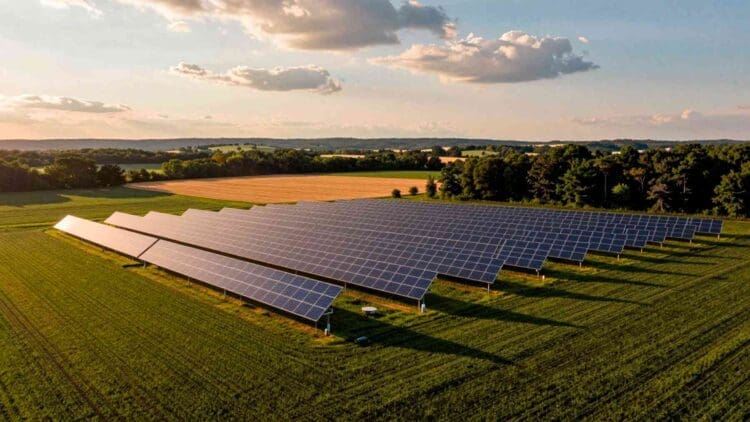

As solar energy infrastructure expands across New York state, finding space for it is becoming increasingly complicated. On April 22, researchers from Cornell University, The Nature Conservancy, the U.S. Geological Survey, and Central Michigan University published a study in Geography and Sustainability introducing a geospatial model designed to map where solar development, farmland preservation, and biodiversity conservation overlap — and conflict — across the state.
Study published on solar siting conflicts in New York
The study, titled “Sustainability Trade-offs at the Nexus of Solar Energy, Agriculture and Biodiversity,” appeared in Geography and Sustainability on April 22. It brings together researchers from Cornell University, The Nature Conservancy, the U.S. Geological Survey, and Central Michigan University — a collaboration that reflects how seriously the solar siting problem is being taken across academic, government, and conservation institutions.
At the center of the study is a geospatial model that evaluates New York state through three distinct but competing lenses: solar development at the lowest cost, farmland preservation, and biodiversity conservation. Layering these priorities onto a single map produces two kinds of output. The model identifies areas where solar development would create relatively few conflicts, and it flags hotspots where building solar infrastructure would require significant trade-offs with agriculture or ecological protection.

Why the model was developed: Growing pressure on land from solar expansion
Renewable energy infrastructure is expanding rapidly worldwide. Researchers point to improved technology, rising oil prices, and ongoing global energy instability as the primary drivers. The result is a surge in utility-scale solar projects — installations large enough to supply power to the grid rather than a single property.
These large projects demand substantial land, and that scale has begun generating real concern in communities across New York and beyond. Residents and local officials worry about what solar development means for the landscape around them. Farmland conversion is a particularly sensitive issue in agricultural regions, while ecologically sensitive areas face their own distinct pressures.
Existing siting processes have not always given planners reliable tools to weigh agricultural and ecological values at the same time. Decisions have often been made without a clear picture of where multiple priorities converge. The Cornell-led team developed this model specifically to fill that gap — to let decision-makers see competing land demands together rather than in isolation.
What the model shows and how it could be used
The model works by overlaying maps of three variables: where solar development would be most cost-effective, where prime farmland is located, and where critical biodiversity habitats exist. Where these layers intersect, the model highlights the nature and degree of conflict. Where they do not, it identifies lower-conflict opportunities for solar siting.
That distinction matters. Not every piece of land in New York poses the same trade-offs — some areas are well-suited for solar development without displacing productive farmland or threatening habitat. Others sit at the intersection of all three priorities, meaning any development there would come at a real cost to at least one competing value.
The tool is designed to operate at the state level, giving communities and planners data they can use to make more informed decisions. Rather than evaluating sites one by one without broader context, planners could use the model to identify which areas warrant protection before specific projects are even proposed. Researchers say this approach could help New York pursue its renewable energy goals without unnecessarily sacrificing food production capacity or habitat connectivity.
Context: Land-use tensions in the renewable energy transition
Large-scale solar deployment is not optional for states trying to meet clean energy targets. It is a central component of both state and national strategies for reducing carbon emissions, which makes the demand for suitable land a structural feature of the energy transition — not a temporary problem.
New York presents a particularly consequential case. The state contains significant areas of prime agricultural land alongside ecologically sensitive habitats, and siting decisions made now will shape the landscape for decades. Getting those decisions right — or wrong — carries long-term consequences for food systems, biodiversity, and rural communities.
The breadth of the research team reflects how seriously institutions are taking these tensions. Involvement of The Nature Conservancy and the U.S. Geological Survey alongside university researchers signals that this is not a narrowly academic exercise; conservation organizations and federal agencies are actively invested in developing better frameworks for navigating these conflicts. The authors also note that the model’s framework is not limited to New York — the underlying approach could be adapted for other states facing similar pressures.
Key takeaways
The study introduces a practical, data-driven tool for a problem that is only going to grow more pressing. It maps where solar development, farmland preservation, and biodiversity conservation overlap across New York state, identifying both low-conflict sites and areas where development would require significant trade-offs.
The research team includes Cornell University, The Nature Conservancy, the U.S. Geological Survey, and Central Michigan University. Published April 22 in Geography and Sustainability, the study offers a framework researchers say could inform siting decisions statewide — and could be adapted for other states navigating the same competing land-use demands.

Carlos is an engineer with strong expertise in technical and industrial topics. He previously worked at international companies such as Siemens and speaks Spanish, German, English, and Italian.