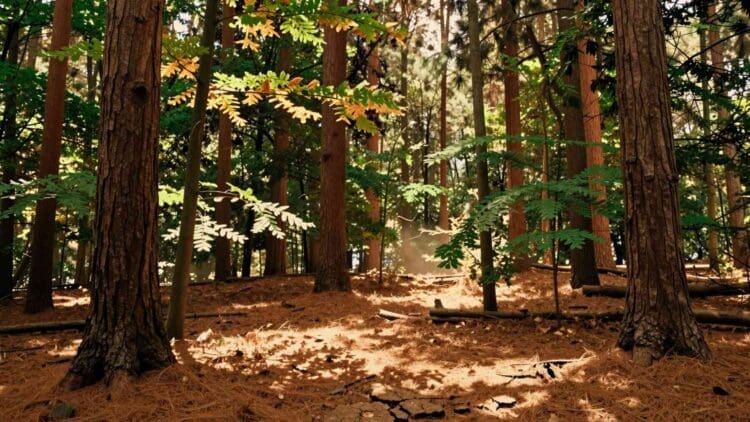

Forests absorb roughly a quarter of the carbon dioxide humans produce each year — a natural buffer that climate projections depend on. But a study published June 18 in Geophysical Research Letters suggests those projections may be significantly off. Cornell University researchers Brendan Clark and Daniele Visioni find that widely used land surface models could be overestimating forests’ future carbon storage capacity by as much as 30% because they miss a recently documented process that warmer, drier conditions trigger in trees.
Study finds land models may overestimate forest carbon storage by up to 30%
The paper comes from Cornell postdoctoral researcher Brendan Clark and senior author Daniele Visioni, an assistant professor of earth and atmospheric sciences. Their work centers on a gap between what widely used land surface models predict and what forest observations actually show.
The numbers are striking. Clark’s analysis suggests these open-source models may overestimate tree growth by a factor of 2 for broadleaf species and a factor of 3 for conifers—together translating to a potential overestimate of carbon storage capacity as high as 30% under future warming scenarios.

That kind of error has real consequences. Climate planning depends on reliable estimates of how much CO₂ forests will absorb in coming decades, from emissions targets to carbon offset accounting. If the models are too optimistic, everything built on them will be too.
Warmer, drier conditions slow tree growth independently of photosynthesis
The core ecological finding driving the study comes from Swiss forests, where researchers tracked both broadleaf and coniferous species over eight years. Hotter, drier conditions reduced growth rates — even when the trees continued to photosynthesize normally.
The mechanism involves turgor pressure: the amount of water inside a tree’s cells. When conditions are dry and warm, that pressure drops. Lower turgor pressure impedes cell division, which means the tree is not adding mass or storing carbon, even while it keeps pulling CO₂ from the air. Photosynthesis continues; growth does not.
“The tree may be photosynthesizing, but it’s not growing,” Clark said.
This decoupling of photosynthesis and growth is the critical insight. Standard land models treat the two processes as equivalent — if a tree is photosynthesizing, it is assumed to be storing carbon at a corresponding rate. The Swiss research and subsequent analysis of major European temperate and boreal tree species show… that assumption does not hold under warmer, drier conditions.
A modeling gap could accelerate projected warming if left uncorrected
The stakes extend well beyond forestry. Land currently absorbs approximately 27% of the CO₂ produced by burning fossil fuels, with oceans taking up another 25% and the remainder staying in the atmosphere. Forests are doing significant work to slow the pace of warming.
If tree growth slows faster than models anticipate, that buffer shrinks. Less carbon stored in wood means more CO₂ stays in the atmosphere, driving more warming — a feedback loop that current projections do not fully capture. Clark built a statistical model projecting tree growth and carbon storage through 2069, then compared those outputs against simulations from a widely used land surface model. The divergence was consistent and substantial, particularly in regions forecast to become hotter and drier.
Visioni framed the broader concern directly. “The more we look, the clearer it becomes that with further warming it will become harder for nature to keep up,” he said. His point is not that forests stop mattering, but that counting on them to absorb emissions at current rates may be a miscalculation.
Researchers call for collaboration between ecologists and climate modelers
Clark did not arrive at this topic through climate modeling alone. He learned about the turgor pressure findings from co-author Shan Kothari, an ecologist and assistant professor at the University of Alberta—a conversation that prompted Clark to start attending forest ecology conferences, a field he had not previously worked in directly.
Climate modelers and field ecologists often operate in separate communities, publishing in different journals and rarely crossing paths at conferences. New biological mechanisms can take years to make their way into computational models. That lag is part of what this study is pushing against.
“There can be a disconnect between ecologists and modelers,” Clark said. “It’s important to bring them together.”
The overestimation problem is not entirely new. Models have previously been shown to overestimate the land’s carbon uptake compared to observations. Clark’s work suggests the turgor pressure mechanism may partly explain that known bias — giving researchers a specific, testable process to incorporate rather than a vague discrepancy to work around. Co-author Manuel Lerdau of the University of Virginia also contributed to the study, which received funding from the Quadrature Climate Foundation and used resources from the National Science Foundation’s National Center for Atmospheric Research.
27% of fossil fuel emissions absorbed by land
The Cornell study identifies a specific biological mechanism — heat- and drought-driven reductions in turgor pressure — that causes trees to slow their growth even while photosynthesis continues. Current land surface models do not account for this process, leading to potential overestimates of forest carbon storage by up to 30%.
None of this means forests have stopped functioning as carbon sinks. It means the models that quantify their future role may need significant revision. With land absorbing roughly 27% of fossil fuel emissions today, even a moderate reduction in that capacity would have measurable consequences for warming projections and climate planning.
Clark’s planned open-source code tool aims to make the correction accessible to modeling teams worldwide—a practical step toward closing the gap between what forests are expected to do and what warmer conditions will actually allow.
Kelly is an experienced writer with 15 years of experience exploring the big stories that shape our world, from tech breakthroughs and space exploration to climate, energy, and the fascinating quirks of science. She has a talent for turning complex ideas into sharp, memorable insights that stay with readers long after they’ve finished reading.