
Off Denmark, a drone flew around a wind turbine while its blades were still spinning and inspected them without forcing the machine to stop generating electricity
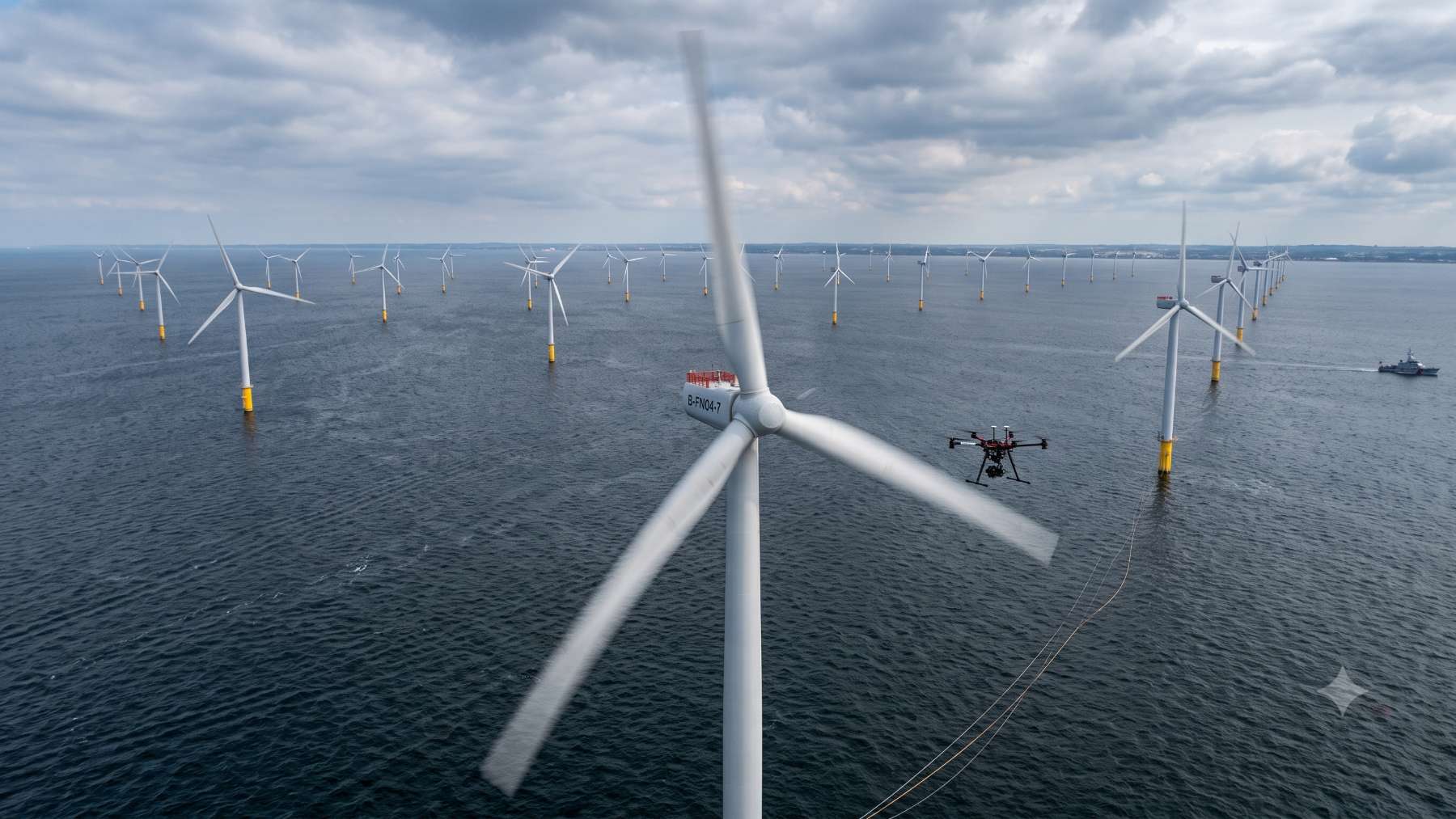 Image generated with artificial intelligence
An autonomous drone in Denmark has moved offshore wind turbine inspection into the future.
Worldwide, coastal nations are rapidly deploying offshore wind projects to meet clean energy demands.
These marine installations are invaluable for harnessing high-speed winds and generating high-capacity electricity.
Her work focuses on making complex topics accessible, informative, and relevant for readers across different areas of interest.
However, the harsh oceanic conditions result in highly complex and expensive maintenance.
Will the pilot results from off the coast of Denmark prove that maintaining turbines can become simpler?
How coastal communities struggle to keep carbon footprints low
A major portion (nearly 40%) of the global population lives within 60 miles of a coast.
As more people continue to inhabit these regions, economic activity increases.
Beyond hosting dense populations, these regions also have major trade ports and heavy industrial hubs.
This includes major commercial centers, manufacturing plants, and shipping networks.
These operations all require substantial volumes of high-capacity electricity.
As a result, local utilities are under relentless strain due to high energy demands.
However, while strict international climate regulations mandate rapid decarbonization, these coastal zones often struggle.
Viable land is extremely scarce, expensive, or already tightly developed.
This leaves little to no space for utility-scale wind turbine deployment that requires vast open land.
Consequently, coastal nations are increasingly relying on offshore wind projects miles out at sea to get the job done.
These installations offer significant advantages compared to their onshore counterparts.
From major power potential to a maintenance dilemma
Densely packed regions often experience lower, erratic wind speeds due to physical obstacles, like buildings and terrain.
Installing wind turbines on open oceans addresses this issue.
It also increases electricity production up to 50% and achieves significantly higher capacity factors.
Yet oceanic operations introduce major environmental and operational challenges.
Structural wear occurs more frequently due to constant exposure to corrosive saltwater, extreme waves, and winds.
As a result, offshore wind turbine blades require regular inspection and repairs.
Usually, specialized service vessels are dispatched along with rope-access technicians.
These manual inspections are not only costly, but also dangerous.
Operators are often forced to wait for more ideal weather conditions before inspection and maintenance can occur.
In addition to long wait times, traditional inspections require shutting down active wind turbines.
This all leads to expensive energy downtime and lost revenue.
To overcome this, RWE hosted a test site for a new autonomous drone.
Conducting active wind turbine inspections with a drone
RWE partnered with Danish startup Quali Drone for the launch of the AQUADA-GO project.
Energy Cluster Denmark facilitated the initiative at the Rødsand 2 Offshore Wind Farm.
The farm’s wind turbines have been operating since 2010, offering a realistic ocean environment for testing.
The project entailed deploying a specialized, high-capacity autonomous drone to streamline logistics.
Tracing rotating turbine blades from the sky
The drone is equipped with visual cameras and thermal imaging sensors.
Its advanced computer-vision software tracks spinning blades, enabling safe navigation around active turbines during flight.
As it flies, thermography sensors detect minute surface temperature fluctuations created by internal friction.
The drone has an onboard AI model, designed by the Technical University of Denmark.
This model analyzes the thermal-mechanical data in real time.
This enables the drone to identify visible surface erosion alongside hidden subsurface cracks.
The inspection is conducted without stopping electricity generation that coastal communities desperately need.
These autonomous drone test flights fundamentally reshaped the economics of offshore wind turbine maintenance.
Using the drone eliminates dangerous rope-access work, protecting crew from high-risk marine conditions.
Additionally, avoiding wind turbine shutdowns prevents major financial losses resulting from operational downtime.
Maintenance vessel transport times are also reduced, which lowers overall maintenance and inspection costs.
Furthermore, this cuts vessel emissions by up to 50%. Ultimately, using drone technology accelerates progress to achieving global net-zero goals.
Anke Maree is a writer with a clear and engaging editorial style. Her work focuses on making complex topics accessible, informative, and relevant for readers across different areas of interest.
