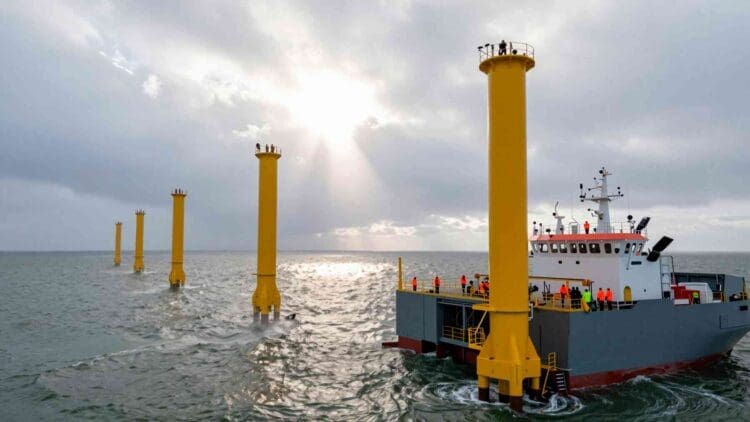

Equinor and Polenergia have passed the halfway mark in turbine foundation installation for their Baltyk 2 and Baltyk 3 offshore wind projects in the Baltic Sea. More than 50 monopiles and transition pieces are already sitting on the seabed, the developers confirmed during the ongoing mid-2026 construction campaign.
The two projects sit between 14 and 23 miles off the Polish coast. Together, they’ll support 100 wind turbines once complete.
Halfway milestone reached in Baltic Sea foundation campaign
Foundation installation kicked off in May 2026, starting at Baltyk 2—the farther of the two sites, 23 miles from shore. Crews drove monopiles into the seabed and connected them to transition pieces, and those distinctive yellow tops now poke above the waterline, making the progress easy to spot from a distance.

While work moved forward at Baltyk 2, the team was simultaneously prepping Baltyk 3, just 14 miles offshore—including rock placement to protect subsea infrastructure. Foundation installation has since shifted there too, pushing the overall campaign past the halfway point.
Both CEOs say the project is running on schedule. Adam Purwin, CEO of Polenergia, called the milestone “an important and very tangible” sign that a complex engineering and logistics operation is “progressing efficiently and according to plan.” Michal Jerzy Kolodziejczyk, CEO of Equinor Polska, pointed to the scale and pace of construction as proof that teams and partners are delivering.
Why foundation installation is the most demanding phase
Offshore wind construction has several tough stages, but foundation installation is one of the hardest. Monopiles have to be driven precisely into the seabed, then fitted with transition pieces that’ll eventually carry the full load of a 260-meter turbine tower. There’s not much room for error.
The operation demands tight coordination between offshore crews and onshore logistics. Kolodziejczyk specifically called out offshore expertise, operational safety, and coordination as essential at this stage. A single breakdown in the supply chain — or one safety incident — can stall the whole campaign for weeks.
Thialf, one of the largest installation ships in the world, stretches more than 656 feet long and spans 288 feet wide. More than a dozen additional vessels, including component supply ships, support the operation. Later this summer, the campaign shifts to installing the jacket structures that’ll support the offshore substations—the next major milestone before turbines go up.
Combined capacity and contribution to Poland’s energy grid
When complete, Baltyk 2 and Baltyk 3 will together host 100 wind turbines, each rated at 14.4 MW, giving both farms a combined generating capacity of up to 1.44 GW. That’s a meaningful addition to Poland’s power mix.
The turbine towers will stand 853 feet tall—roughly the height of an 85-story building. Mounting them on the foundations now being installed is scheduled for next year.
Before power reaches shore, it passes through offshore substations that collect electricity from the turbines and step up the voltage from 66 kV to 220 kV for efficient long-distance transmission. Once both farms are fully operational, they’re expected to generate enough electricity to cover the annual demand of approximately two million Polish households—a real contribution to national energy supply and to Poland’s goal of cutting dependence on fossil fuels.
Project timeline and developer background
Baltyk 2 and Baltyk 3 are a joint venture between two energy companies with very different home bases. Equinor is a Norwegian energy major with deep offshore expertise built over decades in the North Sea; Polenergia is Poland’s largest private energy group. Together, they’re delivering what ranks among Poland’s biggest offshore wind investments to date.
The construction timeline is tight but clear. Electricity generation is scheduled to begin in 2027, with full commercial operation planned for 2028. That means turbines going up next year need to be connected, tested, and commissioned within a few years—demanding, but achievable if the current pace holds.
Poland is expanding its offshore wind capacity as part of a broader national energy transition. The Baltic Sea offers strong, consistent wind resources, and the country has set ambitious targets for renewable generation. Projects like Baltyk 2 and Baltyk 3 are central to hitting those targets. Purwin framed the milestone in exactly those terms—each foundation installed, he said, brings the project closer to the moment when wind-generated electricity starts flowing into the national grid.
What to know as construction continues
Here’s where things stand heading into the second half of 2026. More than 50 monopiles and transition pieces are in place across both sites. Foundation work is progressing at Baltyk 3 after getting underway first at Baltyk 2, and offshore substation jacket installation is set to begin later this summer.
Next year, turbine towers will be mounted on the completed foundations, and the offshore substations will step up voltage for shore transmission. Both developers say the project remains on schedule for first power in 2027 and full commercial operation in 2028.
When that happens, two million Polish households will have a new source of electricity—generated by 100 turbines standing 853 feet above the Baltic Sea.
Kelly is an experienced writer with 15 years of experience exploring the big stories that shape our world, from tech breakthroughs and space exploration to climate, energy, and the fascinating quirks of science. She has a talent for turning complex ideas into sharp, memorable insights that stay with readers long after they’ve finished reading.