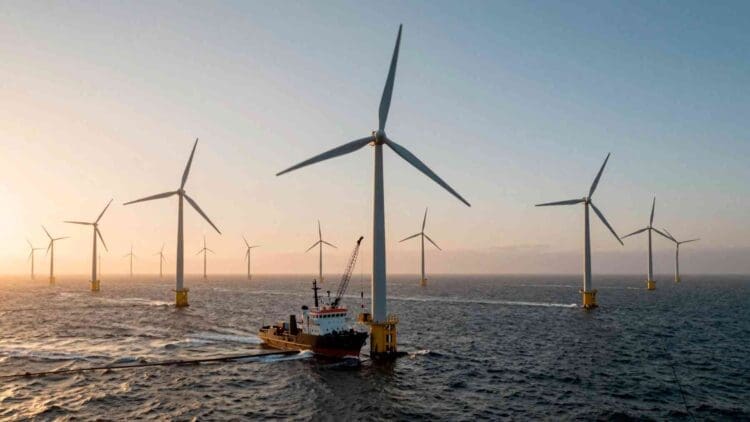

Ecowende’s Hollandse Kust West offshore wind farm just produced its first carbon-free electricity — and it’s now connected to TenneT’s offshore high-voltage grid. The 760 MW project sits 53 km off the Dutch coast and is developed by a joint venture of Shell, Chubu, and Eneco. Offshore construction is still ongoing, with full commercial operation expected by the end of 2026.
First power milestone reached
“First power” sounds like jargon, but the idea is simple: electricity generated out at sea is now flowing through TenneT’s cables into the Dutch grid for the first time. Commissioning Manager Ekansh Aggarwal kept it straightforward — watching the turbines spin and deliver that first power safely was “a great achievement for everyone involved in the project.”
Hollandse Kust West is a Shell, Chubu, and Eneco joint venture operating under the Ecowende name. The farm sits well beyond the visible horizon, 53 km offshore, with full commercial delivery still on track for the end of 2026 and construction running in parallel.

The milestone means more than a project checkbox. Ecowende describes it as a meaningful step in the Dutch energy transition — a signal that large-scale offshore wind is moving from cranes and foundations to actual electricity delivery.
Scale and technical specifications of the wind farm
The numbers are worth pausing on. The farm has 52 turbines, each rated at 15 MW, for a total installed capacity of 760 MW. Offshore construction kicked off in December 2025 with the first monopile foundation going in.
Once fully commissioned, the wind farm is expected to generate 3.3 TWh of renewable electricity per year — roughly 3% of the Netherlands’ total annual electricity demand. That’s a real slice of national consumption from a single installation.
That output figure also explains why the grid connection matters so much. Generating power offshore is only useful if it reliably reaches homes and businesses onshore, which is exactly what TenneT’s infrastructure is built to do.
Grid connection and electricity trading arrangements
The farm delivers its output onshore through TenneT’s offshore high-voltage infrastructure. TenneT developed the “offshore power socket” — the grid connection carrying Ecowende’s electricity from the North Sea to the Dutch mainland. Robin van Buchem, Head of Operations NL at TenneT, called it “another milestone in building the renewable energy infrastructure the Netherlands needs.”
Next Kraftwerke started marketing Ecowende’s electricity on 4 July 2026, handling trading across day-ahead, intraday, and balancing energy markets. The company also acts as a balancing service provider and congestion service provider for the farm.
Hollandse Kust West supports grid stability directly through automatic negative frequency reserve (aFRR), adjusting its output to compensate for frequency fluctuations.
Marc Rühs, CEO of Next Kraftwerke, said the farm is being “optimally integrated into the market,” making a measurable contribution to both grid stability and economic performance.
Day-to-day operations and maintenance will be carried out by Eneco Wind Offshore Operations and Vestas Services. Electricity trading is handled by Next Kraftwerke together with Shell and Shell Energy Europe Limited (SEEL), with Shell Energy Europe Limited acting as the off-taker for 60% of the wind farm’s electricity production.
Ecological measures integrated into the wind farm design
What sets Hollandse Kust West apart from many comparable projects isn’t just capacity—it’s the ecological thinking baked into the design from the start. At Ecowende’s initiative, turbine manufacturer Vestas is painting a single blade red on seven turbines to test whether that color contrast lowers bird collision risk when the blades are spinning.
Above the waterline, the farm includes a dedicated bird corridor, wider turbine spacing, elevated nacelles, adaptive curtailment, and AI-assisted radar monitoring. Each measure targets a specific risk rather than treating wildlife protection as one generic obligation.
Below the surface, the design keeps going. Scour protection around the monopile foundations—material placed there to prevent seabed erosion—has been shaped to create rock crevices and sheltered bays for fish and marine life. Fish holes in the monopile foundations themselves are also being tried as additional habitat.
Ecowende frames all of this as part of a broader ambition: setting a new standard for offshore wind that works with nature, not just around it.
Commercial operation slated for the end of this year
Hollandse Kust West has crossed a real threshold. Connected to TenneT’s offshore grid and producing its first carbon-free electricity, the farm is on track for full commercial operation by the end of 2026.
Its 52 turbines — each rated at 15 MW — add up to 760 MW of installed capacity. At full output, the farm will generate around 3.3 TWh per year, covering roughly 3% of Dutch electricity demand.
Grid integration is already running, with Next Kraftwerke trading electricity across multiple markets and providing balancing services. The project also stands out for its ecological approach, from red-painted blades to underwater habitat features built directly into the foundations. Taken together, Hollandse Kust West is one of the more closely watched offshore wind projects in Europe right now.
Kelly is an experienced writer with 15 years of experience exploring the big stories that shape our world, from tech breakthroughs and space exploration to climate, energy, and the fascinating quirks of science. She has a talent for turning complex ideas into sharp, memorable insights that stay with readers long after they’ve finished reading.