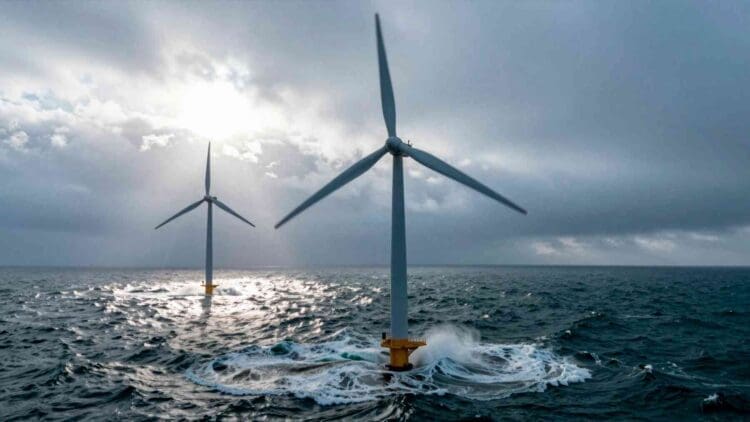

Imagine a giant wind turbine floating on the ocean. The waves crash. The platform rocks violently.
You would expect the power output to drop, right? Most people assume that bigger waves mean bigger losses.
But a new study reveals a shocking twist for the future of clean energy. It all comes down to a hidden relationship between massive blades and moving water.

When the ocean rocks a wind turbine, size changes everything
Floating offshore wind turbines never sit still. Ocean swells push them forward, backward, and side to side.
This constant motion completely reshapes the air flowing around the blades. Engineers have spent years studying this exact problem.
How do ocean waves affect the power produced by floating wind turbines? Early research using smaller test models always pointed to a clear penalty. The motion simply killed the efficiency.
But new simulations using a massive 22-megawatt design flipped the script. When the waves got rougher, this giant turbine actually generated more average power.
Dynamic stall: The aerodynamic culprit — and unexpected ally
The secret lies in the sheer scale of modern engineering. The giant turbine features a staggering 931-foot rotor.
As the platform rocks, these enormous blades slice through the air at extreme angles. This triggers a complex aerodynamic event known as dynamic stall.
Airflow detaches from the blade, creating a massive zone of reverse air. For a brief moment during the rocking cycle, power generation actually goes negative.
But then the math shifts. The violent motion creates an explosive burst of lift and torque on the upstroke.
This burst more than compensates for the temporary losses. Smaller turbines cannot replicate this trick because their blades do not push the air hard enough.
The downstream turbine gets a surprise boost
The study also tested what happens when you place two of these giants in a row. The second turbine was placed directly behind the first one.
Surprisingly, the second turbine also got a massive boost from the rocking motion ahead of it. It did not experience dynamic stall itself.
Instead, the moving turbine in front acted like a giant blender. It stirred the air violently and pulled high-speed wind down into its wake.
By the time the wind reached the second turbine, it had recovered its speed. The second machine got a stream of high-energy air for free.
Vortex rings, turbulence, and the physics of wake recovery
To understand why this happens, look at the spinning tips of the blades. They create powerful, spinning tunnels of air called wingtip vortices.
When the platform rocks, these vortices quickly bunch together into thick rings. These rings bend downstream and break apart much faster than usual.
The early breakdown acts like an injection of energy into the wind stream. It forces fast-moving air back into the slow-moving shadow behind the turbine.
Interestingly, the massive 22-megawatt turbine creates less chaotic turbulence than smaller models. Yet, its wake recovers its speed much faster.
The physics show a clear inverse relationship between turbulence and wind deficit.
More turbulence means quicker recovery, allowing the wind to recharge almost instantly.
What this means for the future of offshore wind farms
The offshore wind industry is growing at a breakneck pace. Developers are constantly pushing into deeper waters that require floating platforms.
The 22-megawatt machine used in this study represents the absolute frontier of modern clean energy. Yet, most current engineering tools are still calibrated for older, smaller turbines.
If next-generation machines behave this differently, our current computer models might be deeply flawed. We need new tools to predict how these giants will actually perform at sea.
The findings could also completely revolutionize how we design offshore wind farms. If rocking platforms actually help restore wind speed, we can pack turbines much closer together.
This could dramatically cut the cost of deep-water projects. More research is needed, but the ocean waves we once feared might just become our greatest ally.
Kelly is an experienced writer with 15 years of experience exploring the big stories that shape our world, from tech breakthroughs and space exploration to climate, energy, and the fascinating quirks of science. She has a talent for turning complex ideas into sharp, memorable insights that stay with readers long after they’ve finished reading.