
All five Hywind Scotland turbines made the trip back to port for maintenance, and the quieter seascape they left behind wasn’t quiet at all: underwater noise jumped 29 decibels as nearby porpoise detections fell 33 percent
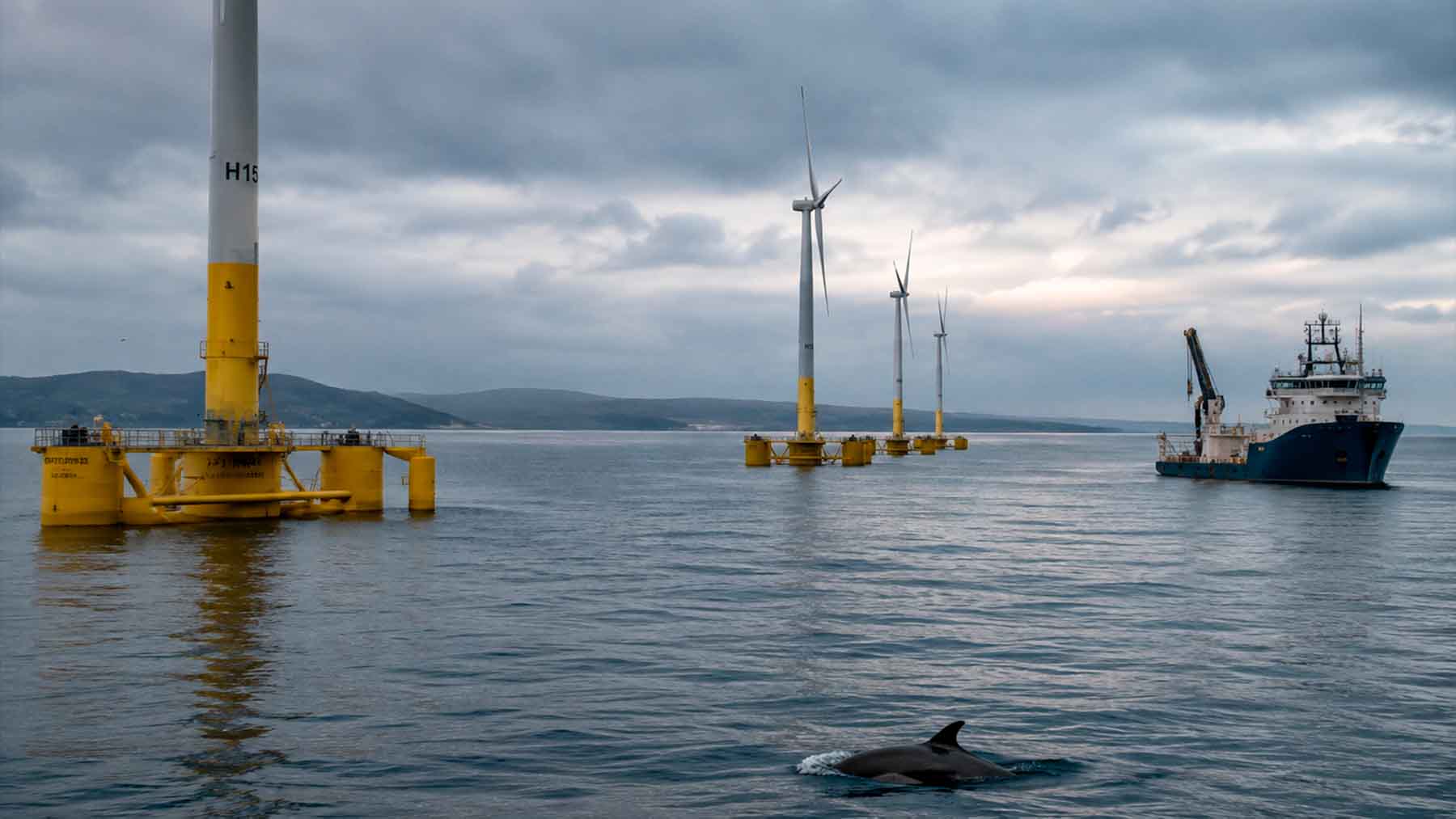 Image generated with artificial intelligence
Routine maintenance of offshore floating wind turbines in Scotland has been found to impact surrounding wildlife.
Nations worldwide are pushing offshore infrastructure into deeper waters to harvest stronger resources.
This deep-sea shift is key to meeting decarbonization goals and higher energy demand in coastal regions.
Scotland’s coastal areas have near-shore zones that are heavily crowded with existing projects, fisheries, and busy shipping lanes.
The infrastructure’s true environmental impact remains largely unknown, but recent research indicates short-term consequences.
Will it be necessary for developers to implement mitigation to ensure marine wildlife conservation?
How offshore turbine deployment will help major coastal hubs
Living near the coast has attracted people for centuries.
Historically, humans clustered near trade routes and ports because it minimized physical survival costs.
Resources such as food and water were much easier to acquire, and economic growth occurred more quickly.
Today, people are still surging to the coast, but for different reasons.
Key attractions include a slower, healthier lifestyle, milder climates, and the rise of flexible remote work.
As a result, these regions now host almost 40% of the world’s population.
Inevitably, this has led to rapid urbanization and industrialization to accommodate rising needs.
Additionally, electricity demand in these regions has risen significantly.
To adhere to strict decarbonization targets, renewable energy sources must expand to replace fossil fuels.
Unfortunately, these densely populated coastal hubs have little to no room for green energy development on land.
This is why several nations are turning to offshore power generation.
Moving offshore wind into the deep sea
The transition to offshore wind power entirely bypasses land limitations.
The open ocean offers space to deploy large-scale turbines that capture faster and more consistent wind.
However, these installations have standard fixed-bottom foundations, which are limited to shallow depths up to 197 feet.
Scotland’s coastal areas have near-shore zones that are heavily crowded with existing projects, fisheries, and busy shipping lanes.
This means expansion of traditional offshore turbines has become limited.
The nation aims to achieve net-zero greenhouse gas emissions by 2045.
To achieve this, offshore green capacity must continue to expand, which is why deep-sea projects have become essential.
Floating wind turbines are fundamental to continuing clean energy growth.
They overcome seabed depth limitations, as the floating platforms can be installed much farther out at sea.
However, the harsh marine conditions, such as extreme waves, can accelerate structural degradation.
Researchers have uncovered that more frequent maintenance impacts marine mammals.
The ecological footprint of routine maintenance
Researchers are only beginning to understand the consequences of floating wind farms on the ocean’s wildlife.
At the Hywind Scotland farm off the northeastern coast of Aberdeenshire, a study revealed the impacts of tow-to-port maintenance.
During this routine practice, floating turbines are disconnected and hauled to land for component repairs.
The study monitored the changes in underwater sound levels and marine mammal activity.
The acoustic devices revealed significant disruption.
Changes in harbor porpoise activity
Sound levels increased up to 29 decibels above standard operational averages.
Vessel towing and mooring adjustments were key drivers of this underwater noise spike.
This triggered a major decline in harbor porpoise activity.
Within less than half a mile of activity sites, detections dropped up to 33%.
Overall disruptions occurred up to 1.2 miles away.
Fortunately, once the high-intensity work stopped, the detection rates recovered quickly.
These findings indicate that marine mammal displacement was localized and temporary.
Hywind Scotland is the world’s first commercial floating wind farm.
Despite the short-term ecological impacts, the project remains fully operational and pioneers offshore clean energy.
The study highlights that future floating projects should account for the potential acoustic footprint during major maintenance.
Key suggestions include using seasonal scheduling, localized monitoring zones, and quiet vessels.
Ultimately, deep-water renewable energy can grow with marine conservation by relying on proactive mitigation strategies.
More details about the study can found using APA CITE: Harris, C. B., Benjamins, S., van Geel, N., White, E., Scott, B., & Williamson, B. J. (2026). Impacts of large-scale maintenance of a floating offshore wind farm on noise levels and harbour porpoise activity. ICES Journal of Marine Science, 83(8), fsag150.
Anke Maree is a writer with a clear and engaging editorial style. Her work focuses on making complex topics accessible, informative, and relevant for readers across different areas of interest.
