
Scientists modeled a 1,300-panel floating solar island beside salmon cages in the Caspian Sea, and found the combined system could pay for itself faster than the panels alone
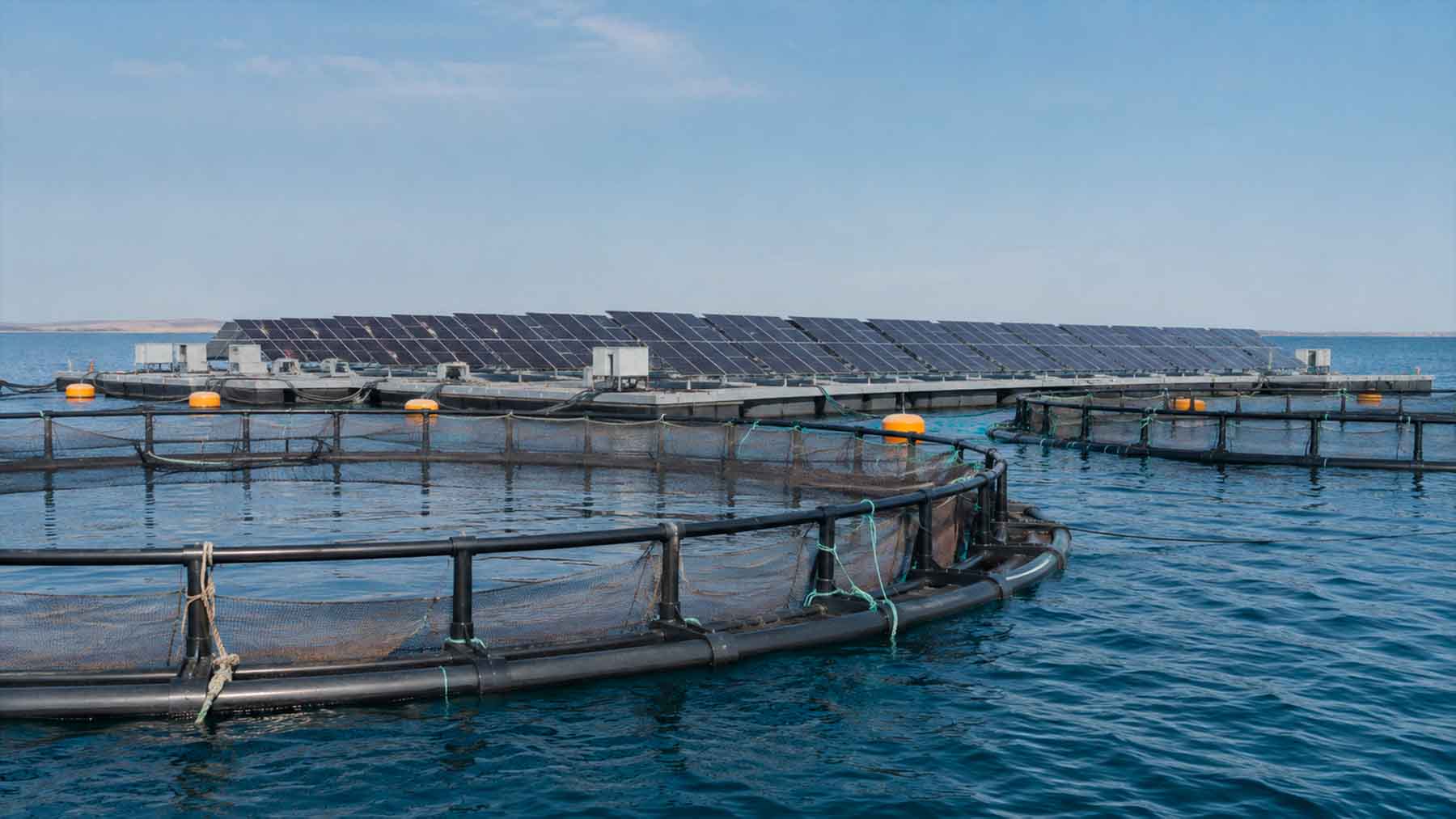 Image generated with artificial intelligence
A hybrid model combines floating solar power with aquatic food production, accelerating the recovery of the initial investment cost.
Globally, nations are rushing to boost green energy capacity, but certain bottlenecks slow progress.
Onshore, land scarcity is intensifying, encouraging the transition toward ocean-based deployment.
This approach not only addresses land scarcity and food security issues but also makes boosting offshore green capacity more economical.
But even the open sea faces competition over space, leading to dual-use infrastructure exploration.
Will combining renewable energy infrastructure with fish farming help maximize resource efficiency?
How land-use conflicts have intensified
Historically, the world has competed over a variety of valuable resources.
In some cases, this competition has led to significant conflict, and this is still experienced today.
Precious metals, crude oil, and fresh water remain among highly sought-after resources.
However, fertile land has become fiercely contested, especially as populations expand and climate targets grow more crucial.
Worldwide, agriculture already uses nearly 11.9 billion acres, which is over one-third of Earth’s total land area.
Over recent decades, urbanization has also expanded significantly, leaving few remaining natural habitats.
This limited space onshore complicates the global shift toward renewable energy sources.
Green infrastructure needed to achieve decarbonization goals requires vast tracts of land for development.
International Energy Agency projections indicate that up to 231,661 square miles of land will be needed to triple green capacity.
Consequently, this triggers immense competition and community resistance.
To avoid this, offshore deployment must be prioritized.
Boosting green capacity on the open ocean
Offshore capacity is growing rapidly, as it accelerates global decarbonization and bypasses land constraints.
The open ocean offers vast spaces and powerful, consistent forces like wind and tidal currents.
However, to maximize marine space, a diverse mix of green technologies should be deployed.
While turbines may be standard ocean infrastructure, floating solar panels are emerging as key innovations.
The ocean’s water-cooling effects naturally lower panel temperatures, which increases solar efficiency.
It can also be added to existing wind farms, lowering connection costs and balancing power production.
Unfortunately, the technology faces high initial capital investment costs, slowing global deployment.
It requires marine-grade materials, specialized anchoring, and complex moorings, which leads to immense upfront expenses.
To address this financial barrier, researchers are exploring marine aquavoltaic systems.
A hybrid system was modeled for the coast of Iran’s Caspian Sea to test its economic viability.
The study indicates that this combined concept can pay for itself at a significant rate.
Lowering floating solar costs with aquatic food production
The combination of floating solar power generation and food production can offer distinct benefits.
A simulation study evaluated a 1,300-panel floating solar island with salmon cages.
This dual infrastructure would simultaneously produce clean electricity and food.
The system consists of thin-film solar modules mounted on floating structures directly next to the fish cages.
The salmon benefit from the shade of the structures.
Meanwhile, over 300 megawatt-hours of electricity annually are fed directly into the grid.
The Gomishan region of the Caspian Sea was selected due to ideal conditions for raising Atlantic salmon.
From beneficial conditions to a high profit margin
Water temperatures remain below lethal limits, keeping fish stress-free.
Low salinity and chlorophyll levels reduce disease risks.
Furthermore, capital recovery is accelerated by generating dual income from electricity sales and commercial fish yields.
The hybrid model achieved a 42% annual profit margin.
The initial investment cost was recovered in four years.
The study’s findings indicate that combining aquaculture with floating solar power will open new financial doors.
High upfront capital barriers can now become opportunities for profitable dual revenue.
This approach not only addresses land scarcity and food security issues but also makes boosting offshore green capacity more economical.
The next step will be scaling array sizes and improving structural durability for rough marine conditions.
Ultimately, deploying hybrid offshore platforms on the open ocean is key to a sustainable future.
The simulation can be reviewed using Momeni, A., Gorjian, S., Mokhtarzadeh, H., & Ghobadian, B. (2026). Theoretical Modeling and Performance Evaluation of a Marine Aquavoltaic System in the Northern Part of Iran. Results in Engineering, 110075.
Anke Maree is a writer with a clear and engaging editorial style. Her work focuses on making complex topics accessible, informative, and relevant for readers across different areas of interest.
