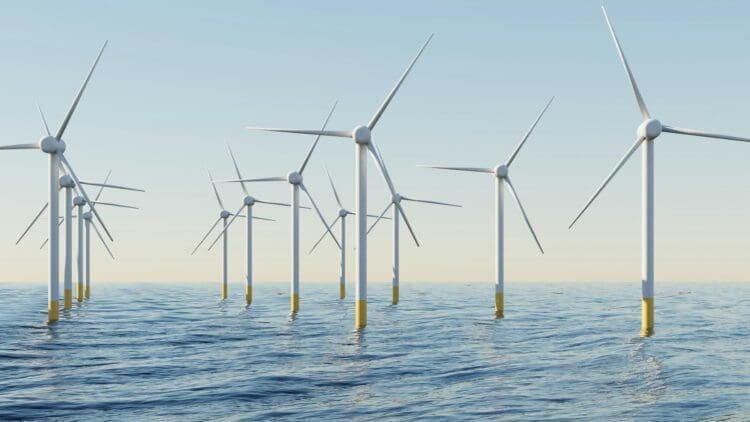

Nearly 19 gigawatts of offshore wind capacity — enough to power every household in the Netherlands. That’s what Ocean Winds brought to WindEurope 2025 in Copenhagen, where the company marked five years since launching as a modest 7 GW joint venture between EDP Renewables and ENGIE.
The anniversary is more than a line on a growth chart. At the industry’s flagship annual gathering, Ocean Winds is signaling that offshore wind — and its own place in it — means something larger than kilowatt-hours.
A joint venture that outgrew its own ambitions
When Ocean Winds launched in 2020, it inherited a 7 GW portfolio from its two founding sponsors. Substantial by industry standards, yes — but it proved to be a floor rather than a ceiling. Five years on, the company oversees nearly 19 GW across 17 projects, a near-tripling that few joint ventures in any sector manage to pull off.


The growth wasn’t simply a matter of absorbing existing assets. Since inception, Ocean Winds secured seven entirely new projects totaling 12 GW — capacity built from scratch rather than inherited. Three projects totaling 1.5 GW are already operational, moving the portfolio from development pipeline to real-world generation. That combination of organic wins and delivered output sets the company apart from ventures that expand on paper but stall at execution.
Each completed project strengthens the case for the next. Each new award adds credibility to future bids. The pattern is one of compounding momentum, and it’s hard to fake.
Four construction sites running simultaneously across Europe
Talking about capacity is one thing. Actually building it — simultaneously, across multiple countries — is another. Ocean Winds is currently running four major offshore construction projects in parallel: Moray West in the United Kingdom, and three French farms — Îles d’Yeu et Noirmoutier, Dieppe-Le Tréport, and EFGL. Together, these sites add roughly 2 GW to the operational fleet.
Managing four large-scale offshore builds at once demands serious logistical coordination, from marine installation windows to supply chain sequencing. That Ocean Winds is doing so without apparent disruption to its development pipeline suggests genuine operational depth — not just commercial reach.
France is emerging as a particularly strategic market. Beyond the three farms under construction, the company was awarded the floating wind project Éoliennes Flottantes d’Occitanie, a sign it’s positioning itself in next-generation offshore technology rather than only proven fixed-bottom installations. Poland adds yet another dimension: the BC Wind project is in its final development phase, and Ocean Winds has selected Crist — a local Polish supplier — to deliver the offshore substation, reflecting a deliberate effort to build domestic supply chains rather than import ready-made solutions.
Reaching beyond Europe: a foothold in Asia-Pacific
The most geographically significant development of the past year may be the least visible from a European vantage point. Ocean Winds was recently awarded the Electricity Business License for its Hanbando project in Incheon, South Korea — a regulatory milestone that opens the door to construction in one of Asia-Pacific’s most active offshore wind markets.
The move marks a meaningful shift in the company’s identity. A developer with assets concentrated in Europe operates within a familiar regulatory and logistical environment. One with a licensed project in South Korea is something different: a genuinely global operator navigating distinct permitting regimes, grid structures, and supply chains. Geographic diversification also reduces exposure to policy cycles in any single market, and as offshore wind demand accelerates across Asia-Pacific, an early foothold carries strategic value that only compounds over time.
“Beyond Energy”: reframing what offshore wind is for
The “Beyond Energy” campaign, launched at WindEurope 2025, is Ocean Winds’ most direct statement yet about how it views its own role. The framing extends beyond electricity generation to address how energy is produced, distributed, and integrated — treating these not as technical functions but as interconnected social responsibilities.
CEO Craig Windram’s public remarks at the event pointed toward generational thinking rather than near-term capacity targets. The language of “ensuring a cleaner, more sustainable future for generations to come” is aimed at a broader audience than project financiers or grid operators — it speaks to industries, communities, and policymakers, the constituencies that ultimately determine whether large-scale offshore infrastructure earns lasting social license.
Whether “Beyond Energy” shifts perceptions as much as it signals intent remains to be seen. But the timing is deliberate. Launched at the industry’s flagship gathering, at the five-year mark, it positions Ocean Winds as a company thinking about what offshore wind is for — not just how much of it can be built.
That question is likely to define the next five years of the industry’s evolution, and Ocean Winds appears intent on helping answer it.