
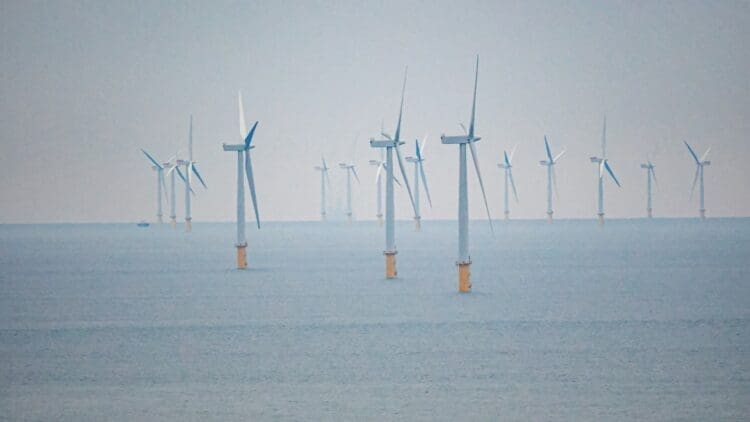

On March 23, 2026, electricity from wind turbines standing 27 miles off Virginia Beach reached the grid for the first time. The moment capped more than a decade of work to build America’s largest offshore wind plant: 176 turbines, roughly 580 miles of undersea cable, and a first-of-its-kind American installation vessel purpose-built for the job.
When Dominion Energy first proposed the project in 2019, the offshore wind industry in U.S. federal waters was largely theoretical. What followed was anything but straightforward.
A bet placed before the industry existed
When Dominion Energy unveiled CVOW in September 2019, the proposal stood apart from anything else in the U.S. market. Rather than partnering with an independent developer, Dominion planned to self-develop, own, and operate 2.6 GW as a regulated, rate-based utility asset. No commercial-scale offshore wind had been built in U.S. federal waters yet. No Jones Act–compliant installation vessel existed either.

The foundation of that bet was a federal lease Dominion had held since November 2013, won at only the second competitive renewable energy lease sale ever held on the Outer Continental Shelf. That 112,800-acre parcel, 27 miles off Virginia Beach, gave the company a head start no competitor could easily replicate.
Two forces were building internal momentum at the same time. Dominion had just announced a net-zero emissions commitment, and its Virginia service territory was absorbing data center load at twice the PJM system-wide growth rate — meaning the economics were shifting in the project’s favor even before state law caught up.
From two turbines to 176: how a pilot shaped a commercial giant
Rather than jump straight to full-scale construction, Dominion built a two-turbine, 12-MW pilot in the same lease area. By June 29, 2020, the pilot was complete, making CVOW the first offshore wind project installed in U.S. federal waters. It produced environmental baseline data, export-cable routing experience, and installation protocols that fed directly into the commercial Construction and Operations Plan Dominion filed with BOEM in December 2020.
State legislation arrived at a critical moment. The Virginia Clean Economy Act, passed in April 2020, established a 5.2-GW offshore wind target, declared utility-owned projects in the 2.5–3 GW range to be in the public interest, and created a regulated cost-recovery pathway under State Corporation Commission oversight. That statutory framework made the full commercial project viable.
Engineering at ocean scale: cables, foundations, and a historic vessel
Each of the 176 Siemens Gamesa SG 14-222 DD turbines carries a 14.7-MW rating and a 222-meter rotor diameter. According to Dominion, a single blade rotation generates enough power to supply one home for a full day.
Connecting those turbines to shore required roughly 231 miles of inter-array cable feeding three offshore substations, plus nine buried export cables totaling 350 miles running to Virginia Beach. The 176 monopile foundations — each exceeding 1,000 tons — were installed by DEME Group’s vessel Orion. BOEM conditions restricted pile driving between November and April to protect North Atlantic right whales, a constraint that shaped the entire construction calendar.
Turbine installation depended on Charybdis, a 472-foot vessel built in Brownsville, Texas — the first U.S.-built, Jones Act–compliant offshore wind turbine installation vessel ever constructed. It was purpose-built to remove a bottleneck that had long complicated offshore wind development in American waters.
Stop-work orders, court injunctions, and a rising price tag
CVOW cleared its full federal permitting stack between September 2023 and April 2024, touching BOEM, the Army Corps of Engineers, and the EPA. It also became the largest project ever to complete the FAST-41 streamlined interagency review program.
On December 22, 2025, the Department of the Interior issued a 90-day stop-work order affecting CVOW and four other East Coast wind projects. Less than a month later, on January 16, 2026, a federal district court granted a preliminary injunction allowing construction to resume, citing risks to grid reliability for military and civilian infrastructure.
The project’s budget grew from an original $8 billion estimate to approximately $11.4 billion. To ease that capital burden without surrendering control, Dominion sold a 50% noncontrolling stake to Stonepeak in 2024 for roughly $2.6 billion.
First power, future scale, and what comes next
Offshore substation #2 was energized on March 23, 2026, delivering wind-generated power to the Virginia grid for the first time. As of June 2026, all 176 foundations were complete and 16 turbines had been installed, with commercial operations targeted for mid-2027.
Dominion projects up to 9.5 TWh of annual output and roughly $5 billion in customer fuel savings over the project’s first decade. In August 2024, Dominion won a BOEM bid for an additional 176,505-acre lease area — renamed CVOW-South — capable of supporting roughly 800 MW of additional development in the 2030s. A planned merger with NextEra Energy, announced in May 2026, could accelerate that expansion. NextEra’s CEO has said CVOW remains on track and called reaching first power a reliable signal that commercial operations will follow.

Carlos is an engineer with strong expertise in technical and industrial topics. He previously worked at international companies such as Siemens and speaks Spanish, German, English, and Italian.