
These cheap solar panels are full of tiny flaws—but they generate almost as much electricity as the expensive ones
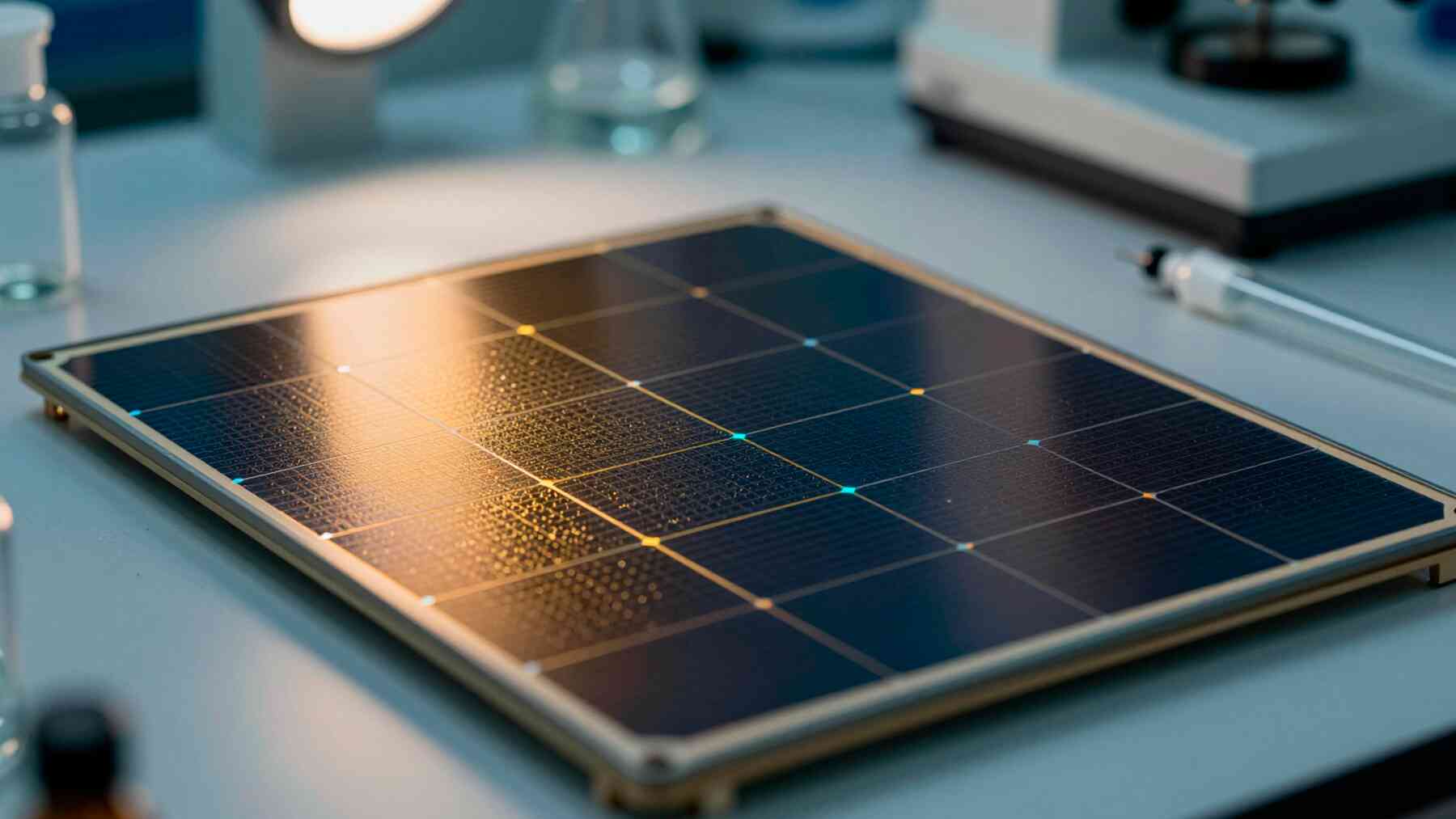
In solar technology, purity has long been non-negotiable. Silicon solar cells — the industry standard for decades — demand near-perfect crystals, painstakingly purified to eliminate defects that would otherwise trap electrical charges and kill efficiency.
Perovskite solar cells break that rule entirely. Made cheaply from solution and riddled with structural imperfections, they have no business performing as well as they do — yet their efficiency is now closing in on silicon’s. For years, researchers couldn’t explain why. Now, a team at the Institute of Science and Technology Austria may finally have an answer, hiding deep inside the crystal itself.
A solar material that breaks the rules
Silicon’s dominance in solar technology rests on one principle: purity. Every defect in a silicon crystal is a potential trap for electrical charges, and trapped charges mean lost energy. Producing silicon wafers suitable for solar cells requires extraordinary refinement — an expensive, energy-intensive process that has shaped the economics of solar power for decades.
They exist deep inside crystals, far beyond the reach of most surface-probing measurement techniques, so confirming their presence required a new approach entirely.
Perovskites take the opposite approach. These lead-halide compounds grow from solution, in a process closer to mixing a liquid than sculpting a crystal. The result is a material riddled with structural imperfections. By silicon’s logic, it shouldn’t work at all.
Yet over the past 15 years, perovskite efficiency has climbed steadily. When researchers first identified their photovoltaic potential in the early 2010s, the numbers were modest. Today they’re approaching silicon-level performance — a trajectory sustained across a fundamentally impure material, which is exactly what made the mystery so persistent and so worth solving.
The charge transport problem at the heart of solar cells
Every solar cell performs the same basic task: absorb light, generate electrical charges, and deliver those charges to electrodes before they disappear. The charges in question are electrons — negatively charged — and “holes,” their positively charged counterparts. Keeping them separated long enough to do useful work is the central challenge.
In perovskites, the odds seem stacked against this. When an electron and a hole form a bound pair — called an exciton — they tend to recombine quickly, releasing energy as heat rather than electricity. Yet experiments have consistently shown that charges remain separated far longer than they should, traveling hundreds of microns through the material without being trapped. No one had a convincing explanation for why.
Internal forces pulling charges apart
To crack the problem, ISTA researchers Dmytro Rak and Zhanybek Alpichshev proposed something counterintuitive: that internal electric forces inside perovskite crystals actively pull electrons and holes apart, preventing recombination.
They tested this using nonlinear optical techniques to inject charges deep inside the material — well away from the surface. What they observed was consistent and clear: an electrical current flowing in the same direction every time, with no external voltage applied. The material itself was doing the separating.
Critically, this behavior appeared even in unmodified, as-grown crystals — not an artifact of processing or surface chemistry. The team proposed that these separating forces concentrate at specific structural boundaries called domain walls, regions where the crystal’s internal arrangement shifts slightly.
Making the invisible visible: silver ions as crystal detectives
Domain walls posed an immediate practical problem. They exist deep inside crystals, far beyond the reach of most surface-probing measurement techniques, so confirming their presence required a new approach entirely.
Rak drew on his chemistry background to develop one. Since perovskites can conduct ions, he introduced silver ions into the material. Those ions migrated naturally through the crystal and accumulated along the domain walls, drawn by the same structural features the team was trying to locate. Once in place, the ions were converted into metallic silver, and under a microscope, the hidden network became visible for the first time. Alpichshev compared the technique to angiography in living tissue — revealing internal structure without disturbing it.
Defect highways and what they mean for solar technology
What the imaging revealed was striking. Domain walls don’t appear as isolated features. They form a dense, interconnected network running throughout the perovskite material — extensive enough in coverage to explain a great deal.
When a charge pair forms near a domain wall, the local electric field acts immediately, pulling the electron and the hole to opposite sides before they can recombine. Once separated, each charge can drift along the wall over what Rak describes as “eons on a charge carrier’s timescale,” traveling long distances and ultimately contributing to usable electricity.
These domain walls are the highways. The defects that should have been liabilities are instead the infrastructure that makes the whole system work.
The implications reach beyond explanation. Most efforts to improve perovskite solar cells have focused on adjusting chemical composition, but this research points to a different lever entirely: engineering the internal structure directly, shaping the domain wall network to optimize charge transport. That path could push efficiency higher while preserving the low-cost, solution-based production that makes perovskites attractive in the first place.
Disclaimer: Our coverage of events affecting companies or institutions is purely informative and descriptive. Under no circumstances does it seek to promote an opinion or create a trend, nor can it be taken as investment advice or a recommendation of any kind.

Carlos is an engineer with strong expertise in technical and industrial topics. He previously worked at international companies such as Siemens and is multilingual.
