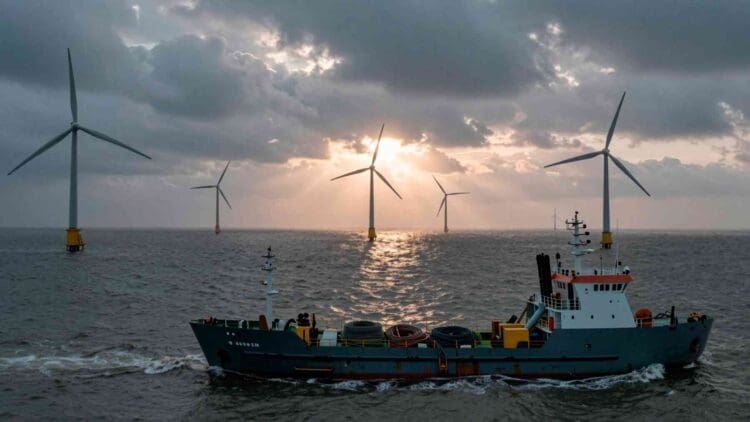

Offshore wind market conditions have remained subdued through the second quarter of 2026, even as energy security concerns pushed renewables higher on political agendas in the UK, France, Germany, and beyond. TGS | 4C’s newly released Q2 2026 Global Market Overview captures that tension: near-term forecasts have been trimmed, yet the long-term outlook is quietly strengthening as governments accelerate clean energy ambitions to reduce dependence on imported fuel.
Q2 2026 offshore wind market remains subdued, report finds
TGS | 4C’s Q2 2026 Global Market Overview for Offshore Wind delivers a clear headline: market indicators stayed subdued across the quarter. No auctions were awarded during Q2, making it a quiet period for new contract activity. Two notable setbacks defined the period — France’s AO9 auction was delayed, and Estonia’s Saare 3 auction failed to proceed.
Commissioning activity outside China was modest. Just 518 MW came online in non-Chinese markets, while China added 1.1 GW over the same period, bringing global operational offshore wind capacity to 91.5 GW. Total 2026 commissioning is expected to reach around 15 GW by year-end—the second highest annual figure on record—which means the pace will need to accelerate considerably through the back half of the year.


Geopolitical pressures and supply chain costs drive short-term challenges
External shocks shaped much of the quarter. The closure of the Strait of Hormuz contributed to a 34.6% year-on-year rise in diesel prices, a direct cost pressure on offshore wind construction and logistics. Hot-rolled coil steel prices climbed 37% year-on-year; copper rose 35% over the same period.
US tariffs compounded the picture. Alongside geopolitical instability, they are adding both risk and inflationary pressure to projects at a time when bankability is already difficult to establish—and those combined forces have driven auction and project timing delays that are now showing up in revised capacity forecasts.
The 2030 non-China offshore wind capacity forecast has been cut from 133 GW to 119 GW, an 11% drop year-on-year and a 2 GW reduction since last quarter. The broader trajectory is also sobering: 2040 expectations are down 15% from Q2 2025 and 26% from Q2 2024, reflecting the scale of market recalibration that has accumulated over recent years.
Energy security push lifts long-term outlook despite near-term forecast cuts
The political backdrop is shifting in the sector’s favor, even as near-term numbers have been trimmed. The UK, France, and Germany have each accelerated their renewable energy ambitions, driven by a shared desire to reduce reliance on imported energy. The conflict involving Iran and the associated disruption in the Strait of Hormuz have pushed energy security to the top of political agendas across key markets.
Ivar Slengesol, Managing Director and VP at TGS | 4C, noted that while the impact on short-term offshore wind indicators is not yet visible, “the industry can look forward to political boosts in key markets going forward.” That view is reflected in the report’s structure: 2030 forecasts have been modestly reduced, but 2040 expectations have been modestly adjusted upward relative to the sharp 2030 cuts, though they remain significantly lower than previous years’ historical outlooks due to recent macro-recalibrations.
The full-year 2026 Final Investment Decision forecast stands at 8.8 GW, reflecting a backlog of projects delayed during the difficult 2022–2024 cycle now progressing toward commitment. Jordan May, Senior Analyst at TGS | 4C, pointed to nine ongoing auctions and another fifteen due to start before the end of the year as evidence that global activity remains substantial, even under strained conditions.
Key project and permitting milestones recorded in Q2 2026
The permitting picture offered some concrete progress. Three UK projects secured planning consent during Q2, including the 2×1.5 GW Dogger Bank South and North Falls, which received consent for 504 MW. TGS | 4C forecasts 20 GW of projects will receive consent across all of 2026, with Europe leading at 18.6 GW.
On the investment side, 518 MW of final investment decisions were made in Q2—entirely in the Asia-Pacific region. South Korea accounted for 390 MW, and Vietnam contributed 128 MW. The UK’s Allocation Round 6 projects pushing toward FID, alongside Allocation Round 7 awarding new contracts, were cited as highlights, were cited as highlights from the broader first half of the year.
Floating wind outlook and market attractiveness updated
This edition of the quarterly report includes a biannual floating wind deep dive. TGS | 4C revised its floating wind outlook downward, now expecting 3.1 GW to begin installation activities by 2030—equivalent to approximately 253 turbines—with average turbine power in the floating segment forecast at around 17 MW by that point.
The UK holds the top position in TGS | 4C’s updated Floating Wind Market Attractiveness Index, followed by France and Japan. The report flags a growing divide between the most and least attractive markets globally, driven by varying policy frameworks, grid infrastructure, and supply chain readiness.
The Q2 2026 report’s core findings are these: near-term offshore wind delivery faces real headwinds from commodity inflation, geopolitical disruption, and auction delays, with the 2030 non-China capacity forecast now sitting at 119 GW. Commissioning remains on track for a near-record year, permitting activity is advancing across Europe, and energy security concerns are generating political momentum that analysts expect to translate into concrete market support in the years ahead. The floating wind segment faces its own recalibration—but the UK, France, and Japan remain clear leaders in attractiveness for developers watching that space.
Kelly is an experienced writer with 15 years of experience exploring the big stories that shape our world, from tech breakthroughs and space exploration to climate, energy, and the fascinating quirks of science. She has a talent for turning complex ideas into sharp, memorable insights that stay with readers long after they’ve finished reading.