
Filipino researchers are generating electricity from the part of a pineapple nobody eats, and they may soon make enough to power an entire factory
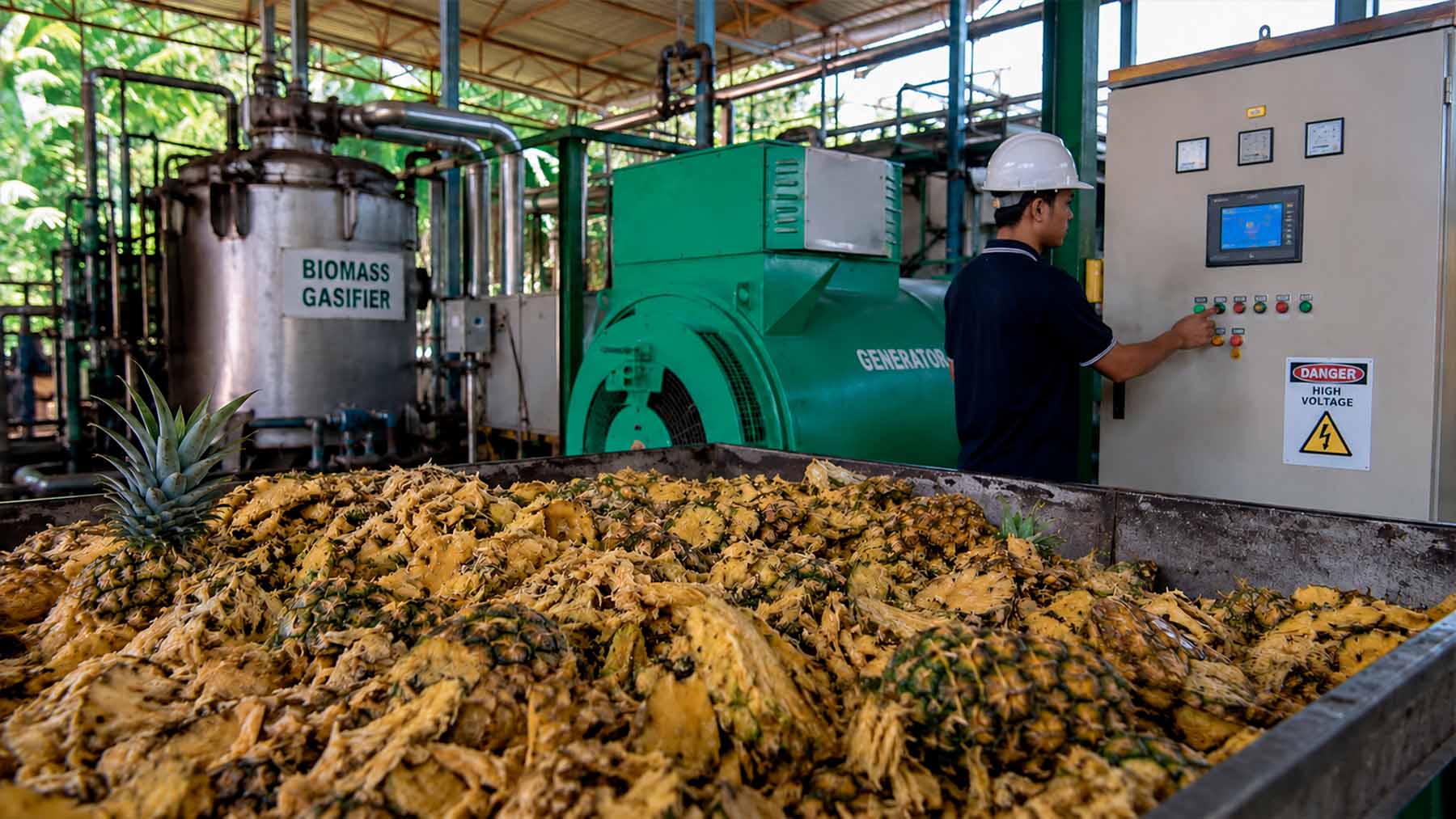 Image generated with artificial intelligence
A Filipino factory is decarbonizing its footprint by repurposing pineapple waste into clean electricity.
Worldwide, industrial manufacturing remains inherently carbon-intensive, especially in agricultural regions.
Unused agricultural crop and food processing waste are heavy contributors to global greenhouse gas emissions.
The Pineapples to Power project’s goal is to convert organic fruit waste into carbon-neutral electricity while boosting local technical expertise.
In the Philippines, this issue is being addressed by repurposing discarded pineapple parts to power entire factories.
Will this method finally help industrial agriculture shift toward a more circular economy model?
How agricultural manufacturing struggles to decarbonize
Nations are mandated to reduce their carbon footprints under strict global climate regulations.
Despite major strides in replacing fossil fuels with renewable energy sources, carbon emissions remain high.
This is due to certain sectors that are hard to abate, as they are heavily reliant on fossil fuel combustion.
Industrial and agricultural manufacturing are key examples of this.
Industrial manufacturing is responsible for nearly 30% of the world’s greenhouse gas emissions.
When this sector is paired with food processing, supply chains contribute up to 18% of total agricultural emissions.
These emissions result from high-capacity thermal energy needed for boilers, canning equipment, and dryers.
Furthermore, agro-processing requires continuous electricity to maintain heavy machinery, refrigeration, and cook produce.
In agricultural regions, grids mostly depend on imported diesel and heavy fuel oil.
Beyond the continued reliance on carbon-heavy fuels to maintain operations, untreated agricultural waste creates additional environmental issues.
The risks of accumulating agricultural waste
Untreated food waste left to decompose in fields and open dumping sites creates hazardous risks.
This includes agricultural scraps like peels, leaves, and organic fruit pulp.
When they decay without oxygen, high volumes of methane are released directly into the atmosphere.
This greenhouse gas is significantly more potent than carbon dioxide.
Within its first 20 years in the atmosphere, the gas traps over 80 times more heat than carbon dioxide.
Methane emissions thus accelerate short-term global warming faster.
Presently, this waste is responsible for almost 8% of all human-caused greenhouse gas emissions worldwide.
Furthermore, untreated organic refuse leaks acidic effluents into local soils and groundwater systems.
This is why it is vital to capture decomposing agricultural waste before it decays.
AHK Philippinen decided to address this issue by coordinating the three-year “Pineapples to Power” project.
Local Philippine partners were connected with German technology providers to develop and maintain the industrial-scale plant.
Producing clean electricity with pineapple waste
What is usually seen as trash is another’s treasure.
The Pineapples to Power project’s goal is to convert organic fruit waste into carbon-neutral electricity while boosting local technical expertise.
The Global Environment Center Foundation is the Japanese government side handling financial subsidy administration, carbon credit verification, and JCM accreditation.
The initiative was founded in South Cotabato, Philippines, across two major processing facilities in Surallah and Polomolok.
The plants process agricultural waste produced by Dole Philippines.
Converting with industrial-scale anaerobic digestion technology
Discarded pineapple crowns, peels, and pulp are routinely collected from processing lines.
These residues are loaded into specialized steel digester tanks.
The tanks are sealed and oxygen-free. Inside, bacteria break down the fruit matter.
The resulting methane gas is captured, conditioned, and channeled into gas engines and industrial boilers.
The methane is burned to generate 5.7 MW of clean electricity, chilled water, and high-pressure steam.
The electricity is then used to power the canning operations directly.
Today, both facilities in South Cotabato are fully operational and continue to generate biogas.
By using pineapple methane instead of fossil fuels, the plants significantly lowered their carbon footprints.
Nearly 50,000 metric tons of greenhouse gas emissions are avoided annually.
The initiative proved that agricultural crop waste can power heavy industry.
Ultimately, these waste-to-energy systems in farming regions are becoming essential in achieving a circular economy.
Anke Maree is a writer with a clear and engaging editorial style. Her work focuses on making complex topics accessible, informative, and relevant for readers across different areas of interest.
