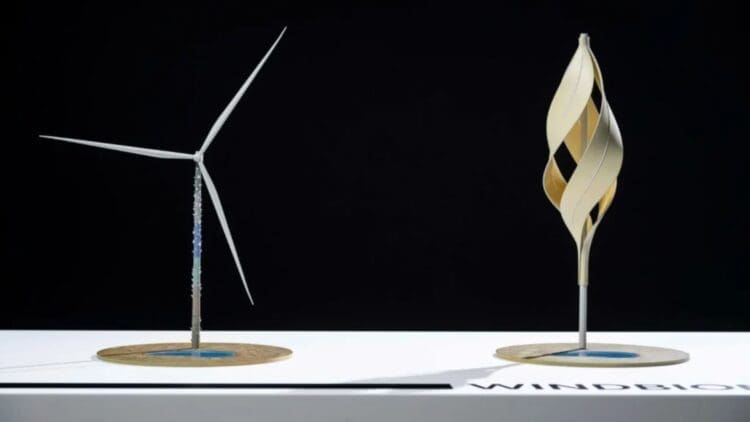

A bio-inspired wind turbine has been created to harness energy and water.
As global power demand continues to rise, the deployment of large-scale wind infrastructure is becoming vital.
However, community resistance due to the stark physical footprint is growing worldwide. These high tensions have inspired engineers to develop innovative designs that are more socially acceptable, like this tulip.

Will locals be more receptive to the dual-purpose golden “tulip” turbine as an ecological asset?
How wind power is rising to the occasion
The swift advancement of smart technology has intensified the global reliance on clean energy.
High-tech transformation alongside industrialization has boosted the world’s energy needs. Annual consumption is now more than 28,000 TWh.
This massive usage requires exceptional volumes of green infrastructure. At the top of this transition is wind power.
The world’s wind capacity has increased exponentially to meet this demand.
Current global wind generation now exceeds 2,300 TWh.
However, there is still a significant energy gap to bridge.
Wind power is among the most affordable and scalable in the renewable energy sector.
This is why utilities are constructing bigger farms. Taller towers and longer blades can capture higher-velocity winds at greater heights.
Unfortunately, plans to scale up conventional infrastructure are facing significant opposition from local communities.
Several critical wind projects are being stalled as widespread resistance grows.
Community pushback is slowing the clean energy transition
The visual and physical footprint of traditional turbines is the primary source of friction.
Utility-scale wind farms are becoming more common to maximize efficiency. Sadly, pristine natural terrains, vast skylines, and coastal views often pay the price.
This stark visual intrusion leads to landscape degradation. Communities often argue that this erases the character and heritage of the local environment.
Many are also becoming vocal about the tangible disruptions to daily life and local ecosystems.
Low-frequency noise from turbine blades impacts the quality of life for nearby residents. These vibrations also alter regional wildlife migratory pathways.
Construction and transportation further disrupt the peace of locals and wildlife.
These factors have raised public concerns over biodiversity conservation.
One of the world’s largest renewable energy operators, the Enel Group, sympathizes with these apprehensions.
The group is a driver of the “Social Acceptance” movement. A report from Enel Group details the innovative concepts designed to fix this rift.
Harmonizing wind technology with the natural environment
Hope Engineering has developed dual-concept designs that form part of the Enel Group’s supported breakthroughs.
The designs are known as WindBioma and WindBloom. Hope Engineering used a bio-inspired approach to reimagine wind infrastructure that blends seamlessly into its environment.
WindBioma tackles visual impact issues
Smart, reflective mirroring surfaces are added to the vertical structure.
The specialized cladding materials adapt to changing natural light and landscapes. This effectively camouflages the installation with its surroundings.
It can also convert existing wind farms into bio-integrated educational landmarks in a non-disruptive way.
WindBloom’s “living” silhouette mimics natural flora
It utilizes flexible golden membranes shaped like flower petals to create a vertical-axis design. These surfaces change shape based on wind intensity.
The specialized petals are engineered to capture rainwater and nighttime condensation from the air.
The water is channeled down the structure to support local wildlife and micro-ecosystems.
It proves green infrastructure can nurture biodiversity.
These two innovative turbine concepts prove that renewable energy systems can be designed in a socially acceptable way.
Utility-scale renewable expansions no longer have to come at the expense of local ecosystems.
By embracing bio-inspired architecture such as the “golden tulip,” developers can overcome community concerns.
This way, the global energy transition can move forward without resistance. These designs can pave the way toward a more sustainable, widely accepted future.