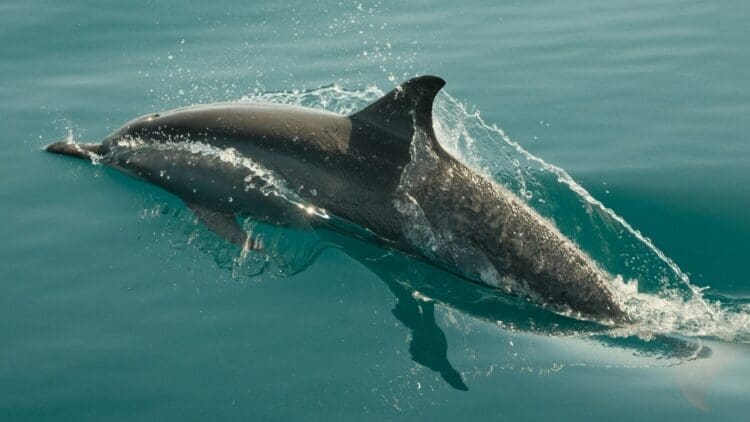

Every day, harbor porpoises cross above the cables threading along the North Sea floor — cables that silently radiate electromagnetic fields into the surrounding water. It happens thousands of times, largely unnoticed and almost entirely unstudied.
Now, for the first time, researchers are asking a question that offshore wind expansion may no longer afford to ignore: can these animals actually sense those fields — and if so, what do they do about it?
A knowledge gap hiding in plain sight
Offshore wind farms depend on subsea cables to move electricity from turbines to shore. Those cables, like any electrical infrastructure, continuously emit electromagnetic fields into the surrounding water. Yet while the industry has spent years studying how underwater noise from construction and operation affects marine life, the question of EMF exposure has remained almost entirely unexamined.




That gap matters most for species like the harbor porpoise. Protected under European law, ecologically significant, and among the most abundant marine mammals in the North Sea, porpoises encounter subsea cables on a daily basis. With North Sea nations targeting 100 gigawatts of offshore wind capacity by 2040, the scale of that exposure is only set to grow — making the absence of reliable data increasingly difficult to justify.
What sparked the EMPACT project
The immediate catalyst came from research on a different species. German studies on bottlenose dolphins demonstrated clearly that cetaceans can detect electric fields — a finding that prompted researchers to ask whether harbor porpoises share that ability. The question was scientifically straightforward, but the tools and experimental frameworks to answer it rigorously had only recently become available.
“The most robust experimental studies in this area have only emerged within the last five years,” says Adam Smith, a researcher at the University of Southern Denmark.
In 2024, Vattenfall partnered with the University of Southern Denmark and Sweden’s Royal Institute of Technology to launch EMPACT — a project designed to determine whether porpoises detect EMF and, if so, at what exposure levels their behavior begins to shift. Marine biology, electrical engineering, and field ecology were brought together under a single research umbrella.
Three animals, three completely different reactions
The project’s first phase drew on existing data collected from wild porpoises fitted with small, non-invasive electronic tags attached temporarily using suction cups. Those tags tracked movement, diving behavior, and electromagnetic field exposure as the animals moved through their natural environment — including across subsea cables.
The results were notable, but they raised as many questions as they answered.
“When we looked at the studies, we found three completely different behavioural responses when an animal was above a cable,” says Joanna Sarnocinska-Kot, a bioscience expert at Vattenfall. One animal showed no detectable change in swimming or hunting behavior whatsoever. A second surfaced as it crossed the cable and stopped feeding entirely. A third dove toward the seabed and fed almost continuously while tracking the cable’s path.
Three animals. Three outcomes with almost nothing in common. That inconsistency could reflect individual variation in sensitivity, differences in behavioral context, or both — each possibility carrying its own scientific and conservation implications. For the research team, the divergence wasn’t a setback. It was the reason to dig deeper.
Trained porpoises and positive reinforcement science
Phase two, launched in 2025, moved the investigation into a controlled setting. Researchers began working with trained harbor porpoises at Fjord&Bælt Science Education Centre, a research and public outreach institution on Funen Island in Denmark. All studies there use positive reinforcement exclusively — no coercion of any kind.
The controlled environment allows researchers to expose porpoises to precisely calibrated EMF levels and observe behavioral changes in response. The goal is to identify response thresholds: the specific field intensities at which behavioral shifts begin to occur. That level of precision simply isn’t achievable in open-water field studies, where too many variables interact at once. Once threshold values are established, they can be compared directly against EMF output measured from real subsea cables — building a predictive picture of how wild populations may respond across different wind farm configurations.
What the findings could mean for wind farm design
Final results from EMPACT are expected in 2027. If the data supports clear behavioral thresholds, the implications for infrastructure planning could be substantial — potentially influencing how cables are routed, buried, or shielded in future wind farm developments.
The research sits within Vattenfall’s broader BioWinS programme — Biodiversity protection in Wind and Solar — an internal R&D initiative spanning more than 60 collaborative projects aimed at understanding and reducing wind and solar energy’s impacts on nature.
Sarnocinska-Kot is careful about the sequence of steps still required. “To do this, we need to understand the EMF levels generated by subsea cables, the levels to which animals are exposed, and how they respond to them,” she says. All three pieces must be in place before any design recommendations can responsibly follow. By 2027, EMPACT aims to have all three.