
In Ivory Coast, cocoa processors keep the chocolate and want to burn the leftover husks in a power plant designed to provide electricity for 1.4 million people
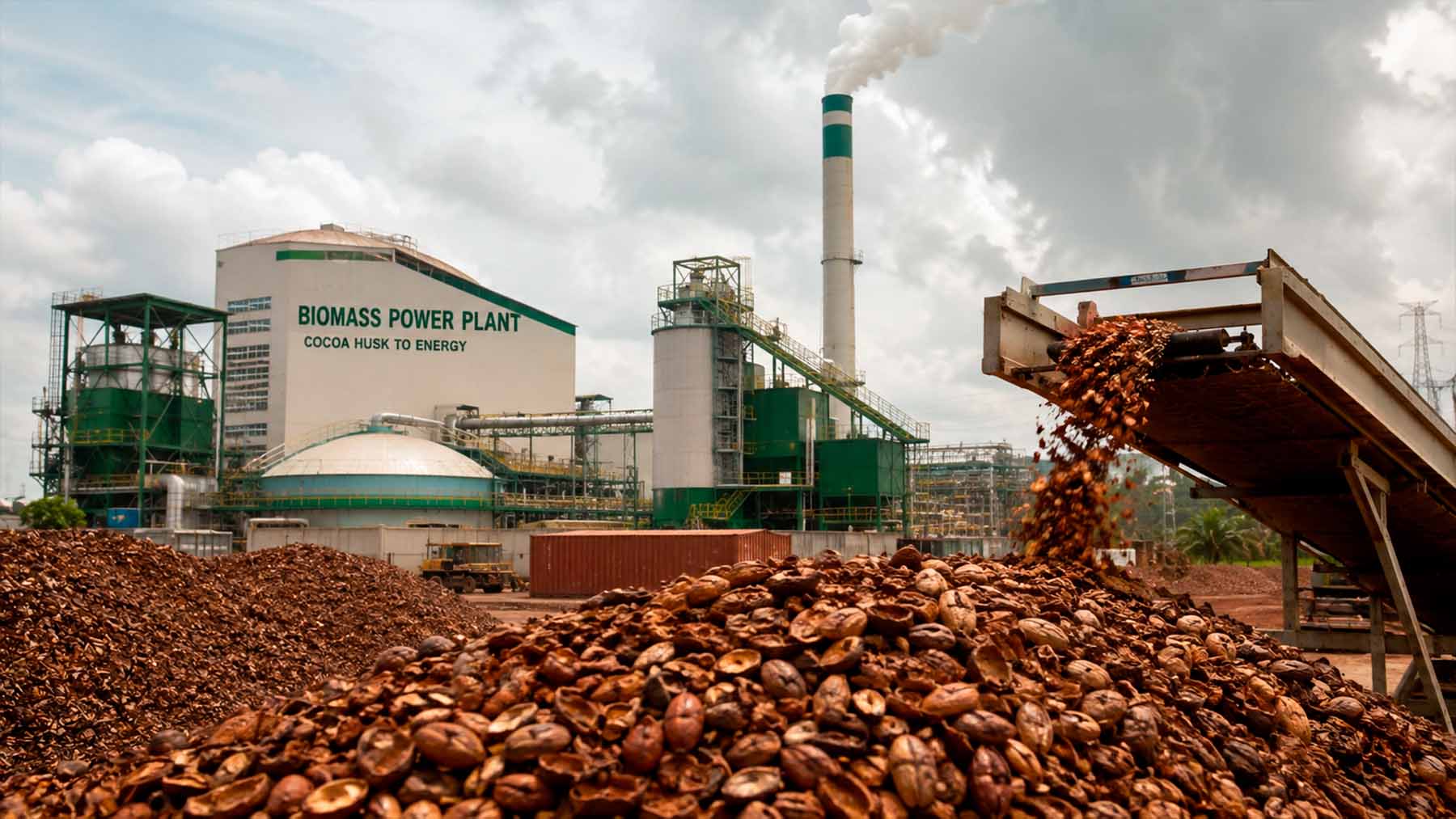 Image generated with artificial intelligence
Ivory Coast processors are addressing agricultural waste issues by burning cocoa husks.
Worldwide, various sectors are under pressure to reduce emissions while expanding access to localized clean energy.
The agricultural sector is a prime example, as heavy crop production annually results in millions of tons of organic waste.
As extreme conditions become more frequent and volatile, all living beings must learn to adapt or die – literally and figuratively.
Instead of letting it decompose and emit greenhouse gases, there is a circular solution.
Will the Ivory Coast approach prove that waste can supply useful renewable power?
How global sectors face mounting decarbonization pressures
Globally, nations are facing the effects of accelerated climate change.
This change is occurring at a faster rate due to the doubled energy imbalance.
Fossil fuels still supply the majority of the world’s power consumption.
As these carbon-intensive fuels are burned, record-high greenhouse gas emissions are released.
Consequently, more heat is trapped in the atmosphere, significantly raising global warming past historical rates.
This triggers immense atmospheric shifts that affect the predictability of weather events.
As extreme conditions become more frequent and volatile, all living beings must learn to adapt or die – literally and figuratively.
Global industrial and energy sectors produce over 70% of greenhouse gas emissions worldwide.
This has driven international pressure to eliminate the reliance on fossil fuels.
However, growing economies need reliable electricity, raising global energy demands.
With demand expected to increase by almost 20% over ten years, these sectors must transition to carbon-free alternatives.
Crop-heavy nations are facing major emissions
The agricultural sector, in particular, faces immense pressure to decarbonize.
The sector accounts for approximately 30% of human-caused emissions worldwide.
This is driven by crop harvesting and processing that generate billions of tons of organic waste annually.
This unmanaged organic waste usually decomposes in open fields. As a result, a potent pollutant, methane, is released into the atmosphere.
Methane is 80 times more destructive than carbon dioxide over 20 years.
This has become a major environmental issue in agricultural hubs like the Ivory Coast in West Africa.
The Ivory Coast is the global leading cocoa producer.
During annual harvests, millions of tons of organic residues are generated.
Over 13 tons of waste are left behind for every tonne of cocoa beans harvested.
But one sector’s waste can become a nation’s green treasure.
Leftover husks and bean shells can be burned to provide clean electricity.
Climate Fund Managers invested $3 million in the method’s development.
A power plant that burns cocoa and other crop waste
Rural communities are actively reconciling agriculture and clean energy production.
In Divo, a massive cocoa-producing region in the Ivory Coast, there is an industrial-scale cocoa biomass plant.
The 76 MW facility operates as a public-private partnership between Climate Fund Managers and Société Des Energies Nouvelles.
Converting agricultural waste into green power
Each year, 600,000 tons of agricultural waste will be converted into clean electricity.
The primary feedstock will consist of cocoa bean shells, pod husks, and end-of-life rubber trees.
The facility burns the waste inside specialized boilers, producing high-pressure steam.
The steam will spin heavy turbines to generate 550 GWh of uninterrupted baseload power annually.
The power plant will be directly connected to the Ivory Coast’s national grid.
The goal is to reach operational status by 2029.
Once completed, the plant will supply clean electricity to 1.4 million people.
Additionally, 300,000 tons of carbon emissions will be eliminated each year.
Using agricultural waste as biomass to produce clean power holds additional socio-economic benefits in store for rural communities.
By selling unused pod husks to the Divo project, 36,000 local farmers can receive additional income.
The project will also create more than 3,900 jobs, of which 440 will be permanent roles.
Furthermore, the regional economy will benefit from roughly $7.4 million annually.
Ultimately, scaling decentralized biomass systems addresses agricultural waste and high energy demands.
Anke Maree is a writer with a clear and engaging editorial style. Her work focuses on making complex topics accessible, informative, and relevant for readers across different areas of interest.
