
Kathairos Solutions reaches one million metric tons of CO₂e eliminated using liquid nitrogen pneumatic systems across North America
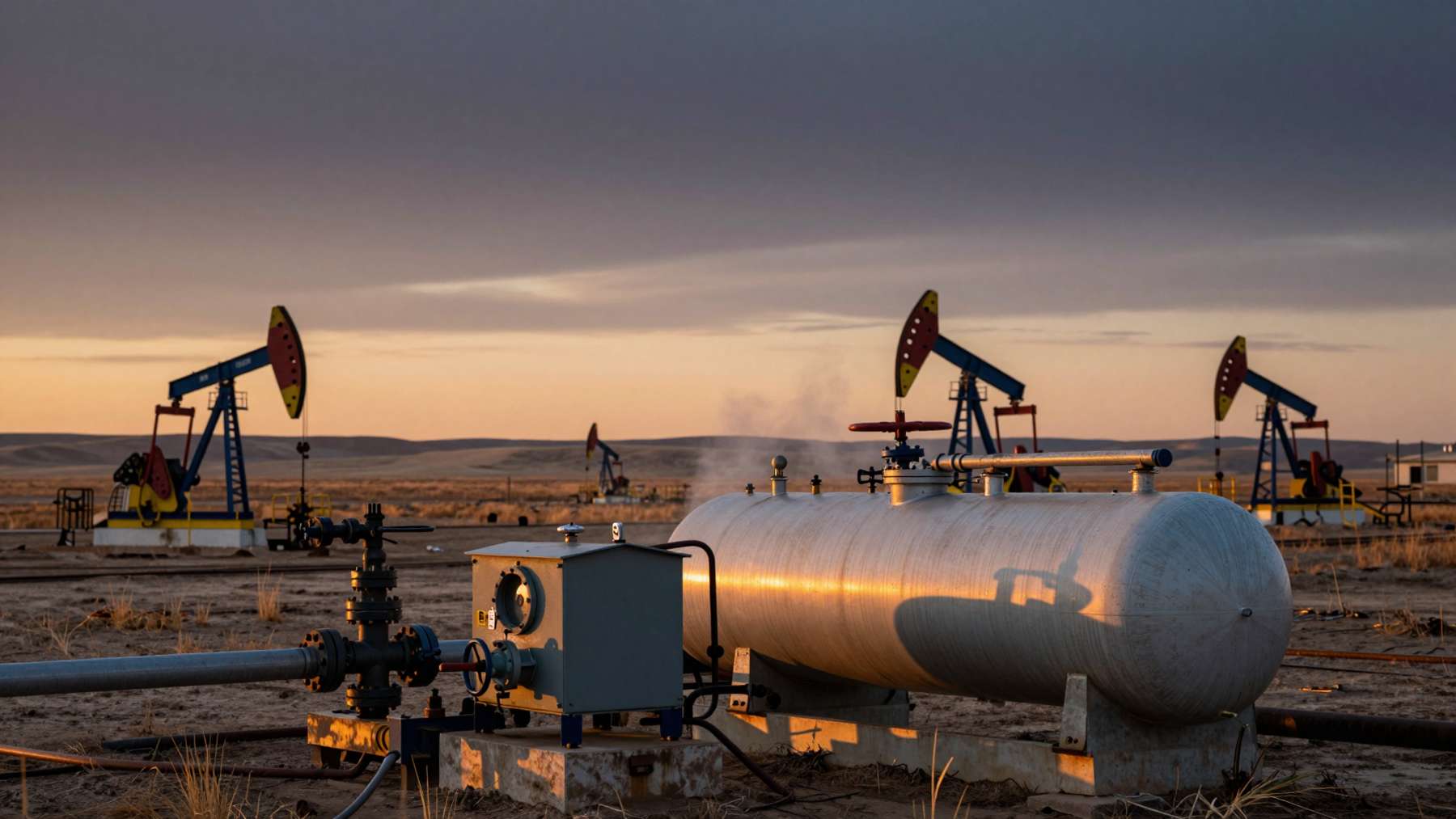 AI-made
Kathairos Solutions announced on June 1 that its liquid nitrogen pneumatic systems have cumulatively eliminated one million metric tons of CO₂ equivalent from oil and gas operations across North America. The Calgary-based company now has 3,000 systems deployed at sites operated by more than 70 companies — eliminating roughly 1,250 metric tons of CO₂e every day.
The milestone traces back to a single liquid nitrogen tank in the field. What began as a niche alternative to methane-powered pneumatic devices has quietly scaled into one of the more measurable methane-reduction efforts in the North American oil and gas sector.
Kathairos Announces One-Million-Ton Milestone
The June 1, 2026 announcement marks a threshold that few methane-reduction efforts have reached. Kathairos Solutions confirmed that its 3,000 deployed liquid nitrogen systems have collectively crossed one million metric tons of CO₂ equivalent eliminated across North American oil and gas operations.
She confirmed that Alberta’s government provided TIER funding through Emissions Reduction Alberta in 2024 to support the technology’s development.
More than 70 upstream and midstream operators now use the technology. The company eliminates approximately 1,250 tCO₂e per day — a rate that, by its own account, exceeds what many companies or technologies report eliminating in an entire year.
How Nitrogen Replaces Methane in Pneumatic Systems
Oil and gas facilities have long relied on natural gas — primarily methane — to power pneumatic controllers and actuators. These devices regulate valves and other equipment across upstream and midstream sites, and the process routinely vents methane directly into the atmosphere.
Kathairos replaces that methane with liquid nitrogen, an inert gas carrying no greenhouse warming potential. The system requires no external power and has no moving parts. Operators face no capital outlay to adopt it, a factor the company credits as central to its adoption at scale.
Pneumatic venting occurs at hundreds of thousands of facilities across North America. Historically, it has been one of the most persistent and widespread sources of methane emissions in the sector — and among the harder problems to address at any meaningful scale.
Climate Significance of the Methane Reduction
Methane is more than 80 times more potent than CO₂ over a 20-year horizon. Kathairos calculates its reductions using a conservative Global Warming Potential ratio of 28:1, which means the reported figures likely understate the near-term climate benefit.
At current daily elimination rates, the company says the impact is equivalent to planting more than 20,000 trees per day. Every reduction is described as direct, attributable, and independently verifiable — a distinction Kathairos emphasizes to separate its results from estimated or modeled figures.
Industry and Government Responses to the Milestone
Alberta Premier Danielle Smith issued a congratulatory statement, noting that Kathairos aligns with the province’s commitment to achieving a carbon-neutral economy by 2050. She confirmed that Alberta’s government provided TIER funding through Emissions Reduction Alberta in 2024 to support the technology’s development.
Alberta’s Minister of Environment and Protected Areas, Grant Hunter, pointed to the province’s Technology Innovation and Emissions Reduction system as a mechanism for giving industry the certainty needed to invest in solutions like Kathairos.
Industry associations in the United States also responded. Marcellus Shale Coalition president Jim Welty praised the milestone and noted that Pennsylvania’s natural gas industry holds the lowest methane intensity of any major producing basin in the country. Missi Currier, president and CEO of the New Mexico Oil and Gas Association, called the result “an impactful” example of practical, scalable deployment across the basins. The Clean Resource Innovation Network noted its prior support for Kathairos, describing the milestone as evidence of Canadian cleantech moving “from innovation to measurable impact.”
Background: Kathairos and the Scale of Pneumatic Venting
Dick Brown founded Kathairos in 2020 on the premise that the oil and gas industry would address pneumatic venting if a practical, affordable solution existed. The company completed its first commercial deployment in 2022 and now operates across sites ranging from the Montney basin in western Canada to the Permian Basin in the southwestern United States.
Central to its offering is Atlas, an operator-facing data platform. Every Kathairos system transmits hourly, site-level data to Atlas, giving operators real-time visibility into exactly how much methane their sites are eliminating — converting methane reduction from a compliance exercise into a quantifiable operational metric.
Pneumatic venting remains a challenge at hundreds of thousands of facilities across the continent. Kathairos’s milestone suggests that addressing it at infrastructure scale is achievable — not through a single large project, but through thousands of individual site conversions accumulating into a measurable aggregate result. With 3,000 systems active and a daily elimination rate still climbing, the company describes the one-million-ton figure as a starting point, not a ceiling.

Carlos is an engineer with strong expertise in technical and industrial topics. He previously worked at international companies such as Siemens and is multilingual.
