
A giant kite rose above a Dutch highway construction site and used its tether to charge the vehicles and electrical equipment working below
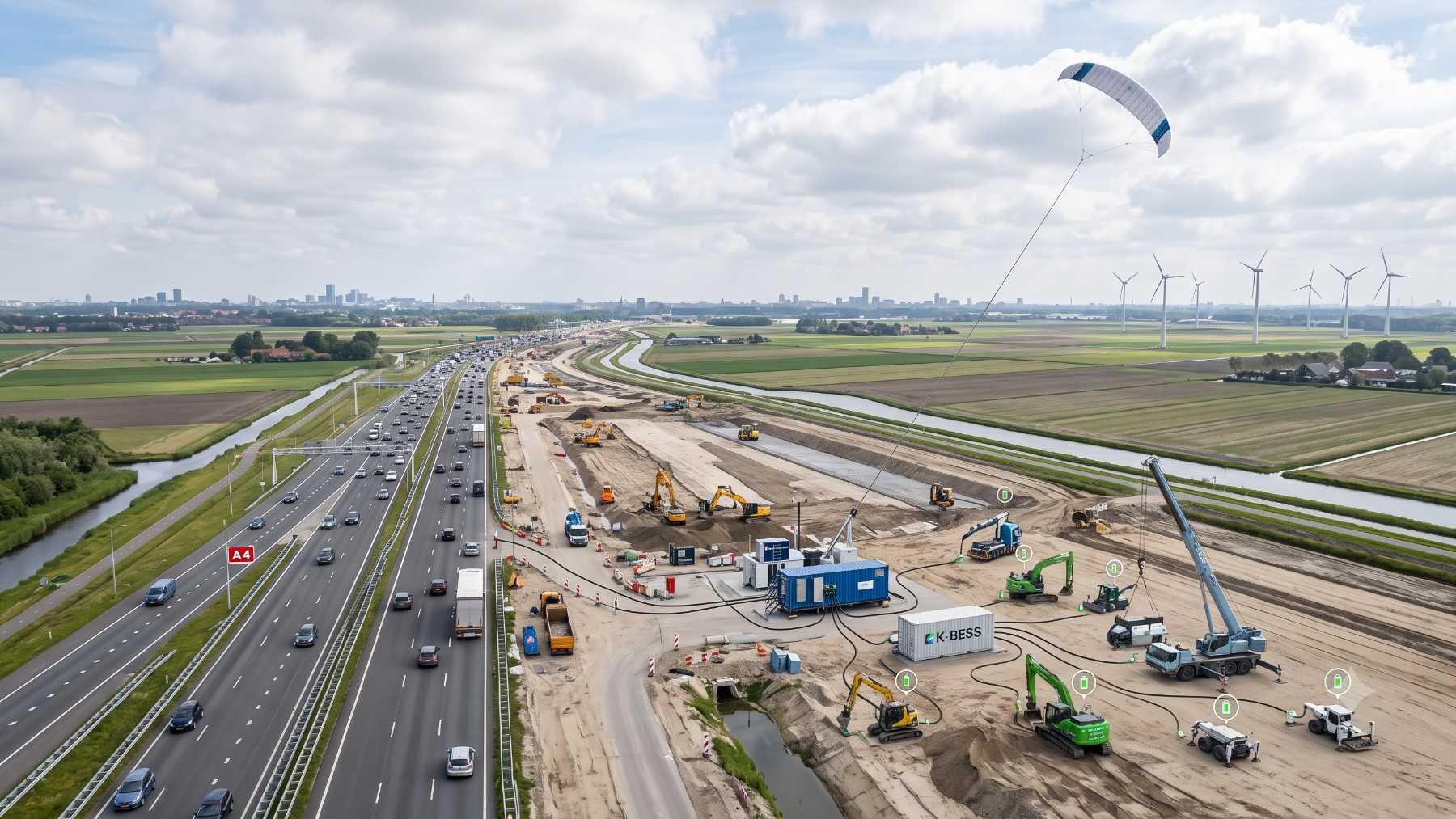 Image generated with artificial intelligence
A Dutch construction site overcame grid congestion issues using a giant kite for alternative power.
Globally, electric grids are under immense strain as modern economies require vast amounts of high-capacity electricity.
This leads to significant challenges for remote or temporary job sites that require provisional utility connections.
Her work focuses on making complex topics accessible, informative, and relevant for readers across different areas of interest.
Traditionally, these sites rely on carbon-intensive diesel generators to continue operations.
Will the innovative Dutch technology prove to be a viable clean energy solution?
How modernization has triggered significant grid congestion
The global shift away from fossil fuels toward electricity is meant to advance society.
Instead, this major transition of modern economies has created more complexities.
Digitization and industrial transformation are central to this electric change.
Manufacturing becomes more advanced, and AI and data centers are rapidly expanding.
Consequently, the new infrastructure requires unprecedented volumes of continuous electricity.
Altogether, the world’s energy consumption is being pushed to historical highs.
Global utility networks are aging and cannot handle this sudden surge in demand.
Traditional grids were designed for predictable electricity production from centralized fossil fuel plants.
Now, power loads are high in volume and fluctuating, straining existing infrastructure.
While it is possible to expand, the process requires complex permitting, substantial capital, and years of construction.
As a result, capacity bottlenecks and growing backlogs increase, triggering widespread grid congestion.
This significantly slows provisional power connections, creating challenges for temporary and remote projects.
The environmental toll of confined construction sites
There are several densely populated, space-constrained nations worldwide.
Since viable space is limited, it becomes more challenging to decarbonize these countries.
Engineers have created innovative solutions to increase green capacity in densely packed regions.
However, most of these technologies are designed for continuous energy generation at permanent sites.
This creates significant complications for temporary construction projects that face long grid connection delays.
These sites often lack space for large, temporary clean power-generating equipment.
To maintain operations and tight timelines, contractors usually depend on heavy-duty diesel generators.
While they provide immediate power relief, they take a heavy toll on the environment.
Diesel combustion produces high concentrations of carbon dioxide, fine particulate matter, and nitrogen oxides. This directly conflicts with climate mandates.
Fortunately, a Dutch startup called Kitepower decided to address the overall carbon footprint of job sites.
Its solution was to design a giant kite for clean electricity generation.
Capturing high-altitude wind with a giant kite
Kitepower’s mobile airborne wind energy system is a clever alternative to traditional turbines.
A post from Kitepower via LinkedIn recently announced that its pilot on the A27 highway expansion has come to an end.
The giant kite was deployed near the Hagesteinsebrug along the Lek river.
Since the river overflow area is prone to flooding, the land is unsuitable for permanent installations.
That is why the 30 kW giant flexible kite was highly effective.
Generating electricity at 1,150 feet high
The kite is connected to a ground-station generator inside a shipping container.
During the reel-out phase, the kite flies up to 1,150 feet in crosswind figure-eight patterns.
The pulling force uncoils the Dyneema tether from the ground winch, spinning the generator to produce electricity.
At maximum tether extension, the kite adjusts to lower drag.
A fraction of the produced power is used to reel the tether back in to the ground station.
The total electricity is stored in mobile site battery packs.
Kitepower’s A27 highway pilot proved that mobile airborne wind energy is commercially viable.
The off-grid airborne power successfully replaced diesel generators in powering equipment and vehicles. This significantly lowered the site’s overall carbon footprint.
It also indicated that land constraints can be overcome to boost green capacity.
Ultimately, grid congestion will worsen globally, but airborne wind systems are essential tools to overcome the challenge.
Anke Maree is a writer with a clear and engaging editorial style. Her work focuses on making complex topics accessible, informative, and relevant for readers across different areas of interest.
