
New York researchers mapped 291 bird species against more than 16,000 places suited for floating solar, and Canada geese turned out to be a problem for the panels too
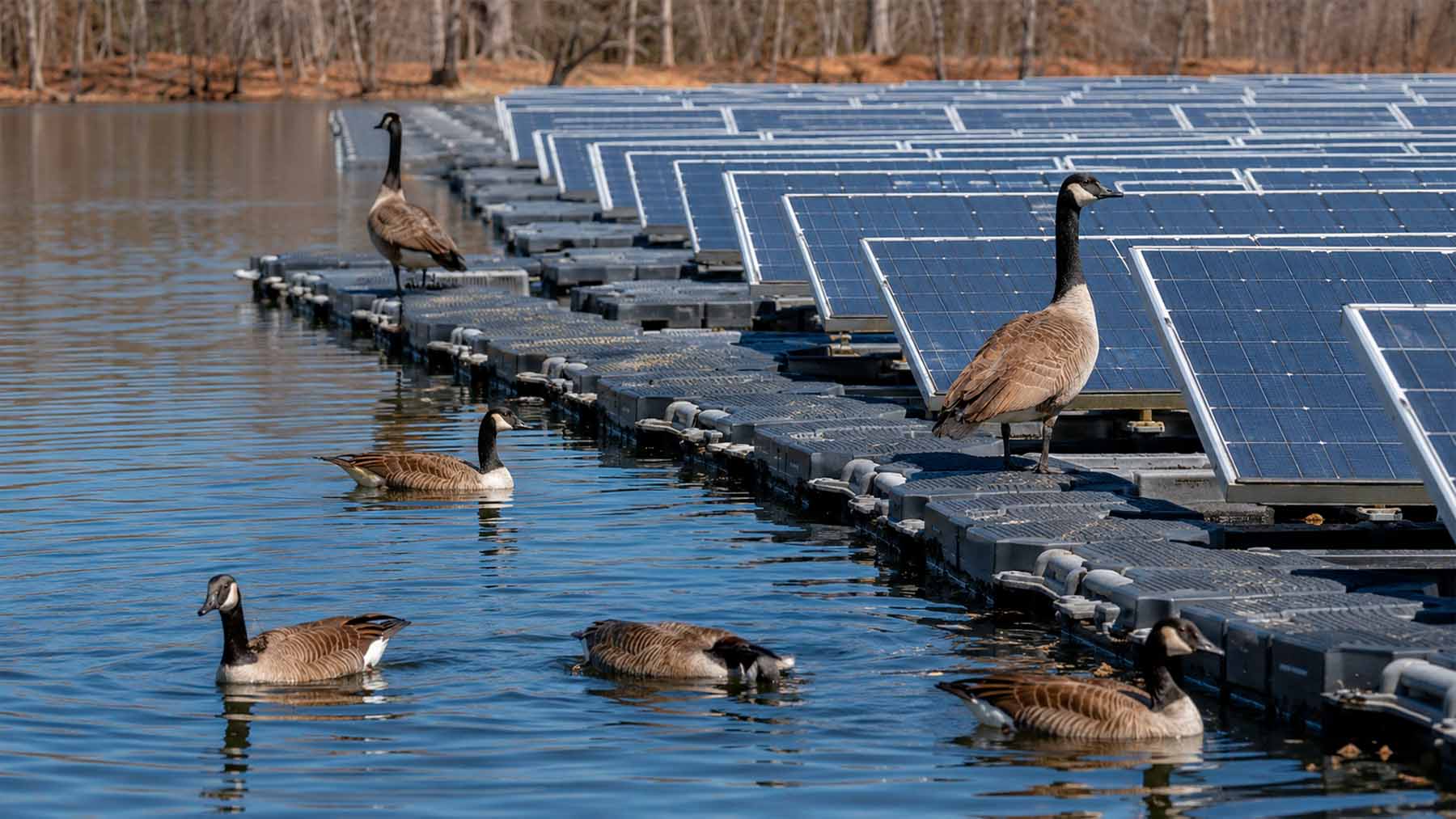 Image generated with artificial intelligence
New York is set to expand its floating solar capacity, but first, environmental impact studies must be conducted.
The United States is actively working toward achieving its ambitious climate goals.
While green infrastructure is key to meeting these targets, space is running out for land-based installations.
Ultimately, the study proves that targeting artificial reservoirs for floatovoltaics while avoiding smaller, biodiverse water bodies will overcome these risks.
Floating arrays are seen as the ultimate solution, but concerns about wildlife conservation remain.
Will New York’s research help developers find the critical balance between the two?
How American climate targets require a rapid rise in green capacity
The United States’ power demand has undergone its greatest change since the start of the new millennium.
Electricity usage steadily grew in 2000 due to an increase in the population.
Today, this energy consumption is increasing more aggressively due to major commercial loads.
The adoption of electric vehicles, rapid industrialization, and AI data centers are primary contributors to these heavy loads.
In 2025, data centers accounted for almost half of the nation’s total power demand growth.
The latest projections predict this demand to reach 66 gigawatts by 2027.
With this significant rise, national grids are becoming immensely strained.
Renewable energy sources are essential to break utilities’ continued reliance on natural gas.
This fossil fuel still supplies nearly 40% of American power to prevent shortages.
While federal goals target 100% clean electricity by 2035, with solar leading the way, land-based arrays are facing challenges.
The barriers to growing traditional solar capacity
Utility-scale solar-and-battery facilities in the U.S. have become fundamental to regional grids.
These plants help bridge the gap between midday production and early morning and nighttime demand.
Expanding this green source’s capacity is fundamental.
However, these large-scale installations require up to eight acres of land per megawatt of capacity.
With more projects planned, securing this acreage faces competition with local forestry, agriculture, and residential zoning.
This need for land triggers significant local resistance.
Consequently, several developers were recently forced to cancel approximately 30% of planned green projects during the siting phase.
To overcome these barriers, more developers are turning to floating panels, or floatovoltaics.
Placing arrays on reservoirs, lakes, or ponds offers distinct benefits, such as panel cooling, increased efficiency, and overcoming land-use disputes.
However, the main challenge is understanding and mitigating the effects on local wildlife.
Researchers from University of Cornell conducted a study to determine the effect of floatovoltaics on bird species.
Mapping the Northeast’s avian distribution
Natural water bodies are being increasingly targeted for floating solar deployment.
Over 16,000 suitable ponds and lakes were mapped based on infrastructure proximity and size.
The water bodies were compared with data obtained from the Cornell Lab of Ornithology’s eBird Status and Trends tool.
This helped to evaluate 291 bird species using habitat needs, physical traits, and conservation status.
Key findings of avian distribution against solar potential
High energy potential rarely overlaps with high bird activity.
Projects can be developed without compromising power output or endangering local wildlife.
Nonetheless, these interactions vary based on water body size.
The highest risk of bird-solar conflicts was identified for smaller lakes and ponds near coastal regions and the Great Lakes.
Additional two-way risks were also highlighted:
Birds with limited vision and low agility face high collision risks near arrays. The horned grebe is an example.
The risk for lower solar output and higher maintenance costs increases. This is due to excessive soiling on glass caused by a high abundance of Canada geese.
Land constraints are tightening nationwide, making floating solar developments more vital than ever.
To safely scale the technology, combining eBird regional modeling with specific field studies is key.
This way, national green energy targets can be met while conserving wildlife habitats across U.S. waterscapes.
Ultimately, the study proves that targeting artificial reservoirs for floatovoltaics while avoiding smaller, biodiverse water bodies will overcome these risks.
The study can be reviewed at APA CITE: Allison D. Binley, Adam Gallaher, Amanda D. Rodewald, Steven M. Grodsky; Potential Interactions Between Birds And Floating Photovoltaic Solar Energy: Spatially Informed Species Vulnerabilities, Techno-Ecological Risks, And Sustainability Trade-Offs. Environ. Sci. Technol. 13 January 2026; 60 (1): 510–521. https://doi.org/10.1021/acs.est.5c09819.
Anke Maree is a writer with a clear and engaging editorial style. Her work focuses on making complex topics accessible, informative, and relevant for readers across different areas of interest.
