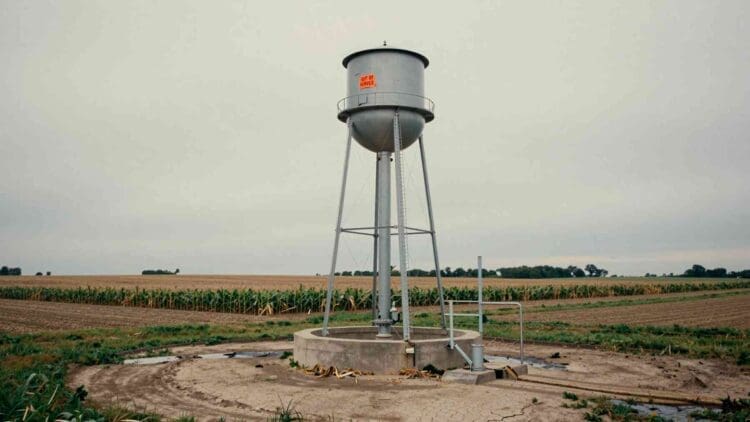

Princeton, Iowa, spent nearly $800,000 building a backup well—then had to shut it down. Testing in September 2024 found nitrate levels of 12.1 mg/L in the new well’s water, just above the EPA’s legal limit of 10 mg/L. By spring 2025, concentrations had climbed to roughly 16 mg/L. The well remains offline, leaving the town of about 1,000 residents with no reliable second source of drinking water.
Princeton shuts down backup well after nitrate tests exceed EPA limit
When September 2024 test results came back, Princeton officials moved quickly. Nitrate levels in the new well measured 12.1 mg/L—just above the EPA’s federal maximum of 10 mg/L—and the well was pulled from service as soon as results were confirmed.
Conditions did not improve. By spring 2025, levels had risen to approximately 16 mg/L, well beyond the legal threshold. The town had invested nearly $800,000 in the replacement well and an accompanying water tower, making the shutdown both a significant financial loss and a serious public health concern for a community of roughly 1,000 people.




Why the new well became contaminated
Princeton’s problems with backup water supply go back further than this crisis. The town’s original backup well was closed in 2009 after years of nitrate violations—the same issue now affecting its replacement.
The new well ran into trouble almost immediately. An oversized pump caused months of water main breaks shortly after installation, and then came the contamination readings.
Nitrate pollution is commonly tied to agricultural runoff from fertilizer and manure, a persistent challenge across rural Iowa. Princeton paid nearby landowners to restrict fertilizer use on roughly 25 acres surrounding the well. Mayor Travis Volrath acknowledged that effort has yielded little: “I would say the data shows that we haven’t moved the needle much. It has gently trended down, but not far enough to matter.”
The town now depends on a single well; residents face health and financial risks
With the backup well offline, Princeton’s approximately 350 households and businesses rely entirely on one main well. There is no redundancy if that primary source encounters problems.
The health stakes are concrete. Federal health guidance identifies infants and pregnant people as facing the greatest risks from elevated nitrate levels in drinking water.
Addressing the problem will likely be expensive. If officials cannot locate and repair a possible crack in the well casing, a reverse osmosis treatment system may be required — an option that could cost more than $1 million, a figure town leaders say Princeton cannot absorb. The situation could also push the town toward increased borrowing, higher water bills, and reduced local control over its own water system.
The town previously rejected a $2 million buyout offer from American Water
Before the backup well crisis escalated, Princeton had an opportunity to transfer its water system to a larger operator. American Water’s local subsidiary offered $2 million to purchase the system, but town leaders declined, partly because the company required infrastructure upgrades that would have cost more than the purchase price itself.
That decision now sits in a complicated light. Public works foreman Chris Rindler was direct about what is at stake: “We have 1,000 people that need water, potable water. And to not give them that reliable backup, well, I don’t think that’s an option.”
Whether the rejected buyout would have prevented the current situation remains unclear. Princeton now faces a costly problem with limited financial tools to address it.
Iowa’s broader nitrate pollution problem underlies Princeton’s situation
Princeton’s experience is not an isolated case. Water systems across Iowa are increasingly struggling with nitrate contamination tied to agricultural activity, particularly where fertilizer and manure runoff reaches groundwater.
Associate state geologist Ryan Clark described Princeton’s contamination as part of something much larger. Nitrate pollution in the region, he suggested, reflects “a much bigger picture” extending well beyond any single town or field.
Small municipalities like Princeton face a particular disadvantage here. They manage aging infrastructure on limited budgets, and state and federal funding options for remediation remain scarce for towns of this size.
An $800,000 white elephant
Princeton spent nearly $800,000 on a backup well that cannot be used. Nitrate levels tested at 12.1 mg/L in September 2024 and rose to roughly 16 mg/L by spring 2025; both are above the EPA’s 10 mg/L limit. The town now depends on a single main well serving about 350 households and businesses, with a potential treatment fix exceeding $1 million that officials say is unaffordable. Fertilizer restrictions on nearby land have produced little measurable improvement. The problem, meanwhile, reflects a wider pattern of nitrate contamination affecting rural water systems across Iowa.
Kelly is an experienced writer with 15 years of experience exploring the big stories that shape our world, from tech breakthroughs and space exploration to climate, energy, and the fascinating quirks of science. She has a talent for turning complex ideas into sharp, memorable insights that stay with readers long after they’ve finished reading.