
Texas engineers built a solar desalination device inspired by pendulum physics that produced drinking water through the night in Texas
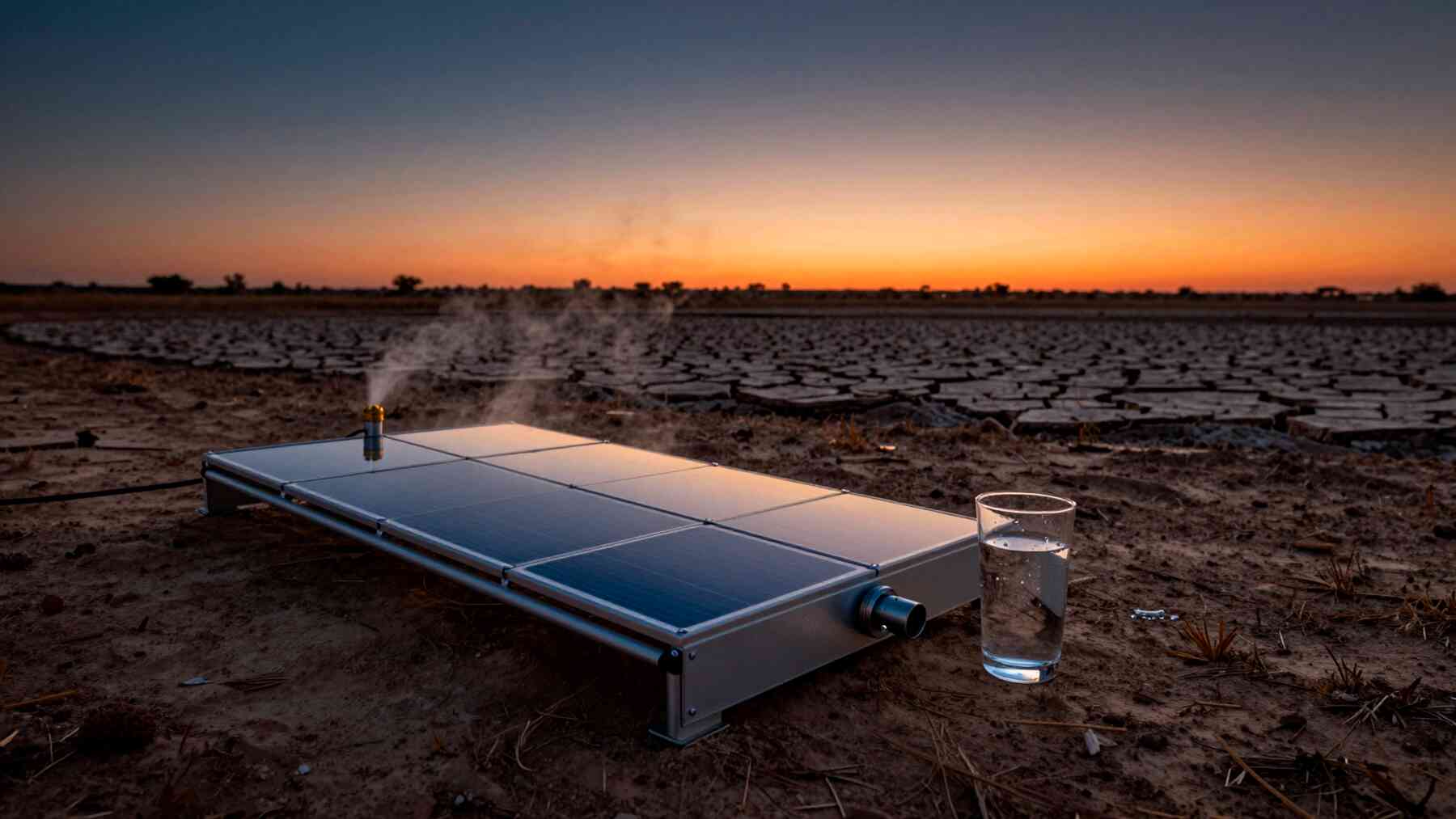 AI-made
Billions of people lack reliable access to fresh water, yet the most abundant energy source on Earth goes dark every night and hides behind every cloud.
In San Marcos, Texas, a small prototype built by Rice University engineers kept producing drinking water through both, quietly running as sunlight faded. It required no batteries, no external energy storage, and no filtration membranes. What it used instead was something closer to the physics of a pendulum.
A water crisis that demands a new kind of solution
Fresh water scarcity is accelerating worldwide. According to the World Resources Institute, the problem will deepen in the coming years, hitting off-grid and coastal communities hardest – precisely the places least equipped to build the infrastructure that conventional desalination requires.
The team also ran simulations using solar intensity profiles from cities across the United States — from cloudy Portland, Oregon, to sunny Albuquerque, New Mexico.
Most desalination plants rely on reverse osmosis, a membrane-based process that is energy-intensive and fragile. Those membranes foul over time, degrade, and require costly replacement. Reverse osmosis also recovers only 35–50% of fresh water from seawater, discarding the rest as hypersaline waste.
The Rice University team wanted a different starting point — a decentralized, modular system that communities could deploy without connecting to a centralized grid and without the maintenance demands that membranes consistently impose.
How STREED works: resonance as an energy strategy
The system is called STREED: Solar Thermal Resonant Energy Exchange Desalination. In resonant systems — pendulums and tuned electrical circuits — energy oscillates efficiently between forms at specific frequencies. The Rice engineers asked whether that same principle could govern heat inside a desalination device.
Rather than two liquid channels separated by a membrane, STREED uses one heated channel of saline water alongside an adjacent air channel. As warm, salty water flows through, water vapor crosses into the air stream, leaving salts behind. That vapor later condenses into fresh water in a water-air heat exchanger. The critical part is what happens to the heat: it oscillates between the counter-flowing saline water and air in a resonant pattern, storing and recycling thermal energy internally. No external batteries or thermal storage tanks are needed, which cuts both cost and maintenance burden substantially.
Matching the sun’s shifting power throughout the day
Sunlight is not constant. It peaks at midday, weakens under clouds, and disappears at night — and most solar desalination systems simply slow down or stop when intensity drops.
STREED takes a different approach. The team borrowed a concept from electrical engineering called dynamic tuning: internal water and air flow rates adjust continuously to match the sun’s varying output. According to co-first author William Schmid, this kind of light-dependent flow control had not previously been applied to solar desalination.
Co-first author Aleida Machorro-Ortiz described the result as a system operating “robustly and with minimal maintenance around the clock” – production does not pause when a cloud passes or when the sun sets.
Test results: efficiency gains across climates
The prototype was tested in San Marcos, Texas, where it produced up to 0.75 liters of drinking water per hour. That figure represents a working prototype, not a theoretical maximum.
The team also ran simulations using solar intensity profiles from cities across the United States — from cloudy Portland, Oregon, to sunny Albuquerque, New Mexico. Across those varied conditions, STREED outperformed systems using static flow rates by 77% water-recovery efficiency over a representative week. Machorro-Ortiz noted that high energy-to-water efficiency held even in low-sunlight conditions. Sunny locations produced more total fresh water, but efficiency did not depend on strong solar intensity — a distinction that matters for regions where reliable sunshine cannot be guaranteed.
Membrane-free design and high-salinity performance
Replacing membranes with an air channel does more than simplify construction. It removes the single component most likely to fail. As corresponding author Alessandro Alabastri put it, the system is “more robust because we don’t have any membranes to foul or break”.
STREED handles high-salinity brines without a significant drop in water quality or output — a problem that stymies conventional reverse osmosis. All materials were selected for durability and low maintenance, with scalability toward off-grid communities kept explicitly in mind. The study was published in Nature Water and received support from the National Science Foundation, Mexico’s National Council of Science and Technology, the Robert A. Welch Foundation, and the Department of Energy’s Solar Desalination Prize.
A prototype producing 0.75 liters per hour is a proof of concept, not a community-scale solution. What the Rice team has demonstrated is that the underlying physics work — that a membrane-free, storage-free, continuously operating solar desalination system is no longer hypothetical. Whether STREED can move from a test site in Texas to deployment in water-stressed communities worldwide remains the question worth watching.
Kelly is an experienced writer with 15 years of experience exploring the big stories that shape our world, from tech breakthroughs and space exploration to climate, energy, and the fascinating quirks of science. She has a talent for turning complex ideas into sharp, memorable insights that stay with readers long after they’ve finished reading.
