
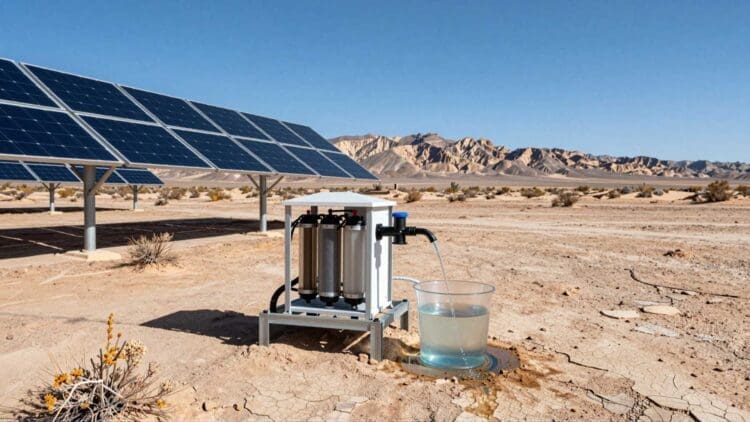

MIT engineers have built a solar-powered desalination system that runs without batteries — and without any connection to the grid. Developed by the GEAR Center team at MIT and published in Nature Water on October 8, 2024, the system was field-tested over six months at a brackish groundwater facility in Alamogordo, New Mexico, where it produced up to 5,000 liters of clean drinking water per day under real-world weather conditions.
MIT Publishes Battery-Free Solar Desalination System in Nature Water
The research comes from MIT’s K. Lisa Yang Global Engineering and Research (GEAR) Center, led by Professor Amos Winter, the Germeshausen Professor of Mechanical Engineering. His co-authors are PhD student Jonathan Bessette and staff engineer Shane Pratt, the core team that has been advancing solar-powered desalination over the past several years.
During the six-month field trial at the Brackish Groundwater National Research Facility in Alamogordo, New Mexico, the prototype ran across a wide range of weather conditions. On average, it harnessed over 94 percent of the electrical energy generated by its solar panels to power the desalination process directly — a figure the team describes as a significant improvement over earlier designs.




How the System Eliminates the Need for Battery Storage
The central innovation is a control strategy called “flow-commanded current control,” developed by Bessette and Pratt. It reads solar panel output three to five times per second, and when additional power becomes available, the system simultaneously increases the water pump flow rate and the electrical current delivered to the ion-exchange membrane stack.
That near-instantaneous response — down to a fraction of a second — is what makes batteries unnecessary. The previous design could only recalculate its operating parameters every three minutes, a window long enough for a passing cloud to disrupt power levels and force the system to draw on battery storage to compensate.
“We could only calculate every three minutes, and in that time, a cloud could literally come by and block the sun,” Winter explained. The new approach closes that gap almost entirely. Required battery capacity, according to Winter, has been cut by nearly 100 percent compared to a traditionally designed solar desalination system.
Potential Impact on Communities Relying on Brackish Groundwater
The system targets brackish groundwater — salty water found in underground reservoirs — rather than seawater. Brackish groundwater is more widely distributed globally than fresh groundwater, making it a substantial potential resource for inland communities nowhere near a coastline. The prototype is sized to supply roughly 3,000 people per day, with plans to scale toward larger communities and eventually whole municipalities.
Bessette notes that climate change is compounding the problem. “This groundwater is becoming more and more saline due to climate change,” he said. Inland, low-income, and remote communities — those with limited access to both seawater and reliable grid power — are the primary intended beneficiaries.
Background: Solar-Powered Desalination and Electrodialysis Technology
Two main methods exist for desalinating brackish groundwater: reverse osmosis and electrodialysis. Reverse osmosis uses pressure to push salty water through a membrane, while electrodialysis uses an electric field to pull salt ions out of water as it passes through a stack of ion-exchange membranes. Reverse osmosis systems have historically required a steady power supply, making them a poor fit for variable sources like solar. Electrodialysis handles fluctuating power more gracefully, which is why the MIT team focused there.
The new system builds on an earlier MIT design based on “flexible batch electrodialysis,” also published in Nature Water earlier in 2024. That prior system used 77 percent of available solar energy on average — already an estimated 91 percent more efficient than conventional solar electrodialysis designs. The latest version improves on that by eliminating nearly all battery requirements. The team plans to launch a commercial company based on the technology in the coming months, with a focus on reliability testing and building a product line for multiple global markets.
Key Takeaways
The MIT system represents a meaningful step forward in solar-powered water treatment. It pairs electrodialysis — not reverse osmosis — with a fast-response control strategy that tracks sunlight changes multiple times per second, eliminating the lag that previously made battery storage necessary.
Field results show the system can produce up to 5,000 liters of drinking water per day while using over 94 percent of available solar energy on average. It targets brackish groundwater, a resource that is widespread but increasingly saline due to climate change. The prototype is community-scale, designed for roughly 3,000 people, with plans to expand further. A commercial spinout is expected within months.

Carlos is an engineer with strong expertise in technical and industrial topics. He previously worked at international companies such as Siemens and speaks Spanish, German, English, and Italian.