
Sandia National Laboratories field-tests AI-driven grid voltage control system at two Texas sites amid rising data center demand
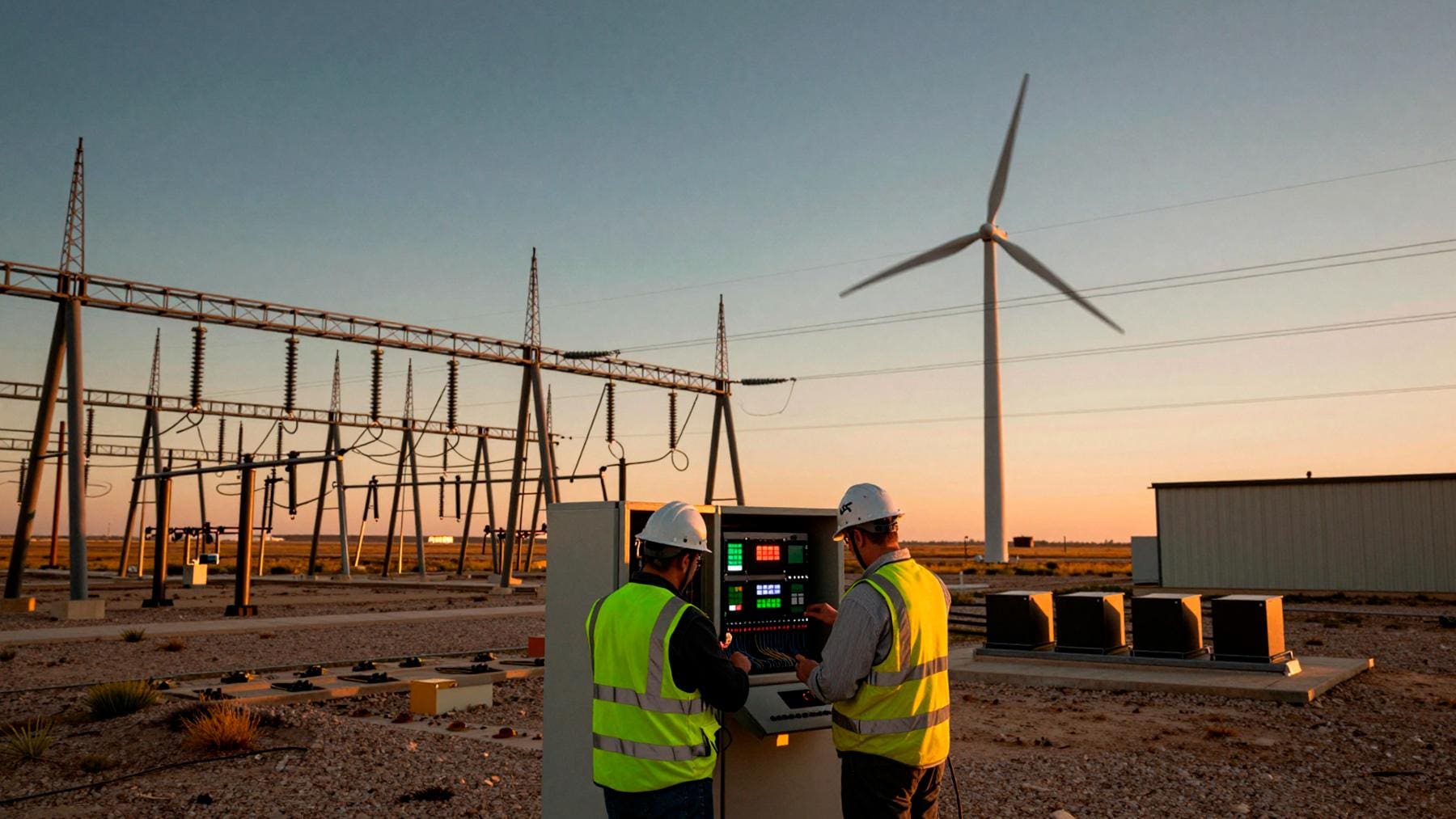 AI-made
Sandia National Laboratories has completed field demonstrations of an AI-driven distributed energy resource management system designed to regulate grid voltage in real time—a capability the lab says is growing more urgent as data center electricity demand accelerates. The tests took place at two Lubbock, Texas, sites: Sandia’s own Scaled Wind Farm Technology facility and Texas Tech University’s GLEAMM microgrid.
The work, led by Sandia engineer Rachid Darbali-Zamora alongside researchers Jon Berg, Miguel Jimenez-Aparicio, and Jorge Leon-Quiroga, is backed by the U.S. Department of Energy. It has moved through computer simulation, laboratory hardware testing, and finally live grid deployment.
Sandia completes field demonstrations of AI voltage-control platform in Texas
Each Lubbock site served a distinct purpose. At the SWiFT facility, the team connected DERMS controls to operating equipment and monitored performance as real-world conditions shifted—a level of confidence required before deploying at mission-critical sites that cannot absorb extended downtime.
The DERMS software forecasts changes in electricity use and available power, then automatically coordinates grid-connected inverters to respond to disturbances.
Texas Tech University’s GLEAMM microgrid added a directly relevant dimension: it includes a data center. Voltage at GLEAMM typically runs about 5% above the level utilities aim to maintain. With the AI-driven controller active, coordinated device responses brought voltage measurably closer to target values.
The measurement approach was straightforward. “We ran an entire day with the controller and an entire day without the controller,” Darbali-Zamora said. “When you compare the voltage graphs from those two, you can visually see that the voltage in the system is improved with the DERMS controller.”
Why grid voltage regulation is becoming harder to maintain
AI-driven data center growth is making electricity demand both larger and less predictable. Meanwhile, more distributed energy resources—rooftop solar panels, battery storage systems, and backup generators—are connecting to distribution grids, giving utilities more devices to coordinate and less margin for error.
Frequency management typically occurs at the bulk power system level. Distribution grids, by contrast, require fast, local voltage regulation to maintain power quality for sensitive loads. That distinction matters especially for defense and other critical infrastructure, where power quality can be as important as power availability.
Traditional voltage management tools include capacitor banks and line voltage regulators. “Those are traditional, conventional devices that are more mechanical — switching on and off,” Darbali-Zamora said. Mechanical switching responds too slowly for the second-to-second fluctuations a modern, resource-dense grid can produce.
How the AI-driven DERMS platform coordinates grid devices in real time
The DERMS software forecasts changes in electricity use and available power, then automatically coordinates grid-connected inverters to respond to disturbances. AI enables the controller to update device setpoints in near real time while respecting each piece of equipment’s operating limits.
A key design choice was working with hardware already in the field. Inverters — the devices connecting solar panels, batteries, and other resources to the grid — are already widely installed. “To provide these services, we’re leveraging inverters that are already in the grid,” Darbali-Zamora said. “That means the utility does not have to make as many upgrades.”
National security is an explicit design goal. Senior manager Charlie Hanley noted that adversaries targeting energy infrastructure is a realistic scenario in conflict situations. Built to adapt in real time, the DERMS system draws on Sandia’s existing expertise in grid threats and vulnerabilities to keep critical systems operating through adversarial disruptions.
Laboratory validation preceded field deployment using power hardware-in-the-loop testing
Before any field deployment, the team validated controls at Sandia’s Distributed Energy Technologies Laboratory using power hardware-in-the-loop, or PHIL, testing. The approach connects real commercial inverters and battery hardware to a real-time grid simulation, allowing rigorous testing without touching the live grid.
PHIL testing surfaced something computer simulations alone cannot: communication challenges. When software exchanges data with actual equipment, messages can arrive late and data links can slow. “Simulations capture dynamics, but they don’t really capture, for example, communication challenges,” Darbali-Zamora said.
Resolving those issues in the lab was essential before anyone went near live infrastructure. “These experiments were critical,” researcher Jon Berg said. “They allowed us to evaluate how the system behaves with real hardware, not just models. That gives us and our partners confidence that the technology is ready for real-world deployment.”
DOE Energy I-Corps program is supporting commercialization of the DERMS technology
Field success has opened a path toward broader deployment. Selected for the DOE Energy I-Corps Phase II program, the project was paired with utilities, microgrid developers, and industry partners to identify practical deployment needs. Stakeholder interviews pointed to a consistent priority: tools that ease coordination of grid-connected devices without adding heavy operational burdens.
The project has since been accepted into Energy I-Corps Phase III, a competitive follow-on effort focused on accelerating commercialization and supporting additional field deployments—reflecting growing utility-sector interest in AI-based grid management. The work also aligns with the DOE’s Genesis Mission, which directs AI toward the nation’s most complex science and technology challenges. Taken together, the SWiFT and GLEAMM demonstrations, the PHIL validation methodology, and the Energy I-Corps pathway represent a repeatable framework for developing AI-driven grid controls, validating them with real hardware, and moving them toward the utilities and operators who need them.
Kelly is an experienced writer with 15 years of experience exploring the big stories that shape our world, from tech breakthroughs and space exploration to climate, energy, and the fascinating quirks of science. She has a talent for turning complex ideas into sharp, memorable insights that stay with readers long after they’ve finished reading.
