
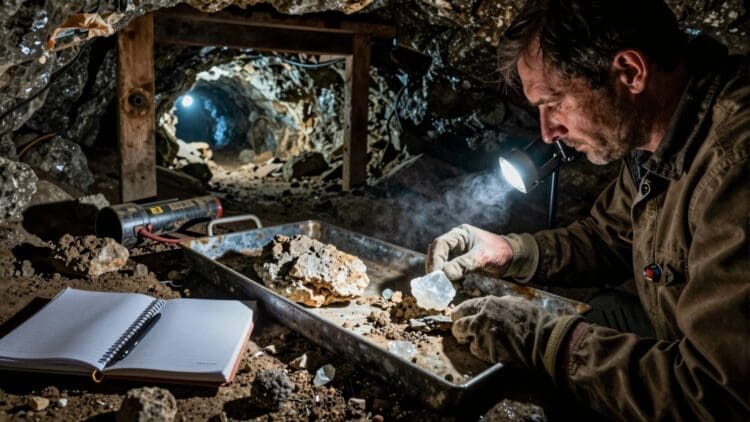

Deep in Serbia’s Jadar Valley, exploration geologists pulled up a dull white crystal during routine drilling in 2004 — and it didn’t match anything in the known mineral record. Analysis by the Natural History Museum in London and the National Research Council of Canada confirmed it was something entirely new.
The mineral was named jadarite, after the valley where it was found. Its chemical formula — sodium lithium boron silicate hydroxide — turned out to be identical to the fictional kryptonite described in a Superman film. The resemblance is more than cosmetic. What this unassuming crystal contains may matter far beyond its modest appearance.
A discovery that stopped geologists in their tracks
Rio Tinto’s exploration team was conducting routine drilling in Serbia’s Jadar Valley in 2004 when they pulled up something that didn’t fit. The white crystal couldn’t be matched to any mineral in the existing record — unusual enough to demand serious attention. Samples went to two of the world’s leading analytical institutions: the Natural History Museum in London and the National Research Council of Canada. Both reached the same conclusion.



This was something previously unknown to science.
The mineral was officially recognized in 2006 and named jadarite, after the valley where it was first recovered. Its chemical formula, LiNaSiB₃O₇(OH), describes a sodium lithium boron silicate hydroxide — a combination never before observed in nature. That alone made it significant. What came next made it famous.
How a Superman film made the connection
The cultural moment arrived through a prop label. In Superman Returns, a museum display case identifies stolen kryptonite as “sodium lithium boron silicate hydroxide” — the exact scientific name of the mineral geologists had just finished cataloguing in Serbia.
The fictional version diverges in telling ways. The film’s kryptonite contains fluorine and glows green, while jadarite is matte white in natural light, though it does fluoresce a pinkish-orange under UV — closer to strange than sinister. The coincidence drew genuine public interest and gave an obscure mineralogical finding an unexpected cultural foothold. The parallel is ultimately a curiosity, though. Jadarite has no supernatural properties, and its real significance lies entirely in its chemistry.
Why jadarite matters for the energy transition
Lithium and boron rank among the most strategically important materials in clean energy infrastructure. Lithium powers the rechargeable batteries used in electric vehicles and grid storage; boron plays a role in everything from industrial magnets to the glass used in solar panels. Jadarite contains both.
ANSTO scientist Michael Page has described jadarite as having “great potential as an important source of lithium and boron.” The Jadar deposit in Serbia is considered one of the largest lithium deposits in the world — a scale that carries real weight for supply chains already straining to keep pace with rising demand. Battery-grade lithium chemicals have already been successfully produced from jadarite samples, which moves the mineral from scientific curiosity to commercially viable resource.
Australia’s role in turning jadarite into a resource
Australia has a direct stake in how minerals like jadarite are processed and brought to market. ANSTO — the Australian Nuclear Science and Technology Organisation — is one of three agencies supporting Australia’s Critical Minerals R&D Hub, hosted by CSIRO alongside Geoscience Australia. The Hub connects research institutions with industry, supporting extraction and utilization of critical minerals across domestic and global supply chains.
Jadarite fits squarely within that mandate. ANSTO has built substantial expertise processing lithium from mineral types including spodumene and lepidolite, and jadarite represents the newest addition to that body of work. The practical goal: give Australian miners and industry partners the technical capacity to process complex mineral resources at commercial scale. As the energy transition advances, the ability to work with unfamiliar mineral types will only grow in importance.
What comes next for the world’s kryptonite
The story of jadarite is still developing. A mineral identified less than two decades ago now sits at the center of conversations about battery supply chains, critical mineral policy, and the industrial infrastructure required to support a low-carbon economy — a trajectory few would have predicted from a single drill core pulled out of a Serbian valley.
The Jadar deposit warrants close attention. Its scale gives it the potential to shift lithium supply dynamics across Europe and beyond, and processing innovations underway at ANSTO will help determine whether deposits like this one can be developed efficiently and responsibly. Jadarite lacks the glow of its fictional counterpart. But as pressure to decarbonize continues to build, that dull white crystal may prove genuinely consequential.

Carlos is an engineer with strong expertise in technical and industrial topics. He previously worked at international companies such as Siemens and speaks Spanish, German, English, and Italian.