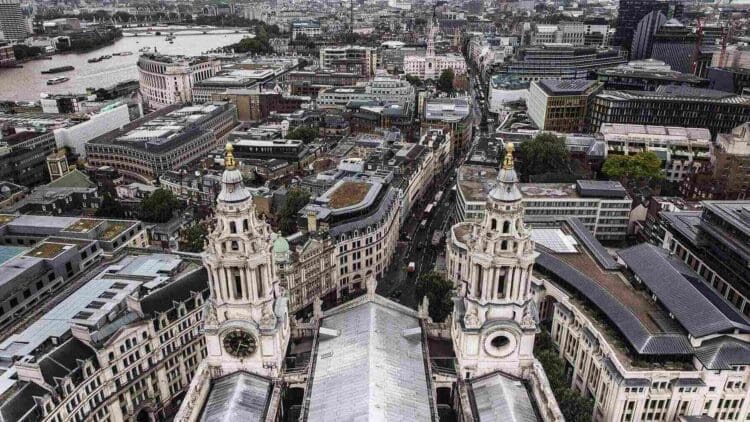

The latest landscape strategy entails a universal color that could help lower urban temperatures.
Globally, nations are feeling the impact as climate change continues to accelerate.
In recent years, Earth’s average temperature has been rising to dangerously higher levels than anticipated.




Now, major city centers are trapping extreme solar radiation, which threatens the health and productivity of billions of citizens.
Will adopting a simple rooftop intervention help improve urban cooling efficiency worldwide?
How global energy demand is warming the planet
Modern infrastructure has expanded significantly in society.
This growing footprint is driven by the adoption of electrification across various sectors.
Examples include EV charging networks, heavy industrial manufacturing, and major AI data centers.
Global data centers consume nearly 565 terawatt-hours of electricity annually. This is attributed to advanced computing workloads and specialized cooling systems.
To power modern economies, vast amounts of high-density energy are required.
This has pushed global consumption to 29,000 TWh, straining grids worldwide.
Presently, renewable energy installations fall short in relieving this pressure.
Operators continue to rely on fossil fuels to keep global grids online.
Resulting greenhouse gases trap solar radiation, warming the atmosphere and accelerating climate change.
This persistent loop has caused a heating trend.
More specifically, urbanites are left to face the consequences as Earth becomes hotter.
Immediate, passive approaches are needed to cool cities without straining already overburdened power grids.
The dangerous realities of urban heat islands
When metropolitan areas experience much warmer temperatures than surrounding rural regions, it is called the urban heat island effect.
Temperature discrepancies occur because dense city surfaces absorb intense solar radiation. These surfaces include concrete pavements, asphalt roads, and dark rooftops.
They store thermal energy during the peak of the day.
At night, the trapped heat is slowly released, preventing a city from cooling down naturally.
In London, temperatures can be up to 18 degrees Fahrenheit hotter during summer heatwaves.
It poses a direct, severe threat to public health and economic productivity.
Extreme urban heat increases the risk of heat exhaustion and fatal heatstroke.
High ambient temperatures accelerate chemical reactions in the air, worsening local smog. This triggers respiratory illnesses.
This also compromises labor capacity and cognitive performance.
Now, municipal planners are pressured to break this thermal cycle.
A University College London study may have found the ideal solution.
The power of a reflective rooftop color
Several interventions were tested to effectively cool down urban centers.
A 3D climate model was created to simulate London’s hottest summer days.
The system compared the following:
- Solar panels
- Street trees
- Green roofs
- Cool roofs
Plant-covered green roofs provided a negligible cooling impact over a 24-hour cycle.
Relief was only mild during peak daylight hours, and heat was still released at night.
Street trees provided ground shade but raised local humidity. This reduced overall human comfort.
Solar panels did not significantly lower outdoor air temperatures.
Air conditioning cools indoor spaces, but releases intense heat out into the city.
Outdoor urban temperatures increased up to 1.8 degrees Fahrenheit.
The definitive winner was to paint rooftops white to create “cool roofs.”
The benefits of widespread adoption of white painted rooftops
Outdoor temperatures are reduced by an average of 2.2 degrees Fahrenheit.
Localized temperatures in dense cities are lowered by up to 3.6 degrees Fahrenheit.
This is because the coatings reflect solar radiation back into the atmosphere.
Green infrastructure is undeniably beneficial for biodiversity and the environment.
However, nature-based interventions fall short as primary defenses against increasing urban temperatures.
As metropolitan heat waves become more extreme, rapid, and grid-neutral innovations are key.
By using white reflective rooftop coatings as a climate strategy, cities can experience efficient cooling.
Global city planners can now drastically lower temperatures while protecting public health and securing economic productivity.
Anke Maree is a writer with a clear and engaging editorial style. Her work focuses on making complex topics accessible, informative, and relevant for readers across different areas of interest.