
A ship with two wings hugs the water as it sails and can power 2,000 homes using only energy from the sea
 Credits: Orbital Marine Power
Thousands of homes can be powered with a vessel that moves with the ebb and flow of the ocean’s energy. Global electricity demands strain the grid as the industry struggles to scale and decarbonize the world at the required pace.
Traditional renewable sources are no longer enough to buffer these pressures, which is why innovative approaches are needed.
Will turning to the sea finally be the way to ensure clean, baseload power?
Data centers require substantial electricity to remain operational, and industrial sectors need significant amounts of renewable energy to decarbonize.
How demands are outpacing renewable deployment
To mitigate the effects of climate change, the world is tightly embracing renewable energy and the path toward electrification.
An electrified world will also fast-track the digital age, ensuring that smart systems and AI become central to society’s evolution.
However, this transformation comes at a significant power cost.
Data centers require substantial electricity to remain operational, and industrial sectors need significant amounts of renewable energy to decarbonize.
The global grid is under unprecedented strain as exponential demand growth is exceeding the pace of renewable deployment.
Wind and solar have advanced significantly, but their intermittency has created a “reliability gap” that is not easy to bridge.
Furthermore, the sheer scale of the infrastructure not only presents economic hurdles but also logistical and environmental ones.
For a world that requires an uninterrupted, baseload supply, these traditional sources are no longer enough.
Ensuring that climate targets are achieved on time while preventing a global blackout now necessitates “thinking outside the box.”
This has led the industry to seek a solution beyond the horizon.
The rise of clean power over the sea
The ocean is an undeniable source of dense and reliable energy, but it has always been difficult to conquer.
For years, the industry has made significant strides in offshore platform technology. Unfortunately, few have managed to survive the unforgiving conditions of the marine environment.
The sea’s relentless force and high density are what attracted the industry in the first place. But they are also the reasons the machines become damaged.
Beyond structural vulnerability, conventional ocean technology faces other challenges.
Some submerged designs rely on rigid, “fixed-to-bottom” infrastructure similar to offshore wind foundations. This complicates maintenance, necessitating specialized divers and heavy-lift vessels.
In many cases, operational expenditures begin to outweigh the value of the generated energy.
Fortunately, Orbital Marine Power developed a unique approach to tap the ocean’s power.
The Pacific Northwest National Laboratory provided a “field report” on how this marine technology is thriving.
A new marine innovation that harnesses energy from the tides
Transforming renewable energy technology into functional art is no easy feat.
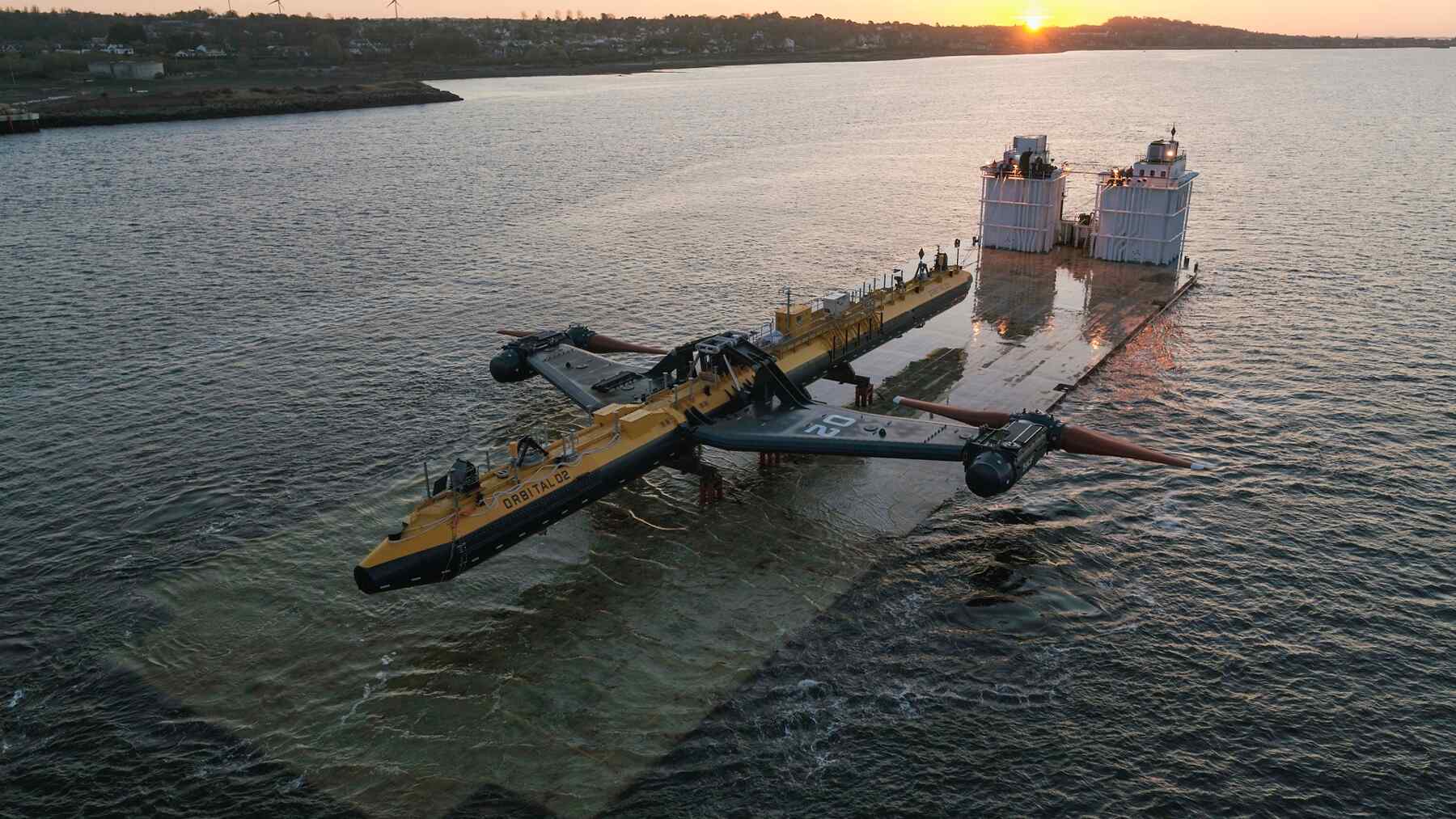
Yet, Orbital Marine Power’s Orbital O2 is truly a 243-foot-long floating masterwork.
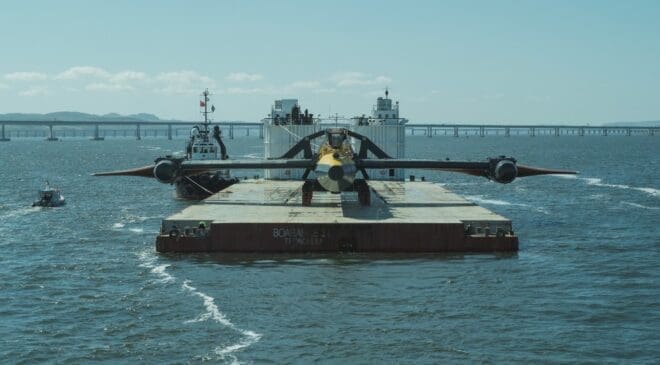
The superstructure consists of a ship center and has two giant retractable 60-foot “wings.” They support two 100-ton nacelles and 65-foot rotors underwater.
The Orbital O2 “hugs the water” rather than being anchored to the seabed, making the platform sleek and easily accessible.
The benefits of a “winged” ship that taps into tidal energy
The nacelles can be raised to the surface, enabling small, low-cost workboats to perform maintenance more easily.
It operates in currents of nearly 9 mph without rotating the entire structure. This is because the rotors have 360-degree pitch control that harvests energy from ebb and flood tides.
Thanks to the Orbital O2, nearly 2,000 homes can enjoy predictable, low-impact electricity.
It shows that this innovation is a viable baseload solution that is as resilient as it is aesthetically pleasing.
With the digital age accelerating, tapping into the power of the ocean will no longer be a carbon-heavy pipedream.
By overcoming the environmental, logistical, and economic hurdles, the next generation of offshore platform technology could soon power the world.
Anke Maree is a writer with a clear and engaging editorial style. Her work focuses on making complex topics accessible, informative, and relevant for readers across different areas of interest.
