
In Arizona, Colorado, and Nevada, solar panels may be creating ‘rain without clouds’ by changing the local climate and quietly helping fight the drought
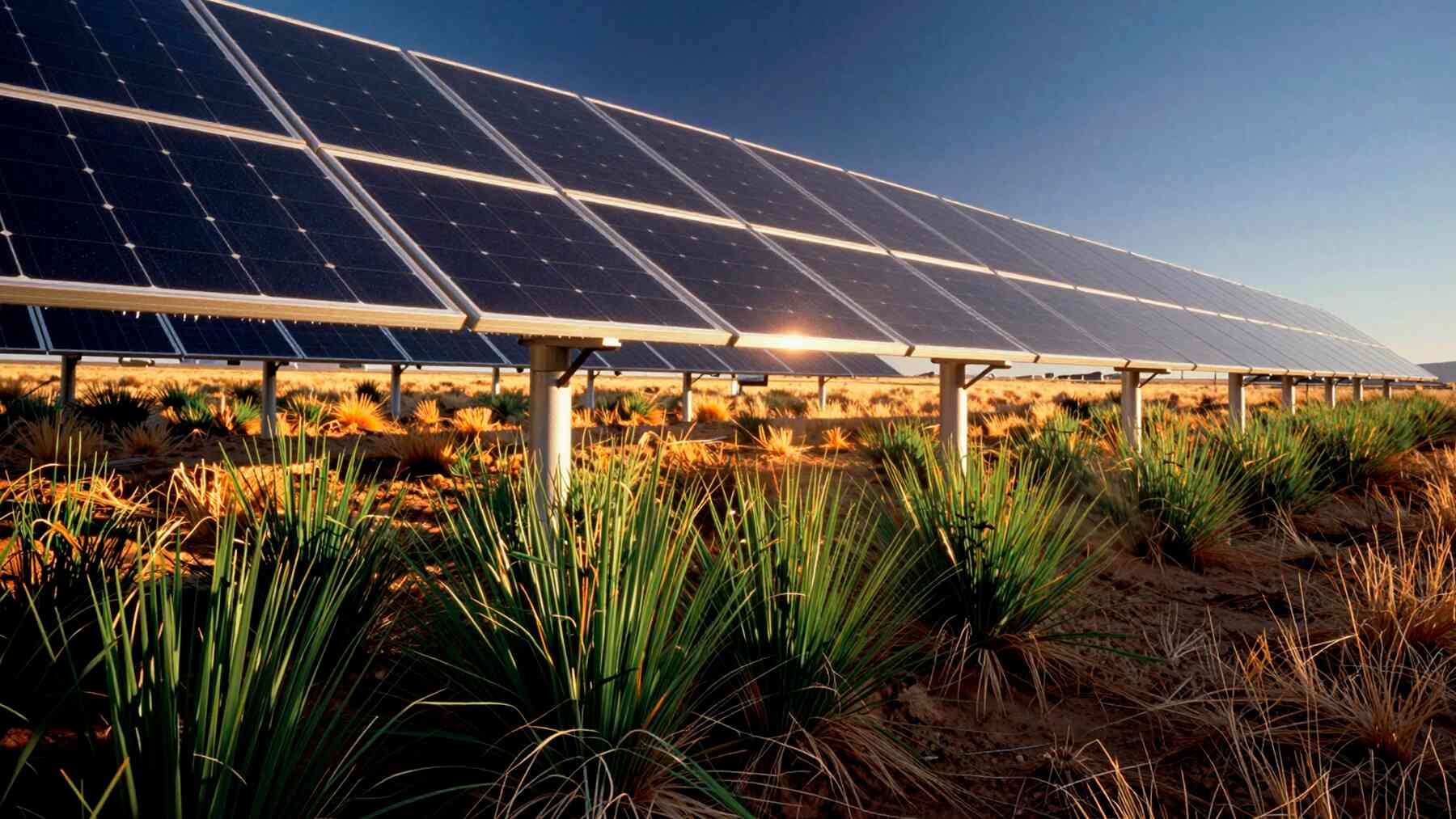 AI-made
Colorado’s semi-arid grasslands are built for hardship. They face sparse rain and relentless summer heat. Plants are perpetually scraping for moisture.
Solar panels planted across that landscape seem like one more burden. They bring less sunlight and less room.
But four years of field data from a solar facility in Longmont, Colorado, are telling a different story.
What makes the finding even more notable is that the Longmont facility was designed purely to maximize energy output, not ecological benefit.
Beneath and around the rows of panels, something is happening to the soil and the plants. Researchers did not fully anticipate this change.
A four-year experiment in Colorado’s grasslands
The research comes from Colorado State University and Cornell University. It was conducted at an agrivoltaics facility in Longmont.
This is the first field study to directly test what happens when solar arrays share space with grassland ecosystems. It tracked real changes in plant growth, soil moisture, and water stress over time.
The team published their findings in Environmental Research Letters in June 2025.
The dataset spans four years of continuous monitoring. This gave researchers a rare window into how conditions shift across wet and dry seasons alike.
The study focused on perennial C3 cool-season grasses. These are the kind that prefer wetter conditions. They are already pushing against the limits of what Colorado’s semi-arid climate can offer.
How solar panels become drought shields
The mechanism is not complicated. However, the scale of the effect surprised researchers.
Panels cast partial shade over the ground beneath them. This lowers soil temperatures and slows down evaporation.
As a result, the soil holds moisture longer. This is a meaningful advantage when rain is already scarce.
There is a second effect. Water that lands on panel surfaces does not evaporate immediately.
It collects and drips to the ground along panel edges. This delivers a small but consistent supplemental dose of moisture to the soil below.
During dry years, those two factors combined to produce striking results.
Grass growing on the east side of the panels was up to 90% more productive in some cases compared to open-field control sites.
During wet or normal years, the effect was smaller. But paneled areas still outperformed the controls. The benefit scales with need.
Why aridity is the key variable
Cornell postdoctoral researcher Matthew Sturchio is a co-author on the paper.
He points to one finding as especially significant. This is the first study to show that the productivity benefit from solar arrays becomes more pronounced as conditions grow drier.
That matters because Colorado’s semi-arid grasslands already operate in a chronic water deficit.
Plants regularly need more moisture than precipitation delivers each season.
Any infrastructure that passively closes that gap deserves serious attention. This is especially true because it requires no irrigation and no intervention.
What makes the finding even more notable is that the Longmont facility was designed purely to maximize energy output, not ecological benefit.
The researchers did not engineer favorable conditions for the grasses. Those conditions emerged anyway.
These include adjusting panel tilt to provide shade when temperatures peak. They also include spacing rows to allow more light during key growth windows.
The current results may represent a floor rather than a ceiling.
The agrivoltaics opportunity—and its limits
The broader context here is agrivoltaics. This means pairing solar infrastructure with agricultural or ecological land uses.
In grassland settings, that typically means livestock grazing or pollinator habitat. Neither of these requires irrigation or heavy machinery.
The solar array generates power. Meanwhile, the land beneath it keeps functioning as an ecosystem.
That dual-use model is appealing precisely because it does not force a choice between energy development and land conservation.
The new findings suggest it may also deliver passive drought resilience as a side effect.
There is an important caveat. The Longmont study focused on C3 cool-season grasses.
The far more common C4 warm-season grasses haven’t been tested yet under solar arrays. These are the ones that dominate the Colorado plains.
C4 grasses thrive in heat and sunlight. This raises a reasonable question about whether shading would help or hurt them.
That hypothesis still needs field data to confirm it.
What comes next: restoration and the new research facility
The research team is not stopping at productivity measurements.
Sturchio and Knapp now hypothesize that solar arrays could serve as active tools for grassland restoration in arid and semi-arid regions.
This means they could help rebuild degraded plant communities, not just preserve existing ones.
Panels create what researchers call environmental heterogeneity. This is a patchwork of shade, moisture, and light conditions across the ground.
That variety may support more diverse plant communities than a uniform open field can sustain. This is especially true under climate stress.
To test that idea, the team is turning to a newly constructed Shortgrass Ecovoltaic Research Facility in Nunn, Colorado.
Future work there will examine whether strategic solar placement can function as a grassland restoration tool.
If the early results from Longmont hold up, the implications reach well beyond Colorado.
Arizona and Nevada face similar semi-arid conditions and expanding solar development.
How panels are designed, oriented, and sited in those landscapes may matter as much for drought resilience as for kilowatt-hours.
The ultimate hook of this four-year study is that renewable energy infrastructure might actually heal the very lands it occupies, turning arid solar fields into thriving ecological sanctuaries.
Kelly is an experienced writer with 15 years of experience exploring the big stories that shape our world, from tech breakthroughs and space exploration to climate, energy, and the fascinating quirks of science. She has a talent for turning complex ideas into sharp, memorable insights that stay with readers long after they’ve finished reading.
