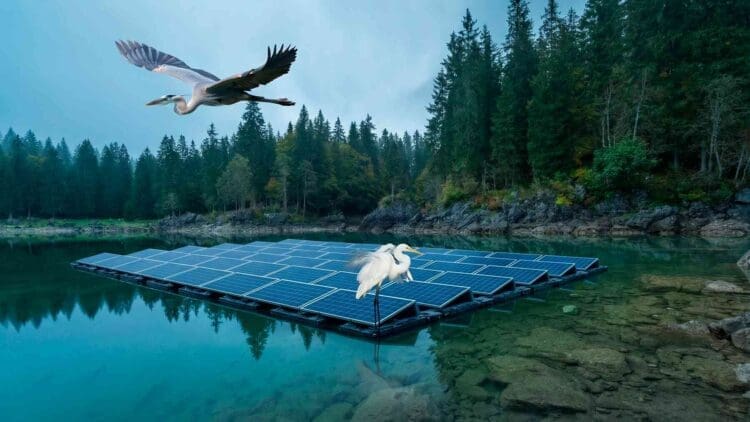

California’s floating solar panels are becoming “artificial islands” for waterbirds, such as herons and egrets.
Fertile land for large-scale solar arrays is becoming scarcer and sparking conflict with other sectors.
As a result, developers are increasingly turning to bodies of water to expand solar capacity worldwide.

Researchers have become interested in the environmental impact of floating panels on local wildlife.
Will these installations also end up displacing nature, or will they create new habitats instead?
How traditional development is becoming less of an option
Global installed solar capacity has reached a new milestone this year.
The capacity has exceeded 3,000 gigawatts (GW), establishing solar as the world’s fastest-growing green source.
Despite this significant achievement, the modern grids demand a continuous electricity supply.
For years, traditional large-scale solar projects have been stabilizing grids while pushing nations closer to net-zero.
Now, land-based installations face significant physical obstacles, requiring vast stretches of land.
The International Energy Agency determined that an additional 231,000 square miles of land will be needed. If not allocated, meeting global climate targets by 2030 becomes almost impossible.
This massive requirement has triggered a great space crunch globally.
Consequently, solar developers compete with other vital sectors.
The greatest conflict is typically with agriculture, increasing the risk of food insecurity worldwide.
Beyond the loss of fertile croplands, development in natural environments threatens biodiversity.
To overcome these bottlenecks, developers must explore other options.
The growing shift toward floating solar panels
Bypassing land-based solar projects will help to evade local opposition and strict zoning regulations.
Rural communities and conservationists often oppose utility-scale solar development to protect natural landscapes.
Furthermore, local environmental laws and property rights have become complex.
This is why obtaining land permits can last for many years.
For these reasons, installing solar panels on top of underutilized bodies of water is becoming increasingly popular.
Panels are now floating on wastewater treatment basins, quarry lakes, and industrial reservoirs. This rarely leads to public protests.
Regulatory approvals also tend to happen faster as the sites have already been modified by human activity.
These installations also present other benefits over their land-based counterparts.
Despite serving a dual purpose in drought-stricken regions, there is limited information on their environmental impact.
This is why researchers from UC Davis conducted a study to determine how waterbirds react to floatovoltaics.
The press release based on the study “Helping birds and floating solar energy coexist,” was published by the University of California – Davis in ScienceDaily.
An artificial floating solar island for birds
Floating solar panels may gradually change the world beneath the water, but they also alter the world above it.
Increasingly more vulnerable waterbird populations are adopting floatovoltaics as artificial islands.
The arrays have large, buoyant platforms that serve as safe, flat surfaces surrounded by open water.
For birds, this mimics natural island geography, increasing protection from land-based predators.
However, the researchers discovered that wildlife behavior is extremely diverse atop these installations.
The different behaviors of various waterbird species
Great egrets use the floating panels as a resting platform between foraging.
Conversely, black-crowned night herons gather in great numbers along the frames before dawn.
Double-crested cormorants dry their wings on the edges and spot prey in proximity.
Smaller birds build nests directly beneath the panels due to shade and weather protection.
The study by UC Davis proves that floating solar panels can create unique aquatic ecosystems.
Since floatovoltaics is still an emerging technology, the researchers emphasize the importance of these impact studies.
They suggest that future projects must consider the diverse reactions of birds to these installations.
It is also crucial to understand that geographic variation will determine conservation needs. Bird tracking and counting must become a standard practice to help mitigate potential risks.
Anke Maree is a writer with a clear and engaging editorial style. Her work focuses on making complex topics accessible, informative, and relevant for readers across different areas of interest.