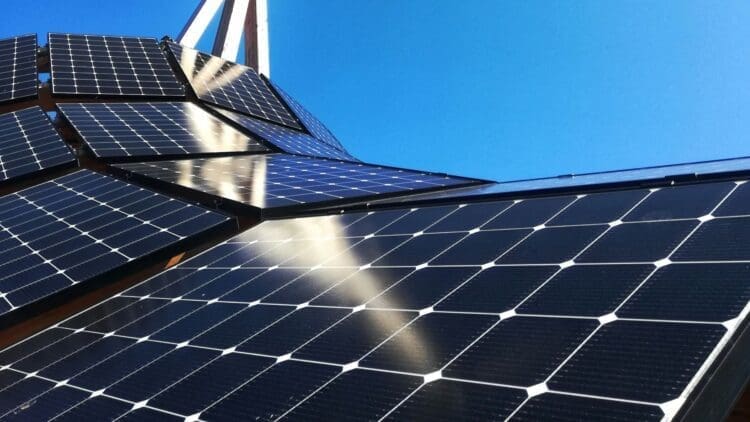

Scientists are advancing solar technology by improving existing systems with a special crystal.
Panel efficiency is essential to ensure the world benefits from the highest possible peak output.
However, this has been limited for a long time because conventional solar panels cannot capture the full spectrum of light. Two “colors” have always been impossible to exploit.



Will integrating this specialized crystal with current technology finally help harness previously wasted energy?
How scaling solar is no longer the answer to endless clean power
The global electricity demand increases annually.
Technology is rapidly advancing, which has spiked the world’s energy consumption.
Powering this high-tech transformation has pushed annual usage over 28,000 TWh.
It has created a significant opportunity for the renewable sector to deploy infrastructure.
Solar power is currently leading in deployment, but it is struggling to keep up with demand.
The world’s solar generation is approximately 2,700 TWh, signifying a great energy gap.
This means solar capacity accounts for less than 10% of global electricity production.
However, bridging this gap cannot be done by simply building larger projects.
Large-scale installations require substantial suitable space, which has become more challenging.
Opposition is growing due to competition with agriculture and natural ecosystems.
In densely packed urban regions, rooftop installation space is finite.
Scaling up is therefore no longer a feasible option to maximize energy output.
This is why existing solar systems must become radically more efficient. If not, the world risks facing vast grid failures.
The silicon bottleneck threatening the energy grid
A failing grid raises the risk of blackouts, which have immediate and catastrophic consequences.
Basic societal operations will come to a standstill. Supply chains and global communication networks will be disrupted.
Prolonged outages eventually trigger severe economic instability and compromise public health and safety.
Ensuring that backup power sources are in place is vital. This includes highly efficient solar infrastructure.
Researchers have been urgently exploring ways to boost solar efficiency levels.
Unfortunately, traditional photovoltaic (PV) technology has hit a physical limit.
Silicon is an exceptional semiconductor, but it faces a major technical bottleneck.
The material’s conversion of red and infrared light into electricity is excellent.
Unfortunately, when it comes to “absorbing the rainbow,” it is blind to the spectrum’s opposite end.
Luckily, a California-based startup has found an innovative solution to this bottleneck.
The press release from Caelux confirmed that a specialized crystal is the answer to higher efficiency.
Working in tandem to boost absorption and output
Caelux’s secret weapon for boosting efficiency is perovskite crystals in tandem with silicon panels.
This is done by coating the protective top glass with this material. This advancement is known as “Active Glass.”
Perovskite’s unique atomic structure is extremely sensitive to high-energy light. This quality makes it excellent at absorbing blue and ultraviolet light waves.
This means Active Glass can now capture the exact “colors” that conventional panels usually ignore. The two distinct, independent power-generating layers offer great advantages.
A Hybrid Tandem module with greater power density
The ability to absorb low-energy and high-energy light delivers up to 30% higher power density.
This results in an energy yield that is 20% higher.
Additional benefits include 20% lower project expenses and easy upgrading of existing infrastructure.
Its compatibility with mainstream solar technology improves the overall return on investment.
Caelux recently achieved a major milestone by shifting the technology from the lab to the field.
Its first shipment of Active Glass has been sent to a leading U.S. solar developer. It proves that high-efficiency perovskite-silicon tandem panels are now more than just a concept.
The scaled deployment of these advanced modules can finally unlock previously wasted energy. The world’s power grids can become more secure, and the global renewable energy transition can move forward.
Disclaimer: Our coverage of events affecting companies is purely informative and descriptive. Under no circumstances does it seek to promote an opinion or create a trend, nor can it be taken as investment advice or a recommendation of any kind.