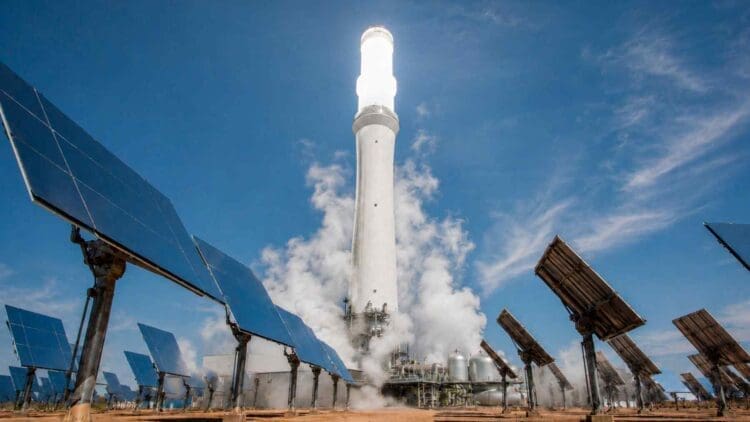

Solar power peaks at noon. Energy demand peaks at night.
This mismatch creates the costly “duck curve” gap.
While utilities rely on massive chemical batteries to bridge it, lithium-ion storage brings volatile supply chains and severe environmental degradation.

A breakthrough “Twin-Technology” solar tower offers a cleaner path.
It generates 753 MWh annually by running 24/7 on atmospheric physics, using the ground as a sustainable thermal battery.
Could this mechanical engine finally replace traditional grid batteries?
How the challenge of solar intermittency has escalated
Climate mandate deadlines are rapidly approaching, and nations worldwide are accelerating their transition to renewable energy.
Furthermore, energy needs are at a record high, meaning green capacity must grow exponentially to try to keep up.
This has led some industries to face paradoxical challenges. For the solar industry, greater success has exposed the source’s inherent limitations.
Intermittency is among its primary problems.
In many regions, demand peaks in the early evening when residential consumption spikes, exactly when solar production stops.
It places pressure on grid operators who must quickly ramp up alternative power sources to prevent potential blackouts.
This led the industry to turn toward large-scale battery energy storage systems (BESS) to combat this issue.
Unfortunately, as the scale of solar integration increases, the challenges associated with BESS have also escalated.
Traditional battery systems present critical complications
The more standard BESS becomes in stabilizing the global grid, the further it is from being a perfect solution.
Standard lithium-ion batteries rely on cobalt and nickel, facing 30% price volatility and supply chain risks. It creates a reliance on volatile global supply chains and increases the risk of complex geopolitical tensions.
Lithium mining requires 500,000 gallons of water per metric ton, contradicting “green” goals.
Additional complexities include the environmentally invasive extraction of these minerals, which is also extremely energy-intensive.
As the pressure to increase renewable capacity rises, the volume of minerals required could lead to severe shortages and expenses.
Chemical batteries degrade within 10 years; the TTSS mechanical structure lasts 30+ years.
These complications necessitate a mechanical innovation – a void “Twin-Technology” could fill.
Transforming solar with a 24/7 mechanical engine
Researchers from Qatar University and Al Hussein Technical University have proposed a new solution called the “Twin-Technology Solar System” (TTSS).
This unique energy system moves away from conventional methods by focusing on atmospheric physics.
Its design consists of a giant 656-foot-tall tower that serves as the bi-directional engine. It generates power using rising heat (updraft) and falling cool air (downdraft).
The updraft: Turning soil into a thermal battery
An 820-foot-wide glass canopy traps solar heat. The ground beneath absorbs this thermal energy during the day.
It heats the trapped air beneath, and as the air temperature rises, it becomes less dense than the surrounding atmosphere. Hot air rises through the chimney at speeds up to 15 m/s, driving a turbine at the base.
The soil reaches temperatures of 60°C (140°F), acting as a “thermal reservoir” that slowly releases heat after sunset.
At night, the warm soil continues to heat the air, maintaining the updraft even in total darkness.
The downdraft: Making energy “rain”
en perimeter shafts spray water mist into hot ambient air at the tower’s peak.
Evaporative cooling makes the air 3–5% denser; gravity pulls this heavy ‘cold plug’ down to spin secondary turbines.
The combination of these two distinct airflows in the TTSS enables production of nearly 753 MWh annually.
This dual-action design doubles the output of single-direction solar chimneys, yielding 2.14 times more energy.
Unfortunately, the system’s heavy reliance on water for mist presents a significant challenge in arid regions.
Globally, water sources are becoming extremely scarce. Engineers must find a way to balance water consumption with the system’s energy gains before it can replace conventional batteries.
Anke Maree is a writer with a clear and engaging editorial style. Her work focuses on making complex topics accessible, informative, and relevant for readers across different areas of interest.