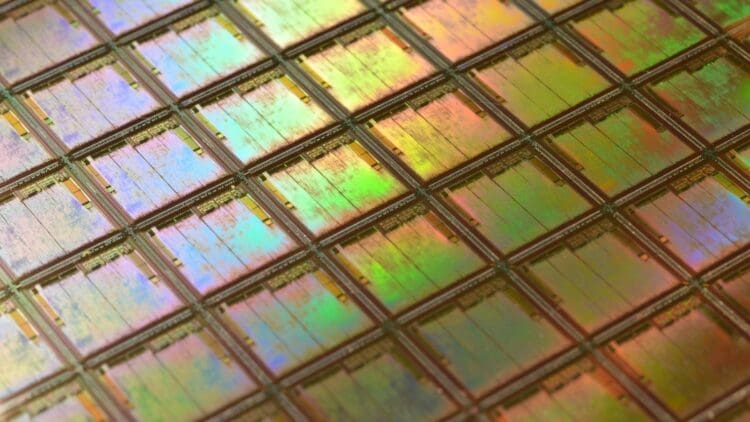

Renewable generation is not the only key to sustainability, as the white light of electronics also plays a role.
Modern technology has evolved significantly over the years, with many devices now foldable, wearable, or transparent.
Unfortunately, their white light-producing materials have not caught up and remain stubbornly rigid or inefficient.




Will newly developed flexible films prove that the secret to the perfect white has always lain hidden between the gaps?
How macro success has left a micro disparity
National and international climate mandate deadlines are rapidly nearing, pushing renewable energy production into unprecedented acceleration.
Globally, the infrastructure footprint has expanded significantly, including giant offshore turbines and extensive solar farms.
This expansive scaling at a record pace is also attributed to the world’s shift toward electrification, which requires substantial electricity.
The integration of cloud data processing and storage, and AI into nearly all aspects of life, also plays a role.
Now that the macro-infrastructure of the energy transition is maturing, a critical bottleneck at the micro-scale has come to light.
The fault lies with the efficiency and the structure of the hardware that consumes power.
Internally, everyday technology components consume significant amounts of energy and rely on rigid, often rare inorganic materials.
This has led to a disparity between green electricity generation and truly sustainable consumption.
To overcome this, the world’s electronics require small-scale innovations.
An energy drain and a brittle barrier
Digital displays and smart sensors have become common interfaces in the energy landscape and modern life.
Yet, the collective consumption of these components is responsible for the substantial drain on the grid.
Consider traditional lighting systems as an example. More often than not, they are inefficient and lose a great percentage of energy as heat.
This “leak” is one of the reasons that electricity usage offsets clean power production.
Another challenge lies with the manufacturing of high-performance white light.
The materials are made using inorganic phosphors and rare-earth metals. The extraction of rare earths is extremely invasive, and many nations face supply chain issues.
Researchers have attempted to replace these materials with flexible organic dyes, but aggregation has been a significant molecular hurdle.
This stifles light emission, causing poor efficiency and “muddy” colors.
Advancements left materials efficient but brittle, or flexible but dim. Now, researchers have found the perfect balance.
A flexible organic film that emits pure white
Producing light that is whiter than the brightest white may have seemed impossible until now.
Researchers from Universitat Jaume I and Gunma University found a solution by reimagining the film’s structure.
Their focus shifted toward the polymer matrix, a structural network that holds all the molecules in place.
The perfect molecular environment to produce a crisp white glow
The key was to fine-tune the hydrophilicity (water-attractiveness) of the matrix. This way, a stable environment that serves as a molecular spacer was created.
This overcomes aggregation by keeping blue and yellow organic dyes suspended and separated.
It allows the mixture of light outputs without interference, resulting in “pure” white light.
By shifting their focus to the matrix’s hydrophilicity, the team achieved a significant breakthrough.
The approach led to an energy conversion efficiency of over 50%, a record for organic flexible films.
Beyond the lab, achieving pure white light with these purely organic molecules has other profound implications.
The use of standard chemical processes overcomes the problems associated with invasive rare-earth extraction and high-heat production.
Moreover, these films are physically strong and flexible enough to be laminated onto curved surfaces. This opens the door to a variety of applications.
By offering a concise path toward “green electronics,” true sustainability could finally be achieved on all scales.
Anke Maree is a writer with a clear and engaging editorial style. Her work focuses on making complex topics accessible, informative, and relevant for readers across different areas of interest.