
Twenty-four tagged harbor seals shared the sea with 77,968 offshore-wind hammer strikes off England, and researchers traced a behavioral response zone stretching more than five miles from the pounding construction noise
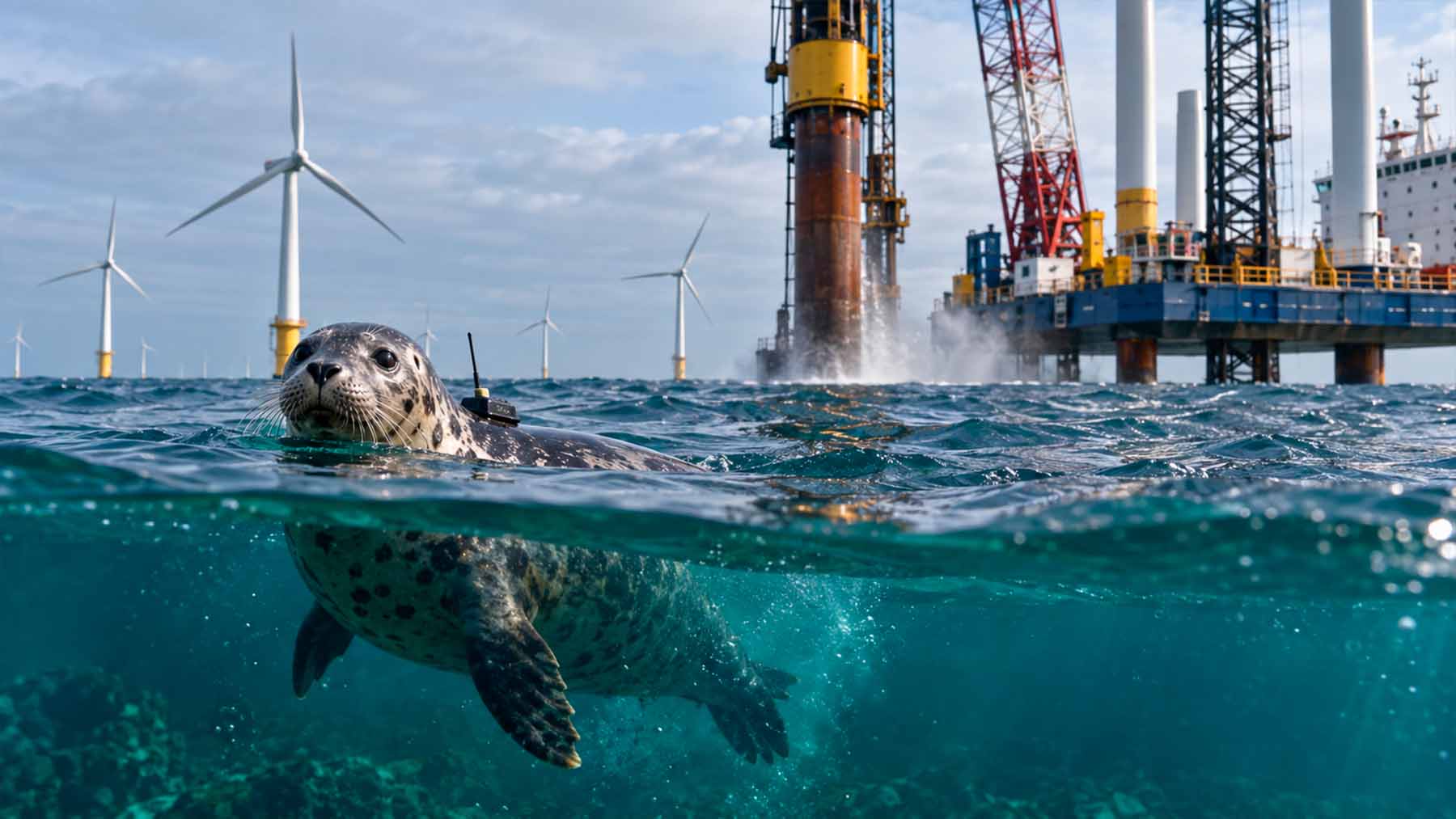 Image generated with artificial intelligence
Local ocean wildlife is behaving differently as offshore wind energy scales up in English waters.
Britain is actively breaking away from its fossil fuel-heavy past by boosting green power production.
While offshore generation will strengthen national energy security, it still poses unknown risks to native biodiversity.
Ultimately, rigorous ecological protection management plans are vital to help clean power generation and marine biodiversity thrive.
Recent research focused on tracking harbor seals’ responses to turbine construction.
Will better understanding behavioral shifts help protect vulnerable marine ecosystems during coastal construction?
How Britain’s renewable energy transition started
The United Kingdom has one of the longest histories with fossil fuels.
For generations, the nation has heavily relied on coal and oil.
Coal powered Britain’s electricity for over 140 years, starting in London in 1882.
Soon, smog began building, becoming thicker and severely threatening public health.
By 1956, the Clean Air Act pushed coal-fired power stations out of several major cities.
The discovery of oil in the North Sea and natural gas soon led to new forms of power generation.
However, major climate concerns and air pollution eventually triggered an urgent policy shift.
The Climate Change Act of 2008 was the nation’s first step toward a renewable energy transition.
With this policy, the nation pledged to phase out all coal-fired power stations.
So far, greenhouse gas emissions have been successfully reduced by over 50% compared to 1990 levels.
But the upcoming net-zero climate goals remain challenging.
Addressing land-based challenges by going offshore
Global onshore wind capacity expansion has been significant in meeting climate targets.
However, island nations like the United Kingdom have experienced much slower capacity growth.
The UK is densely populated and prioritizes protecting its natural landscapes and heritage sites.
This leaves limited open space for large-scale renewable energy deployment.
Onshore wind farms are often blocked or delayed by complex zoning laws, planning regulations, and local opposition.
Consequently, turning toward the vast coastal waters offered the fastest solution.
The UK’s major offshore wind projects soon became a massive hit.
Beyond bypassing spatial limitations, the coastal winds are stronger and more consistent.
This means major coastal cities can benefit from higher output of clean electricity.
But this offshore transition is not without consequences.
Ecological impact concerns are increasing, especially regarding the construction phase.
A study was conducted to determine the impact of pile driving on marine mammals’ behavior.
The effect of underwater noise on harbor seals
Monitoring the effects of offshore clean infrastructure on marine wildlife is vital to protect biodiversity.
A research team from the University of St Andrews and Biomathematics and Statistics Scotland conducted this study.
The goal was to establish harbor seal behavioral responses to offshore wind farm construction. The seals are located in a Special Area of Conservation in England’s waters.
Heavy metal piles being hammered into the seabed produce underwater noise.
Precisely 77,968 hammer strikes were produced by intensive piling.
Tracking data from 24 tagged seals
High-resolution GPS tracking was combined with approximate underwater sound fields.
Statistical models were used to measure unusual movement patterns.
The behavioral responses included suddenly halting horizontal travel, sudden speed bursts, and abrupt movement initiation.
Across 216 encounters measured, the study found 15 distinct behavioral responses.
This enabled the researchers to map a behavioral response zone, which will help with future offshore developments.
The zone stretched more than five miles from the construction site.
By mapping behavioral response zones, developers can improve construction schedules to minimize wildlife disruption.
The data will also help regulators establish safer buffer areas around fragile marine reserves.
It is suggested that mitigation tools be used to gently deter seals from prospective construction zones before piling begins. Acoustic deterrent devices are an example.
Ultimately, rigorous ecological protection management plans are vital to help clean power generation and marine biodiversity thrive.
These findings can be reviewed using: Whyte, K. F., Hastie, G. D., Sparling, C. E., Binnerts, B., & Russell, D. J. (2026). Movement Responses of Seals During Pile Driving for Offshore Wind Farm Construction. Animal Conservation.
Anke Maree is a writer with a clear and engaging editorial style. Her work focuses on making complex topics accessible, informative, and relevant for readers across different areas of interest.
