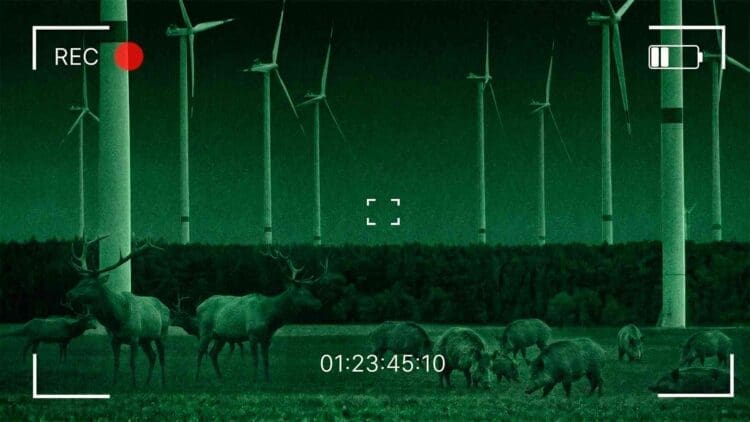

In Korea, deer and wild boars continue their routines despite the presence of a wind farm.
Wind power has become an integral part of the world’s climate goals and energy needs.
Yet, there are persistent concerns about its impact on local ecosystems.


Recent research at a Korean wind farm revealed a surprising reality, but raised another question.
Why does it seem as if the animals are avoiding each other at the wind facility?
How wind power’s role grew more essential
Wind energy has become the cornerstone of global climate strategies.
The world added a record 165 GW of new wind capacity in 2025.
This 40% increase pushed worldwide totals to nearly 1,300 GW.
Rapid expansion is essential, as this renewable source is now a primary tool for decarbonization.
One megawatt-hour of wind generation offsets approximately 0.75 tons of carbon dioxide.
Over its lifetime, a turbine counteracts up to 50 times the emissions produced during its manufacturing.
Beyond climate targets, wind power’s role in securing power grids is fundamental.
Its high scalability reduces reliance on volatile fossil fuel imports.
Furthermore, the push for complete electrification and the rise of data centers are surging electricity demand.
Wind provides a reliable, affordable solution to this spike in consumption.
Adding wind capacity to regional grids ensures energy security while supporting long-term, sustainable growth.
Yet, experts remain concerned about the ecological footprint of wind turbines.
Ecological considerations of wind energy
Wind power may be vital for the climate, but its physical footprint continues to raise environmental concerns.
The most commonly discussed impact involves birds and bat species.
They face high collision risks with the rotating blades of poorly placed turbines along migratory corridors.
In addition to direct strikes, access roads, substations, and transmission lines also carry consequences.
These infrastructures can lead to habitat fragmentation.
Wind farms can displace vulnerable species from their traditional nesting or foraging grounds.
Several modern development practices are addressing these impacts.
Extensive environmental impact studies are conducted to identify key migration routes and sensitive habitats before construction.
However, wind turbines can have other surprising effects, or occasionally, none at all.
In Korea, a study showed that some species continued their routines, but seemed to be “avoiding each other.”
The study “Occupancy of roe deer, water deer, and wild boar in wind farm-integrated forest ecosystems: A case study in Korea” was published in Tethys.
A Korean wind farm’s impact on certain mammals
Some mammals tend to avoid wind farms.
South Korean researchers wanted to determine whether turbines would also act as a barrier to local wildlife.
Three large mammal species were monitored: water deer, roe deer, and wild boar.
Motion-activated cameras tracked occupancy patterns near the facility’s infrastructure and forest interiors.
The data revealed surprising results.
The complex social dynamics of deer and wild boars
The wind farm did not cause major displacement or abandonments.
Instead, the animals integrated the wind farm area into their existing habitat ranges.
Additionally, they utilized “temporal niche partitioning.”
The animals visited the same sites at different times of day to avoid direct encounters.
Their behaviors minimized competition for food and space within the forest.
The study shows that the wind farm does not disrupt established wildlife interactions.
In fact, some wildlife are highly adaptive to modern energy installations.
As global energy consumption continues to surge, the need for rapid large-scale wind capacity expansion grows.
This research proves that large mammals can coexist with new green industrial sites.
This conclusion will help ease concerns worldwide and hopefully greenlight more developments.
However, it remains imperative that in-depth environmental impact studies are conducted beforehand.
By increasing knowledge of animal behaviors, developers can implement responsible site development and management plans.
Anke Maree is a writer with a clear and engaging editorial style. Her work focuses on making complex topics accessible, informative, and relevant for readers across different areas of interest.