
Numerical models for wind farm control are only as reliable as the experimental data used to test them. That has long been the quiet problem: data rigorous enough to do the job has rarely been made publicly available.
Now, a wind tunnel study has produced an open-access dataset that researchers say fills that gap—capturing time-resolved measurements of turbine loads, rotor behavior, controller commands, and wake conditions under carefully controlled, repeatable conditions. What’s in it, and what could it mean for how the field builds and trusts its models?
A gap the wind energy community has long felt
Experimental data sits at the foundation of model validation. Without it, researchers can’t confirm whether a numerical tool is actually capturing real turbine behavior—or just producing plausible-looking numbers. In wind farm control research, that distinction matters enormously. The models inform how turbines are operated, coordinated, and designed.



The specific problem has been scarcity. Datasets that combine time-resolved turbine loads, actuator commands, and well-characterized inflow conditions—all under controlled, repeatable settings—have rarely been made publicly available, creating a genuine bottleneck. Researchers working on competing models can’t easily benchmark against a shared reference, and reproducing another team’s results becomes difficult or impossible.
The field has felt that constraint for years. This dataset is a direct response to it.
What the wind tunnel experiments captured
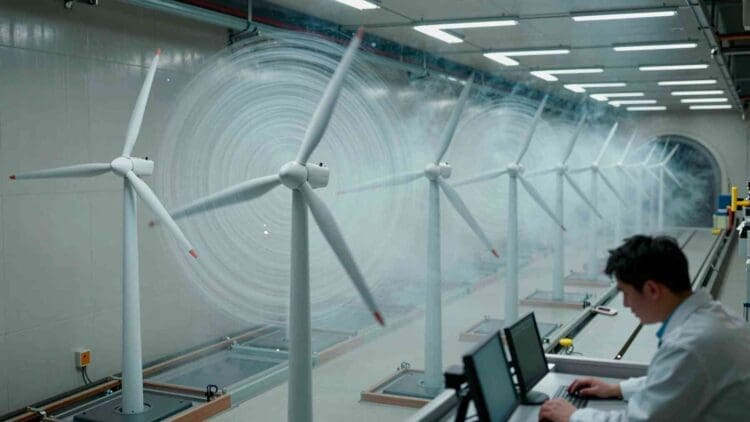
The experiments used actuated, instrumented, scaled wind turbine models inside a controlled wind tunnel environment. Controlled conditions allow for repeatability, which is precisely what makes a dataset useful for benchmarking rather than merely descriptive.
The measurements are unusually comprehensive. On the turbine side, the dataset includes time-resolved tower-base and rotating-shaft moments, rotor speed, generated torque and power, blade pitch angles, nacelle yaw angle, and all controller commands. These aren’t snapshot readings; they track how each variable evolves dynamically during operation. Inflow conditions received equal attention—wind speed, wind direction, air density, and wake-flow measurements were all recorded, giving a full picture of the environment each turbine was operating in.
A broad menu of wake-control strategies tested
One of the dataset’s most notable features is its range. Rather than focusing on a single control approach, the experiments covered yaw-based wake steering, curtailment and derating, Helix control, dynamic yaw actuation, Pulse wake mixing, and individual pitch control—with combinations tested simultaneously.
That breadth matters. Wake control research has historically fragmented across different groups, each developing and testing their own preferred strategy. A dataset capturing multiple strategies under consistent, comparable conditions gives the community a shared reference point that doesn’t favor any particular approach. Crucially, actuator commands, turbine response, and structural loads were all recorded together, letting researchers trace exactly how a given control input propagated through the system—from the command itself, through rotor behavior, to the structural loads the turbine ultimately experienced.
Numerical models included alongside the measurements
The dataset doesn’t stop at raw measurements. It’s complemented by numerical models of the same experiments, creating what the authors describe as a reproducible experimental-numerical benchmarking framework.
That pairing opens up capabilities measurements alone can’t provide. Researchers can use the numerical models to extend the dataset virtually—testing conditions that were never physically run—or to conduct sensitivity analyses that would be impractical inside a wind tunnel. More importantly, the framework enables systematic validation of control-oriented aeroelastic and wake-interaction models against a known experimental baseline. Reproducibility has been a persistent challenge in wind energy research, and pairing physical measurements with numerical models of the same setup is a concrete step toward addressing it.
Why this matters for wind farm design and safety
The dataset was specifically designed to support assessment of fatigue-relevant structural loading under active wake-control operations—a safety-critical concern. Wake-control strategies can alter the load patterns turbines experience across their lifetimes, and understanding those effects is essential for predicting long-term structural integrity.
Beyond structural safety, open access means any research group can draw on this resource, not just those with the resources to run their own wind tunnel campaigns. The longer-term implication is acceleration: with a shared, high-quality experimental reference now available, the development of smarter and more efficient wind farm control strategies at commercial scale could move considerably faster. The bottleneck of scarce validation data was real. Datasets like this one are how the field starts to remove it.
Kelly is an experienced writer with 15 years of experience exploring the big stories that shape our world, from tech breakthroughs and space exploration to climate, energy, and the fascinating quirks of science. She has a talent for turning complex ideas into sharp, memorable insights that stay with readers long after they’ve finished reading.