
A wind farm meant to ensure energy security has been hiding valuable historical evidence.
The past, present, and future do not often collide all in one place, but it was inevitable in East Yorkshire.
For years, the local place names have hinted at the possible presence of ancient civilizations in the region.

Now that archaeological discoveries have been made, what will happen to the area’s potential future of wind energy?
How wind will break a legacy of gas in the UK
The UK is no stranger to cold, often experiencing extreme rainfall and snow, especially in winter.
Fossil fuels were central to ensuring that buildings remained warm and the lights on.
In the 1990s, privatization ensured that North Sea gas was more efficient, affordable, and readily available than coal.
Unfortunately, domestic gas production began to decline in the early 2000s, marking the beginning of an era of imports.
By 2023, nearly 40% of the UK’s energy was imported. The grid became vulnerable to global supply chain issues and price spikes.
The significant reliance on pipeline imports and liquefied natural gas became problematic due to global energy crises.
For this reason, wind power became integral to breaking free from international geopolitical instability.
Yorkshire was soon identified as the gateway to the nation’s independence.
The heart of the UK’s wind revolution
Since 2010, wind energy has saved the UK nearly £104 billion, equal to nearly $140 billion in power savings.
However, the UK Government is only getting started.
The nation aims to achieve a green power system by 2030, with wind energy as the main source. The hopes are to have 50 GW of offshore wind and more than 29 GW of onshore wind by 2030.
For this reason, a record number of newly contracted offshore wind projects were auctioned by the government.
Among the investments is Yorkshire’s Dogger Bank, a vast, shallow sandbank located 80 miles offshore.
The water is relatively shallow, enabling the installation of cost-effective and stable “fixed-bottom” turbines.
This region’s coastline is an attractive choice due to the existing heavy-duty electrical infrastructure, once built for the coal era.
Construction is in full swing, but a discovery at the Dogger Bank Wind Farm led to a temporary halt.
Unearthing a historical world at the wind farm
Before any new offshore wind project in the UK or elsewhere can develop, environmental impact studies must be conducted.
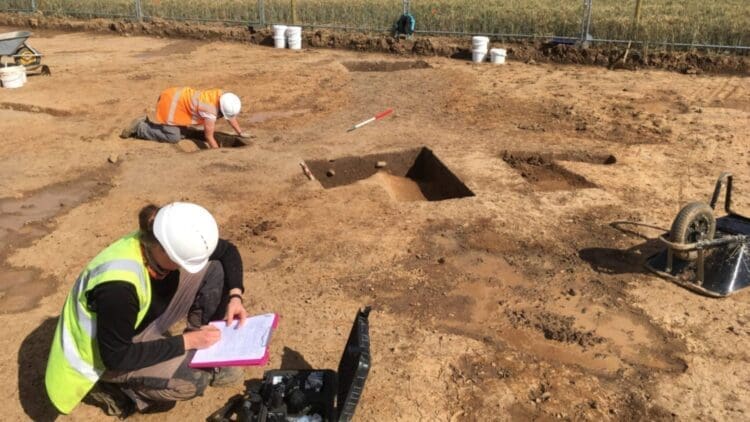
For Dogger Bank, the AOC Archaeology Group led the archaeological investigations, covering a 19-mile land strip.
This area became a cross-section of British history, with physical archaeological evidence found near Beeford. The discovery dates back to before the Viking era, namely the Anglo-Saxon period (5th to 11th centuries AD).
The discovery of Beeford’s timber long hall and more
The long hall was found between Beeford and Skipsea, indicating that the area was once home to a settlement. It has a classic early medieval footprint, once held up by massive wooden posts.
Project manager Rebecca Jarosz-Blackburn underscored the significance of this rare domestic site. It gives a glimpse into how earlier civilizations farmed and organized their communities.
5th and 6th-century metalworkings found adjacent to the hall suggest it was a center of skilled production.
Other discoveries include:
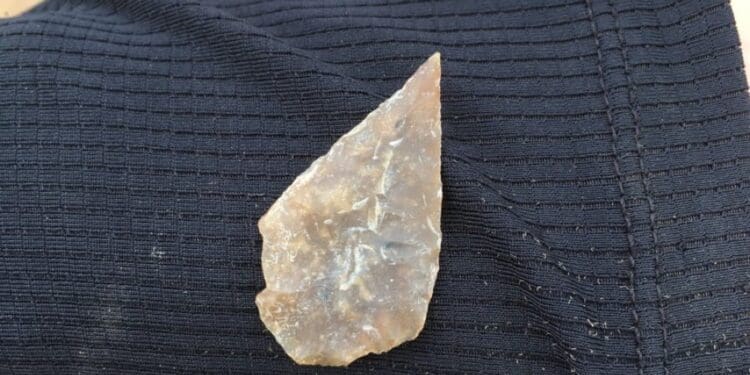
- 6,000-year-old Neolithic flint arrowhead near Beeford
- Well-preserved Iron Age roundhouses between Ulrome and Leven
- Roman wheel-thrown pottery and settled field systems in Burshill
- Medieval glass ornament in Ulrome
The wind farm proves that timelines can collide by illuminating past mysteries.
The farm’s developers funded extensive radiocarbon dating to provide accurate data to local communities and historians.
A museum near the discovery sites will be constructed to house the artifacts once analysis is complete.
As for the 3.6 GW offshore wind project, full project completion is underway. It will soon function atop a landscape known for innovation for over 6,000 years.
Anke Maree is a writer with a clear and engaging editorial style. Her work focuses on making complex topics accessible, informative, and relevant for readers across different areas of interest.