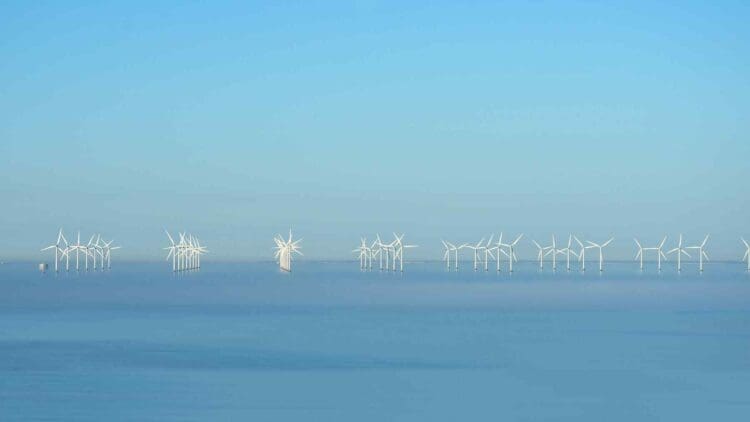

The UK recently had no choice but to “sink” its flagship offshore wind project due to weakened defenses.
The double vanguard of the Celtic Sea was intended to mark Britain as a global leader in floating wind installations.
Instead, the stakes became too high, leading to a sudden exit as a last resort to pick up the pieces.


Will the UK be able to make a comeback to secure the British energy sector’s offshore future?
How British energy security is struggling to gain independence
For years, the UK has been synonymous with coal in the North and gas fields on the North Sea. Eventually, coal plants were decommissioned, and domestic gas production declined.
It left the nation increasingly vulnerable to the international market’s gas price shocks.
To date, gas remains responsible for the 31% of the UK’s electricity and 80% of British households’ heating.
Now, consumers are facing a 42% increase in power prices due to the recent global fossil fuel crisis. The reliance on imports is certainly making things worse.
With monthly prices averaging at £69.72 (approximately $94.35), the transition to renewable energy is becoming more vital by the day.
Offshore wind has become key to breaking free from this costly dependence.
The Celtic Sea was identified as the perfect site to master floating wind to finalize the strategic transition.
The route to resilience: The calm before the storm
Offshore wind capacity has gained significant traction worldwide.
Its role to meet net-zero deadlines has become integral. However, analysts are concerned that the UK’s offshore wind funding could fall short of its 2030 green energy goals.
Despite these concerns, traditional installations have been flourishing in the shallow ends of the North Sea.
Now, the industry is planning on moving into deeper, more volatile waters to capture even greater winds.
Deepwater capacity growth would help bridge the energy gap for digitalization and decarbonization.
For the Celtic Sea, Hexicon’s “TwinWind” technology was at the heart of this transition.
The design enables the installation of two turbines on a single triangular floating platform.
The TwinHub project was intended to serve as proof of concept that floating wind could become commercially viable.
But then this stronghold started facing turbulent waters and was eventually forced to admit defeat.
A vital floating wind project sank for £1
A UK government auction has delivered a record volume of contracted offshore wind capacity at striking prices. However, the TwinHub project’s price tag was striking for a different reason.
In 2022, the floating wind project became the first in the UK to secure a Contract for Difference (CfD). This agreement was intended to be the primary defense, guaranteeing £87.30 (approximately $118.19) per MWh.
When a guaranteed income becomes a liability
By 2026, this safety net evolved into a liability due to the high costs of high-grade steel and heavy-lift logistics. The prices outpaced the project’s initial revenue projections, making it commercially unviable.
By April 2026, the CfD was officially terminated, eliminating the TwinHub’s financial foundation.
Hexicon had no other choice but to offload its 100% stake in Wave Hub Ltd for £1 ($1.35). An undisclosed global engineering firm is now left to face a net impairment of SEK 115 million (nearly $11 million).
Hopefully, the firm can navigate the ongoing supply chain and geopolitical obstacles to bring the project back on track.
This project brings the sobering realities of an unpredictable market to light.
The £1 fire sale proves that no renewable energy project can survive without vigorous economic defenses.
The Celtic Sea remains a strategic site to ensure British energy independence. But before this goal can materialize, global supply chain issues will have to be resolved.
It will be the only way the UK offshore energy industry can meet net-zero goals by the deadline.
Disclaimer: Our coverage of events affecting companies is purely informative and descriptive. Under no circumstances does it seek to promote an opinion or create a trend, nor can it be taken as investment advice or a recommendation of any kind.
Anke Maree is a writer with a clear and engaging editorial style. Her work focuses on making complex topics accessible, informative, and relevant for readers across different areas of interest.