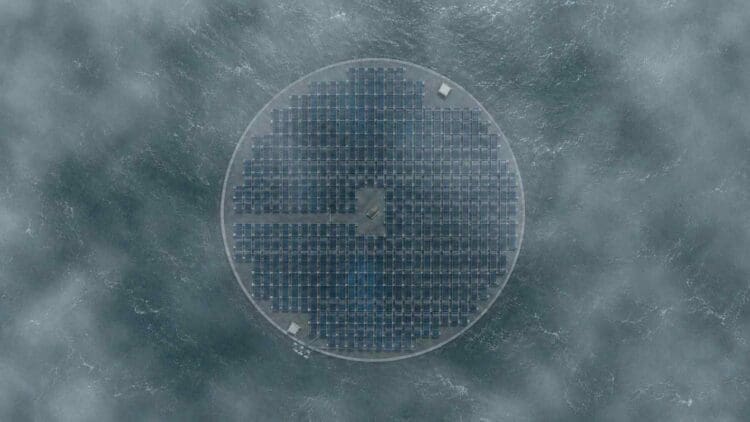

Violent marine weather may have met its match in new life forming underneath a solar plant.
Offshore renewable energy infrastructure overcomes several land-based obstacles. However, the deeper these installations are, the more turbulent the water becomes.
Off the Dutch coast, hurricanes and 32-foot waves are routine phenomena, accelerating mechanical failure.



Will the radical experiment of combining floating solar with another farm transform the underwater ecosystem and tame the wild waves?
How onshore infrastructure was no longer the answer
One of the most densely populated nations on Earth is the Netherlands.
There, viable land space is a rare entity. In recent years, Dutch support for nature conservation has significantly increased.
Farming remains a massive part of the national identity and economy.
This is why large-scale green infrastructure developments on land have triggered immense public debate.
Not only does it displace the limited wilderness left in the nation, but it also conflicts with agricultural needs.
Renewable capacity expansion also faces some of the highest farmland prices in Europe.
Strict government regulations further limit where land-based solar plants can be built.
Nonetheless, national pressure to increase green capacity has become substantial.
The Dutch Climate Act legally requires a 55% reduction in greenhouse gas emissions by 2030. This can only be achieved by using 70% renewable sources to produce electricity.
Therefore, developers turned to the open ocean as an alternative solution.
The industrialization of the deep sea
Shifting the focus to the ocean completely bypassed land conflicts.
Primarily, offshore wind farms became a lifesaver for national climate goals and strategies.
Giant wind turbines rose over the North Sea, generating great output with the high-velocity winds.
However, the environment became highly problematic for standard engineering.
There, the stormy waters are among the most dangerous on Earth.
The Dutch North Sea experiences harsh winter storms and destructive winds annually.
Low-pressure systems increase wave heights past 32 feet. Existing offshore infrastructure often experiences unexpected failures during extreme weather.
Maintenance becomes more routine due to rapid salt corrosion and accelerated mechanical fatigue.
This, in turn, becomes a logistical nightmare. Safe weather conditions have a small window of opportunity.
Upkeep delays become prolonged, and the downtime becomes expensive.
Oceans of Energy addressed these turbulent waters by deploying floating solar panels nearly 7.5 miles out in the North Sea.
Cultivating new life under the solar plant
Floating solar panels are common sights on lakes, but braving the deep sea is a new innovation.
To truly conquer the rough North Sea, engineers also had to look below the surface.
For this, the European Seaweed Association was chosen to orchestrate the ecosystem.
The radical experiment entailed installing a giant seaweed cultivation system underneath the floating solar plant.
Combining 56 floating solar arrays with this system transformed the site’s microclimate.
Naturally shifting marine conditions with seaweed
The system cultivated a thick, flexible clump of seaweed that serves as a natural, submerged “brake.”
The clump absorbs the ocean’s high kinetic energy and stabilizes the floating platforms.
The seaweed simultaneously formed a unique microclimate beneath the panels.
The dense clump filters the water by absorbing 1.8 tonnes of carbon dioxide. This created a thriving sanctuary for marine life.
Meanwhile, the floating solar plant provides shade for the vulnerable ecosystem beneath.
This dual-purpose system maximizes unused spaces between offshore wind farms, making logistics much simpler.
The pilot proved that hostile deep-sea environments can be tamed utilizing ecological solutions.
By using only 5% of the Dutch North Sea, the system addresses the fundamental challenges often faced with offshore infrastructure.
Combining biology with technology opens a completely new frontier for marine engineering.
Climate targets can thus be achieved more easily without compromising safety or durability. Additionally, the planet can simultaneously benefit from higher clean energy outputs and increased food security.
Anke Maree is a writer with a clear and engaging editorial style. Her work focuses on making complex topics accessible, informative, and relevant for readers across different areas of interest.